AlphaFold 3 to IsoDDE: How AI Drug Discovery Got Twice as Accurate in 18 Months
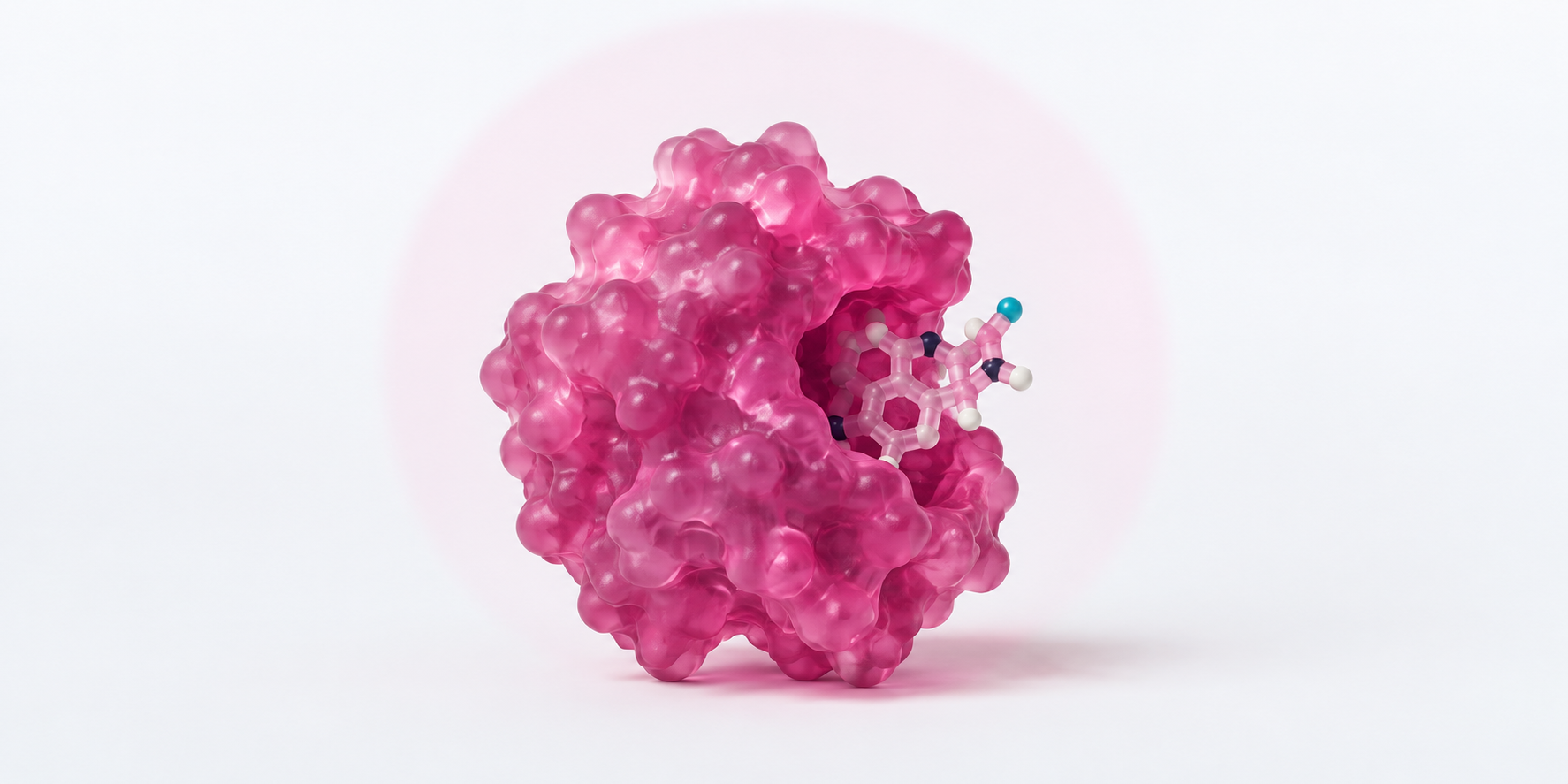
DeepMind's AlphaFold 3 reshaped structural biology in 2024. By mid-2026, Isomorphic Labs' IsoDDE has more than doubled accuracy on the hardest protein-ligand systems.
- #AlphaFold
- #IsoDDE
- #protein structure
- #drug discovery
- #DeepMind
- #Isomorphic Labs
- #computational biology
- #bioinformatics
When DeepMind released AlphaFold 2 in 2021, it solved a fifty-year-old problem in structural biology and made structures freely available for almost every known protein. AlphaFold 3, released in 2024, did something arguably more useful: it predicted not just protein structure but the structure of proteins bound to other molecules — small-molecule drugs, antibodies, DNA, RNA, ions, modifications. By 2026 the system has been used by more than three million researchers in 190 countries, and a successor model called IsoDDE has already roughly doubled its accuracy on the systems where AlphaFold 3 struggles most.
The pace of this shift is unusual even for an active field. It is worth understanding what each generation does, where they break, and what that means for the next generation of biologists entering an AI-saturated discovery workflow.
From AlphaFold 2 to AlphaFold 3: a change in what counts
AlphaFold 2''s output was the 3D structure of a single protein, given its amino acid sequence. That was already enormously useful — but most drug discovery doesn''t care about the protein in isolation. It cares about the protein bound to the small molecule you''re trying to optimise. AlphaFold 3 expanded the prediction surface to include ligand binding, antibody interactions, protein-DNA contacts, and post-translational modifications.
In benchmark sets of protein-ligand complexes, AlphaFold 3 outperforms classic docking software on average. The win is not uniform: it does very well on systems similar to those in the Protein Data Bank, less well on chemical novelty far from the training distribution. That gap is exactly where IsoDDE comes in.
IsoDDE — the Isomorphic Labs Drug Design Engine
Isomorphic Labs spun out of DeepMind specifically to apply this generation of structure prediction to drug design. Their internal system, IsoDDE, builds on the AlphaFold 3 base and is trained and evaluated on the kinds of protein-ligand problems that fail public benchmarks: novel chemistry, distant analogues, cryptic binding sites.
The headline result published in early 2026 was a more-than-doubling of accuracy on these hard cases compared with AlphaFold 3 alone. The number that surprised people most: IsoDDE was able to predict the location of cryptic binding sites on the protein cereblon — a key oncology target — using only sequence as input. Cryptic sites form transiently, are invisible in static crystal structures, and have historically been one of the hardest targets in structure-based drug design.
What this changes about a drug discovery pipeline
Pre-AlphaFold, the slow steps in hit-to-lead were structural — getting a crystal, soaking in compounds, solving co-crystal structures. Many programs ran for years without ever obtaining a useful structure of their target. The 2026 reality is different: usable structural predictions appear in hours, structure-activity refinement happens in the model before you make any compounds, and structural failure is a much smaller share of total program risk.
- Earlier triage. Targets without any obvious binding pocket can be ruled in or out before the first chemist is hired.
- Cryptic-site discovery. Pockets that only open transiently can now be predicted from sequence and used as design starting points.
- Antibody-antigen modelling. AlphaFold 3 handles antibody-antigen complexes reasonably well, accelerating biologics design alongside small molecules.
- Mutation impact prediction. The same machinery predicts how a drug-resistance mutation reshapes the binding pocket, informing whether a backup compound will still work.
What still doesn''t work
It would be useful to be clear-eyed about the limits. AlphaFold 3 is a static prediction — it gives you a snapshot, not the dynamic behaviour of the protein over time. Many drug-target interactions depend on motion that the model does not capture. Membrane proteins, intrinsically disordered regions, and large multi-subunit assemblies are still harder than average. And accuracy on truly novel chemistries — fragments that share little with the training data — degrades, even with IsoDDE''s gains.
The other limitation is downstream. Knowing where a molecule binds is a precondition for designing a drug, not the drug itself. Pharmacokinetics, selectivity across the proteome, toxicity, formulation — none of these are solved by structure prediction. A faster front end exposes how slow the rest of the pipeline still is.
Implications for biology and bioinformatics students
The skills mix has shifted. Five years ago, a wet-lab structural biologist could expect to spend most of a PhD on a small number of structures. Today, the same person is more likely to be evaluating predicted structures, running molecular dynamics on AlphaFold outputs, designing experiments to validate model predictions, and curating the small fraction of cases where the AI is meaningfully wrong.
Bioinformatics programmes that pair structural prediction tools with assay design, chemistry, and ML interpretation are increasingly the route into computational drug discovery. The job description has not gone away. It has moved.
Reactions
From QuizLab
Test Your Knowledge
Quizzes on the same ground as this article. Pick one and see how much stuck.
- BioinformaticsBeginnerIntro to Bioinformatics9questionsStart Quiz
- BioinformaticsIntermediateSequence Alignment14questionsStart Quiz
- BioinformaticsAdvancedPhylogenetic Tree Construction13questionsStart Quiz
- BioinformaticsAdvancedNext-Generation Sequencing (NGS)13questionsStart Quiz
- Cell BiologyIntermediateThe Cell Cycle & Mitosis14questionsStart Quiz
- Cell BiologyAdvancedCell Signaling Pathways12questionsStart Quiz
Keep Reading
More from Scribe
Articles on related ground, and the newest from Scribe.
 Research Insights
From Pixels to Proteins: How Spatial Transcriptomics Is Rewriting Cell Biology
Single-cell sequencing told us which cells exist. Spatial transcriptomics tells us where they are and what they're saying to their neighbours. The 2026 toolkit makes both routine.
biofideXMay 27, 20264 min read Career Guidance
How to Break Into AI Drug Discovery: A Skill Roadmap for the AlphaFold Era
AI-driven drug discovery is one of the most aggressively hiring corners of biotech in 2026 — and one of the most talent-starved. Here's the actual skill stack, the degree paths that work, and the companies hiring entry-level.
biofideXMay 27, 20265 min read Career Guidance
What Can You Do With a Biology Degree? Career Paths and the Skills Each One Needs
Choose the work, not the job title. A practical guide to biology careers: a typical day, the way in and the first skill for each path, which need a PhD, real UK graduate data, and how to test a path in a month.
biofideXOctober 14, 202626 min read Evolutionary Biology
How to Read a Phylogenetic Tree: A Step-by-Step Guide With Practice Trees
Learn to read any evolutionary tree with one simple rule. Built from real primate DNA, this beginner's guide covers clades, rotations, branch lengths, bootstrap values and roots, with eight practice trees and worked answers.
biofideXOctober 14, 202629 min read