What Can You Do With a Biology Degree? Career Paths and the Skills Each One Needs
Choose the work, not the job title. A practical guide to biology careers: a typical day, the way in and the first skill for each path, which need a PhD, real UK graduate data, and how to test a path in a month.

- #biology degree
- #biology careers
- #career advice
- #jobs
- #bioinformatics
- #clinical research
- #regulatory affairs
- #graduate outcomes
Ask what you can do with a biology degree and you usually get a list: lab technician, teacher, ecologist, doctor, researcher and forty more titles. A list like that answers the wrong question. You are not really choosing a job title; you are choosing how you will spend most of your working hours, whether at a bench, in front of data, with patients, writing, checking that rules are followed, or helping a company sell and build things.
This guide starts from that choice. It sorts the main paths open to biology graduates by the kind of work they involve, and for each one it gives a typical day, the usual way in, and the first skill worth learning. It also shows where graduates actually end up, using official survey data, which paths need a PhD and which do not, where biology meets code, and how to test a path in a month before you commit to a master's degree or a training scheme.
One note on scope. Entry routes, qualifications and pay differ a lot between countries, so wherever a fact depends on the country, the article says which one. It leaves out salary tables, which go stale quickly and rarely travel across borders.
Start with the work you enjoy, not the job title
Most science-related jobs open to biology graduates fall into one of six kinds of work. Titles change between countries and companies, but the shape of an ordinary day does not.
- Bench and field: hands-on work with samples, organisms or habitats. Laboratory technician, research scientist, quality control analyst, ecologist.
- Data and code: turning biological data into answers at a computer. Bioinformatician, computational biologist, biostatistician, clinical data manager.
- Patients and health: using biology to test, treat or support people. Biomedical scientist, genetic counsellor, clinical research associate, graduate-entry medicine.
- Explaining: teaching, writing and communicating science. Teacher, medical writer, science communicator.
- Rules and safety: making sure medicines, food and processes are safe and meet the law. Regulatory affairs, quality assurance, drug safety.
- Business: helping science get bought, built or protected. Technical sales, field application scientist, consultant, patent attorney.
To sort yourself, picture an ordinary Wednesday afternoon, not the highlight reel of a job. Would you rather be pipetting, fixing a script that will not run, talking to a patient, drafting a document, checking a process against a rule, or explaining a product to a customer? Your honest answer is a better guide than your favourite module, because most jobs use only a slice of what a degree teaches, but every day of them depends on what you like doing.
Two things make the choice less final than it feels. Many roles mix two kinds of work: a field application scientist spends days in customers' labs and also sells. And people move between kinds all the time; plenty of regulatory specialists and medical writers started at the bench.
Where biology graduates actually end up
Before choosing a path, it helps to see where graduates really go. One of the most detailed public sources is the UK's Graduate Outcomes survey, which asks graduates what they are doing about 15 months after finishing. The figures below come from its latest subject breakdown in What do graduates do? 2025/26: 1,385 UK-domiciled graduates of degrees classed as biology, who finished in 2022/23 and were surveyed between late 2023 and late 2024. International students at UK universities are not included, and related degrees such as biochemistry are counted separately.
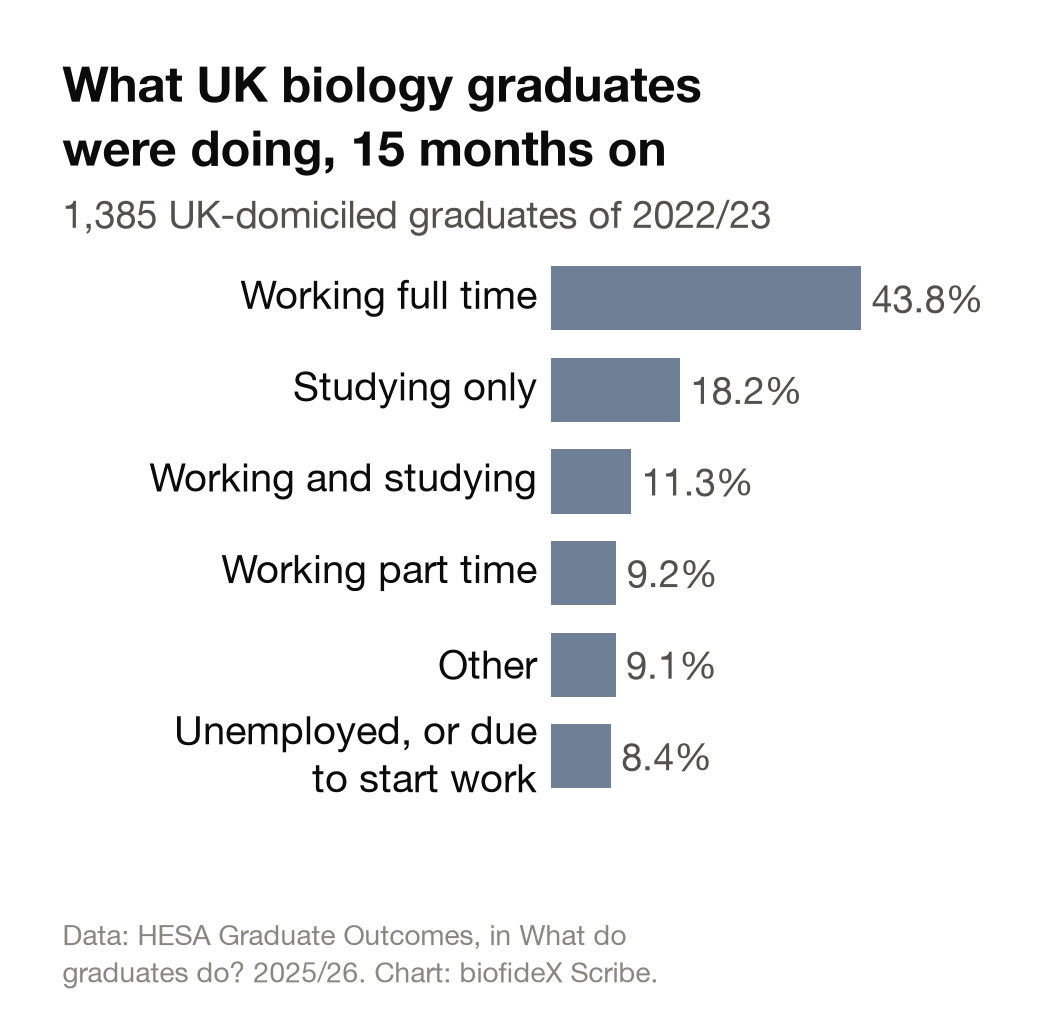
Full-time work was the most common outcome, at 43.8%. But almost three in ten were studying, either with no job (18.2%) or alongside one (11.3%). Of the 410 in further study, about half (49.5%) were on a master's course and a quarter (25.2%) on a research degree such as a PhD, MPhil or MRes; most of the rest were taking professional qualifications or postgraduate certificates such as teacher training.
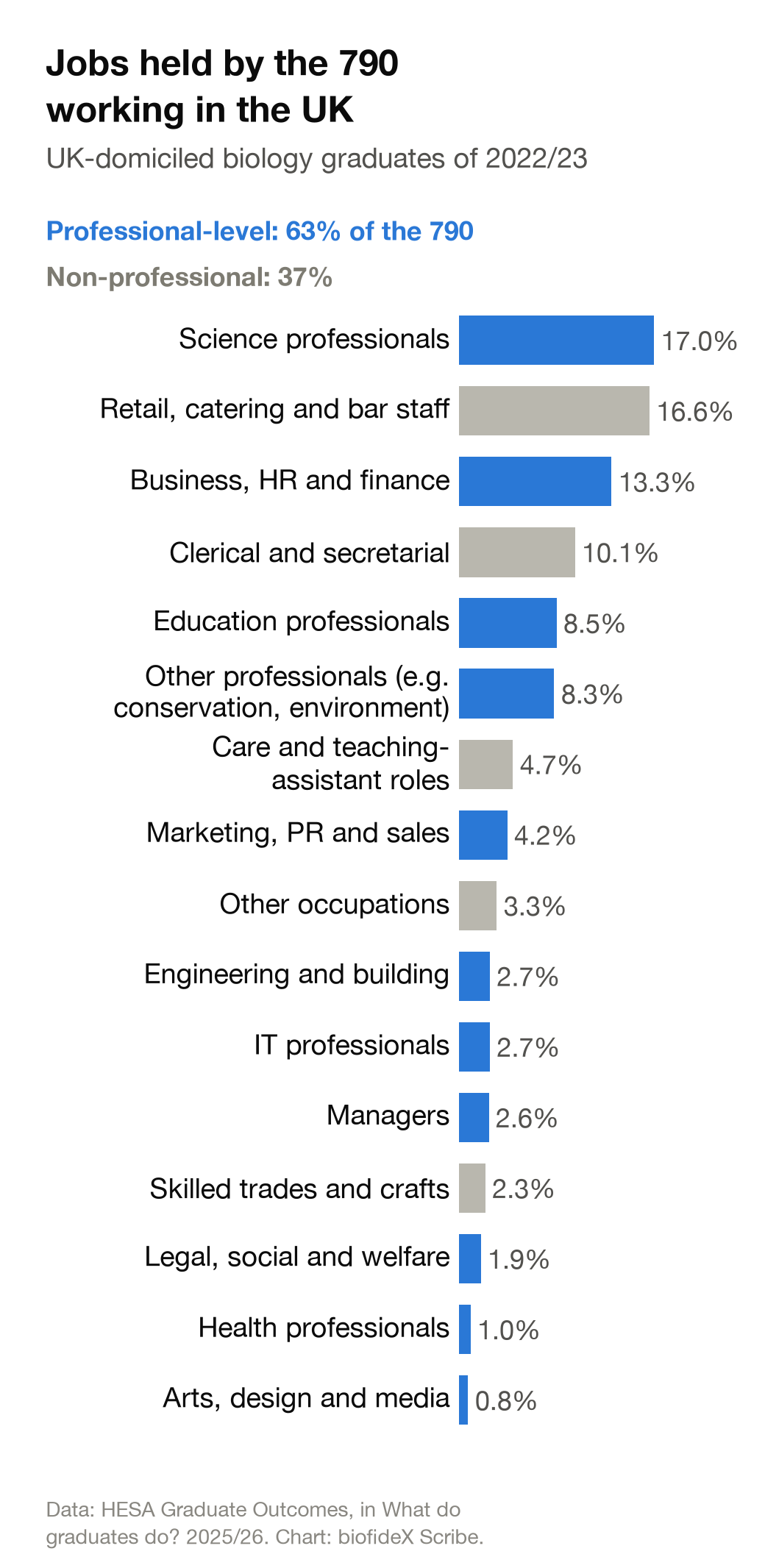
Figure 2 shows the harder picture. Science professionals, a group that includes laboratory technicians, were the largest single group of those in work, at 17.0%, yet only just ahead of retail, catering and bar staff, at 16.6%. Altogether 37% were in jobs the survey classes as non-professional, which usually do not need a degree, against about 28% of all UK graduates that year.
The five most common professional jobs for these graduates, in order, were biological scientist, laboratory technician, secondary school teacher, conservation professional and accountant. Three of the top ten were general business roles that do not draw on biology directly: accountant, business research professional and management consultant.
This does not mean the degree failed those graduates. Fifteen months is early, some people in stopgap jobs are applying or saving for further training, and this cohort graduated into a cooling job market: across all subjects, full-time employment was 56.4%, down from 59% for the previous year's graduates and back near its pre-pandemic level. What the numbers do suggest is that a biology degree is often not enough on its own to land a science job. It pays to add one concrete, job-relevant skill or experience while you can, which is what the rest of this guide is about.
Bench and field science
This is the work most people picture when they choose biology, and in the UK data above, science jobs were the largest professional group. Each path below follows the same pattern: a typical day, the usual way in, and the first skill worth learning.
Laboratory or research technician
A typical day: preparing samples and reagents, running routine methods such as PCR, cell culture or ELISA, keeping instruments calibrated, and recording every step so that someone else could repeat it.
The way in: a bachelor's degree is usually enough, but employers want proof that you have done real lab work: a final-year project, a placement or a summer job. Universities, hospitals, government agencies, biotech companies and contract research labs all hire. In the UK data above, laboratory technician was the second most common professional job for biology graduates.
First skill to learn: one technique you can perform reliably, plus spotless record keeping. Learn what a standard operating procedure (SOP) is, and practise writing one for a method you already know.
Research scientist
A typical day: designing experiments, troubleshooting the ones that failed, analysing results, reading papers and presenting to the team. In universities, add writing grant applications and supervising students.
The way in: leading your own research usually requires a PhD. Companies also hire bachelor's and master's graduates as research associates, who run experiments inside a team; some later move up or go on to a PhD.
First skill to learn: experimental design and basic statistics: controls, replicates, and how many samples you need before a result means anything.
Quality control scientist
A typical day: testing batches of medicines, vaccines, food or water against agreed specifications, recording every result, and investigating any batch that fails.
The way in: a bachelor's degree, usually in a manufacturing company. Shift work is common, and the job is a well-trodden route into quality assurance and regulatory roles later.
First skill to learn: the basics of Good Manufacturing Practice (GMP) and data integrity, the rules that make a test result trustworthy enough to release a product.
Ecologist or conservation scientist
A typical day: depends on the season. Spring and summer bring surveys of plants, birds, bats or amphibians; autumn and winter bring mapping, data entry and report writing. Much of the paid work in some countries is ecological consultancy linked to planning and building projects.
The way in: a bachelor's degree plus field skills that you can show, which usually means volunteering. Early contracts are often seasonal. In the UK, surveys of some protected species need a licence, and many ecologists join the professional body, the Chartered Institute of Ecology and Environmental Management (CIEEM).
First skill to learn: confident identification of one group of organisms, and free mapping software such as QGIS.
Data and code
Sequencing, imaging and other high-throughput methods now produce data sets that need dedicated analysts in research groups, hospitals, drug companies and agriculture. You do not need a computer science degree to start, but you do need to enjoy hours of careful work at a keyboard, including the frustrating hours when code will not run.
Bioinformatician
A typical day: running and improving pipelines for sequencing data (quality checks, alignment, variant calling, gene expression), writing scripts, checking odd results with the biologists who made the samples, and documenting everything so the analysis can be repeated.
The way in: a master's degree in bioinformatics is a common route, and in England the NHS also trains clinical bioinformaticians through its Scientist Training Programme. For some jobs, a portfolio of analyses on public data can stand in for part of it. Genomics labs in hospitals, sequencing facilities, universities and biotech companies all hire.
First skill to learn: the command line and one language, Python or R, applied to a real public data set. Scribe's guides to bioinformatics file formats and volcano plots walk through two everyday tasks with real data.
Computational biologist
A typical day: building models, simulations or statistical methods to answer a biological question, testing them on large data sets, and writing up what they show.
The way in: scientist roles usually expect a PhD, often in a computational, mathematical or quantitative biology subject. Many people arrive from a bioinformatics master's and a few years of work.
First skill to learn: the statistics and linear algebra behind the methods you use, alongside programming.
Biostatistician
A typical day: planning the statistics of clinical trials and health studies (how many patients, how to randomise them, which analysis to run), analysing the results, and explaining them to doctors and regulators.
The way in: usually a master's degree in statistics or biostatistics. A biology degree helps you talk to scientists, but the mathematical training has to come from statistics.
First skill to learn: fitting and interpreting linear models in R.
Clinical data manager or statistical programmer
A typical day: setting up databases for clinical trials, chasing and correcting errors in the data, converting it into the standard formats that regulators such as the US FDA require (the CDISC standards), and producing the tables that go into trial reports.
The way in: a bachelor's degree in a life science is a common starting point. Contract research organisations (CROs), the companies that run trials for drug makers, often train graduates.
First skill to learn: for data management, how electronic data capture systems and data queries work; for statistical programming, SQL (the language for querying databases) plus R or SAS (a statistics package widely used in trials), and what the CDISC standards are for.
Health and patients
These paths put biology to work for people's health. Most of them need an extra professional qualification and registration with a regulator, and the rules change from country to country, so check them before you commit.
Biomedical or clinical scientist
A typical day: analysing patient samples in a hospital laboratory, in areas such as blood sciences, microbiology, genetics or tissue pathology; checking that results are accurate before they reach a doctor; and, at senior levels, developing tests and advising clinical teams.
The way in: it depends on the country. In the UK, biomedical scientists register with the Health and Care Professions Council (HCPC), usually after a degree accredited by the Institute of Biomedical Science (IBMS); most general biology degrees are not accredited, but the IBMS can assess yours and set top-up modules. Clinical scientists in England usually train through the NHS Scientist Training Programme, a paid and highly competitive three-year post that includes an accredited master's degree. It asks for a first or an upper second (2:1), the top two UK degree grades, in a relevant science, or a lower second plus a relevant higher degree; first degrees in animal or plant science generally do not qualify on their own. In the US, medical laboratory scientists usually complete an accredited medical laboratory science programme, often about a year after a biology degree, then pass a certification exam, and some states also require a licence.
First skill to learn: the quality habits of a diagnostic lab, where every result is checked, recorded and traceable, because a wrong number can change a patient's treatment.
Genetic counsellor
A typical day: meeting patients and families, explaining the options for genetic testing and what results mean, helping people make decisions, and working alongside clinical geneticists.
The way in: a specialist master's degree. In the US, that means a programme accredited by the Accreditation Council for Genetic Counseling (ACGC), followed by certification from the American Board of Genetic Counseling; Canada has its own certification board. In the UK, one route is the genomic counselling specialism of the Scientist Training Programme.
First skill to learn: listening, and explaining risk in plain words. Volunteering on a helpline or in a support role is common preparation.
Clinical research coordinator or associate
A typical day: a coordinator works at a hospital or clinic, recruiting patients into clinical trials and collecting their data. An associate, often called a monitor, works for the trial's sponsor and visits sites to check that the data match the medical records and that the protocol is followed.
The way in: a bachelor's degree. In the US, many people start as coordinators; in the UK, Europe and India, the usual first job is clinical trial assistant at a CRO or a drug company. Monitoring usually comes after a year or two. Scribe's guide to clinical research careers covers the ladder in detail.
First skill to learn: Good Clinical Practice (GCP), the international standard for running trials; free introductory courses are widely available.
Medicine, dentistry and other health professions
Where medicine and dentistry are graduate-entry, a biology degree is a common starting point: through graduate-entry courses in the UK, or medical school in the US, which is always a graduate programme. In many other countries, including India, Bangladesh and Pakistan, medicine is entered straight from school instead. Biology also leads to physician assistant programmes in the US and to allied health professions such as physiotherapy and radiography. These are long, competitive routes with their own admission tests, so treat each one as a separate decision rather than a fallback.
Teaching, writing and communication
If the best part of your degree was explaining something to a friend the night before an exam, these paths are worth a serious look. In every one of them, your portfolio and your practice count for at least as much as your grades.
Science teacher
A typical day: teaching four or five lessons, running practical work, marking, and supporting students through exams and everything else going on in their lives.
The way in: most countries require a teaching qualification on top of the degree for state schools, such as a Postgraduate Certificate in Education (PGCE) leading to qualified teacher status in England, a Bachelor of Education (B.Ed) in India, or state certification in the US. Secondary teaching was the third most common professional job for UK biology graduates in the same survey.
First skill to learn: explaining an idea to a 14-year-old without notes. Tutoring or helping at a school science club will tell you within weeks whether you enjoy it.
Medical writer
A typical day: writing and editing the documents that drug development runs on, such as trial protocols, clinical study reports and regulatory submissions; or, on the publications side, journal articles and plain-language summaries for patients. Much of the day is spent reviewing drafts with scientists, statisticians and doctors.
The way in: many medical writers have a master's or a PhD, but there are entry roles for bachelor's graduates who can show strong writing samples. The American Medical Writers Association (AMWA) and the European Medical Writers Association (EMWA) run training and publish career advice.
First skill to learn: turning a dense paper into a clear 250-word summary for patients. Write three, ask someone to edit them hard, and you have the start of a portfolio.
Science communicator, journalist or museum educator
A typical day: writing articles or press releases, producing videos and podcasts, running public events, or designing exhibits and school programmes.
The way in: a portfolio matters more than any qualification, though some people take a master's in science communication. Competition is strong and many start in university press offices, museums or freelance work.
First skill to learn: publishing regularly. A newsletter, a blog or a column in a student paper shows editors that you can deliver to a deadline.
Regulation, quality and safety
Every medicine, vaccine, medical device and food product reaches the public through a web of rules, and someone has to make sure the rules are met. These jobs suit people who like precision, documents and seeing the whole picture of how a product is made. They are also less familiar to most students than research or teaching, so they are easy to overlook.
Regulatory affairs
A typical day: preparing and updating the documents that regulators need before they approve a product or a change to it, tracking new guidelines, and answering regulators' questions on behalf of a company.
The way in: a bachelor's or master's degree, starting as a regulatory associate or assistant in a drug or device company, a contract research organisation or a consultancy. Professional bodies such as the Regulatory Affairs Professionals Society (RAPS) and The Organisation for Professionals in Regulatory Affairs (TOPRA) run training.
First skill to learn: reading what regulators actually publish. The European Medicines Agency publishes a European public assessment report (EPAR) for every medicine authorised through the EU's central procedure, and the US FDA publishes review documents for approved drugs. Start with the short summary and the benefit-risk section of one, and note what the regulator worried about.
Quality assurance
A typical day: auditing how products are made and tested, writing and reviewing standard operating procedures, investigating when something goes wrong, and making sure corrective actions actually happen.
The way in: often after a year or two in a quality control lab, though some companies hire graduates directly.
First skill to learn: structured root-cause analysis, such as the "five whys" or a fishbone diagram, applied to a problem you have seen in a lab.
Drug safety (pharmacovigilance)
A typical day: processing reports of suspected side effects from patients, doctors and published studies, coding them with a standard medical dictionary (MedDRA), judging how serious they are, and contributing to the safety reports that companies send to regulators.
The way in: a life-science bachelor's degree is a common entry point for case-processing roles in drug companies and contract research organisations, with routes later into signal detection (spotting new side effects in the data) and safety science.
First skill to learn: medical terminology, and reading the official product information that lists a drug's known side effects.
Similar work exists outside medicines: food safety and quality, environmental monitoring, and biosafety roles that oversee how labs handle dangerous organisms.
Business: sales, patents and consulting
These jobs sit between the science and the market: selling it, protecting it or advising on it. They reward communication and commercial sense as much as technical knowledge. They are different from general business jobs, such as accounting, that many biology graduates also move into, as Figure 2 showed.
Technical sales or field application scientist
A typical day: visiting labs to demonstrate instruments or reagents, helping customers fix experiments that are not working, and training new users. Sales roles carry targets; field application scientists are the technical experts who support the sales team.
The way in: a bachelor's degree plus hands-on lab experience for sales. Field application roles often ask for a master's or PhD with deep experience in one technique, such as flow cytometry or sequencing.
First skill to learn: explaining a method clearly to someone who uses it differently from you, and asking good questions about their problem before offering a product.
Patent attorney or patent agent
A typical day: reading new inventions and earlier publications, drafting patent applications, and arguing with patent offices about what counts as new and inventive.
The way in: in the UK, trainees join a firm with a science or engineering degree (often a 2:1 or better, and a PhD is common in biotechnology) and qualify through professional exams, which typically takes four to six years. In the US, a biology degree qualifies you to sit the US Patent and Trademark Office's registration exam and work as a patent agent, if you are a US citizen or resident; becoming a patent attorney also requires a law degree and admission to a state bar.
First skill to learn: precise reading and writing. Find a biotech patent on a free search site such as Google Patents, Espacenet or Lens, read its first claim, and rewrite it in one plain sentence.
Consultant or analyst
A typical day: researching markets, diseases and competitors for drug and biotech companies, building spreadsheet models and presentations, and turning them into recommendations.
The way in: life-science consultancies hire bachelor's and master's graduates as analysts, and many PhDs. Interviews often include case studies that test structured thinking.
First skill to learn: spreadsheets and structured problem-solving: breaking a big question into smaller ones you can answer with data.
Project management, product management and early jobs at start-ups also welcome biologists who are organised and comfortable switching between science and business conversations.
Other paths worth knowing
Six kinds of work cover most science-related jobs, but not all of them. A thorough search should also include these:
- Public health and epidemiology: tracking and preventing disease across populations, often after a master's in public health.
- Policy, government and research management: advising on science policy, or running funding programmes and research offices.
- Agriculture, food science, fisheries and plant breeding: large employers in many countries, including much of South Asia.
- Bioprocessing and manufacturing: producing biological medicines, vaccines and enzymes at scale.
- Animal care: research animal technology and veterinary nursing.
- Forensic science: popular with students, but a small job market with strong competition.
- Medical science liaison: the expert link between drug companies and doctors, which usually needs a PhD or a pharmacy or medical doctorate.
- Health economics and market access: judging whether a new treatment is worth its cost to a health system.
Which paths need a PhD, and when one pays off
Most of the paths in this guide can be started with a bachelor's degree. A few need a master's or a specific training post, and only a handful truly need a PhD.
- A bachelor's degree is enough to start: laboratory technician, quality control, clinical research coordinator or trial assistant, clinical data management, drug safety, regulatory affairs, quality assurance, technical sales, ecology and science communication.
- Usually a master's, a training post or a professional qualification: bioinformatics, biostatistics, genetic counselling, teaching, biomedical science (UK) or medical laboratory science (US), and clinical science (in England, through the Scientist Training Programme).
- A PhD is common but not required: medical writing, field application science, consulting, and patent work in biotechnology.
- Usually a PhD: leading your own research, as a university group leader or a company research scientist, and most computational biologist roles.
A PhD pays off when the job you want is asking the research questions yourself. It usually takes three to four years in the UK and much of Europe, and often five to seven in the US. In many countries, including India, Bangladesh and Pakistan, you usually need a master's degree first, and entry often involves national or university tests. Funding varies too: in the Netherlands and the Nordic countries PhD students are salaried employees, while elsewhere a stipend is usually well below a graduate salary.
Two warning signs that you are choosing a PhD for the wrong reason: you cannot name the job it leads to, or it is mainly a way to put off the job market. A master's, too, is most useful when it adds a skill employers ask for, such as bioinformatics, statistics, genetic counselling or teaching, rather than more of the same biology.
If you are outside the UK and the US
Most examples in this guide come from the UK and the US because their routes are well documented, but the logic of choosing by the work travels anywhere. Three local differences matter most.
- Entry routes differ. In India, Bangladesh and Pakistan, for example, medicine is entered straight from school, and a PhD usually follows a master's degree. In India, school teaching usually needs a B.Ed.
- Some work clusters in hubs. India, for instance, has a large industry in drug safety, clinical data management and contract research serving companies worldwide, which regularly hires life-science graduates.
- Check every paid course. Be wary of training institutes that promise a guaranteed job at the end; real employers rarely work that way. Before you pay, look for a recognised qualification, a professional body or a regulator behind the course.
Test a path in a month before you commit
A master's degree costs at least a year and often a lot of money; a training scheme can commit you for three. Before either, spend four weeks testing whether you like the work itself. One week per step is enough, alongside a degree or a job.
- Week 1: read 15 real job ads. Pick the role and the country you want to work in, and save 15 entry-level ads from job boards and company sites. Highlight every requirement that appears in at least half of them. That list, not a university brochure, is the real entry requirement. This week, also message five or six people who do the job, because not everyone will reply.
- Week 2: talk to two of them. Find people through your university's alumni network, a professional body's early-career group or a polite message on a professional networking site; a 20-minute video call is plenty. Ask what they did last Tuesday, what a new starter needs on day one, and what they wish they had learned sooner. Never pay anyone for "mentoring" or a referral.
- Week 3: do a small piece of the actual work. Use the taster tasks below. The point is not to produce something impressive, but to notice whether the hours fly or drag.
- Week 4: decide with evidence. Compare your week 1 list with what you can already show, and pick the single smallest step that closes the biggest gap: a course, a placement, a project or an application.
Taster tasks for the paths in this guide:
- Laboratory work: ask whether you can shadow a lab for a few days or join a summer research scheme. Labs must give you a safety induction first, and some cannot host people who are not enrolled students. Or write a clear SOP for a method you know.
- Quality control and assurance: write a one-page root-cause analysis of an experiment that went wrong, using the five whys.
- Ecology: join a survey with a local wildlife group, or record what you see on iNaturalist or eBird, and learn 20 species in one group. Go with others, get permission for private land, and check for ticks afterwards.
- Bioinformatics: download a small public gene-expression table and make a volcano plot in R or Python.
- Biostatistics: take a published data set and reproduce one figure or test from the paper.
- Clinical research: complete a free introductory GCP course, then read a trial's entry on ClinicalTrials.gov, the WHO's trial registry portal or your national registry.
- Hospital laboratory science: ask a hospital laboratory whether it runs open days or shadowing for students.
- Genetic counselling: volunteer for a few weeks on a helpline or in a support role, and read a patient leaflet about a genetic test.
- Medical writing: write a 250-word plain-language summary of a recent paper.
- Science communication: write and publish a 600-word explainer about a new finding.
- Regulatory affairs: read the summary and benefit-risk section of one EPAR, and list the three things the regulator worried about most.
- Drug safety: read a medicine's official product information and rewrite its most common side effects in plain words.
- Teaching: tutor a younger student, or help at a school science club through an organisation that handles safety checks, such as a DBS check in the UK.
- Technical sales: record a three-minute explanation of a lab technique for someone who has never used it.
- Patents: rewrite the first claim of a biotech patent in one plain sentence.
- Consulting: estimate, on one page, how many people in your country live with a particular disease, showing every assumption.
Conclusion
A biology degree can lead to labs, hospitals, offices, schools and fieldwork, but on its own it is often not enough to get you through the door. In the UK figures, more than a third of the graduates in work 15 months on were in jobs the survey classes as non-professional, and a CV that points somewhere in particular makes the next step much easier.
The way through is simple to state and takes effort to do. Choose the kind of work you want most days, not the most impressive title. Add the first skill that kind of work asks for. Then test it cheaply, in a month, before you spend years and money on a course.
If you want to start this week, pick the kind of work that appealed to you most, start collecting real job ads for it, and choose one taster task to try. By the end of the month you will know more about your next step than any list of job titles could tell you.
Further reading
Three Scribe guides go deeper into particular fields:
From bench to bedside: a practical guide to clinical research careers covers coordinator, monitor and the steps beyond.
How to break into AI drug discovery sets out the skill stack for the data and code paths in drug development.
Building a career in cell and gene therapy maps the job tracks in cell and gene therapy, from the research lab to manufacturing.
From outside Scribe:
What do graduates do? 2025/26, the source of the UK figures above, covers every subject area, not only biology.
Prospects job profiles describe hundreds of jobs, with typical duties and UK entry routes.
The NHS Scientist Training Programme explains each healthcare science specialism and how to apply in England.
Reactions
From QuizLab
Test Your Knowledge
Quizzes on the same ground as this article. Pick one and see how much stuck.
- BioinformaticsBeginnerIntro to Bioinformatics9questionsStart Quiz
- BioinformaticsIntermediateSequence Alignment14questionsStart Quiz
- BioinformaticsAdvancedPhylogenetic Tree Construction13questionsStart Quiz
- BioinformaticsAdvancedNext-Generation Sequencing (NGS)13questionsStart Quiz
- Cell BiologyIntermediateThe Cell Cycle & Mitosis14questionsStart Quiz
- Cell BiologyAdvancedCell Signaling Pathways12questionsStart Quiz
Keep Reading
More from Scribe
Articles on related ground, and the newest from Scribe.
 Career Guidance
From Bench to Bedside: A Practical Guide to Clinical Research Careers in 2026
The clinical research industry hits $52 billion in 2026. It hires biology and nursing graduates without requiring a PhD — and the career ladder is unusually well-documented. Here's how to get on it.
biofideXMay 27, 20265 min read Career Guidance
How to Break Into AI Drug Discovery: A Skill Roadmap for the AlphaFold Era
AI-driven drug discovery is one of the most aggressively hiring corners of biotech in 2026 — and one of the most talent-starved. Here's the actual skill stack, the degree paths that work, and the companies hiring entry-level.
biofideXMay 27, 20265 min read Career Guidance
Building a Career in Cell and Gene Therapy: From Bench to Patient
Cell and gene therapy is hiring across at least six distinct job tracks — most applicants only know two. Here's the full role spectrum, the skill stack each one demands, and the under-the-radar opportunities.
biofideXMay 27, 20264 min read Research Insights
AlphaFold 3 to IsoDDE: How AI Drug Discovery Got Twice as Accurate in 18 Months
DeepMind's AlphaFold 3 reshaped structural biology in 2024. By mid-2026, Isomorphic Labs' IsoDDE has more than doubled accuracy on the hardest protein-ligand systems.
biofideX5 min read