Mitosis Diagram
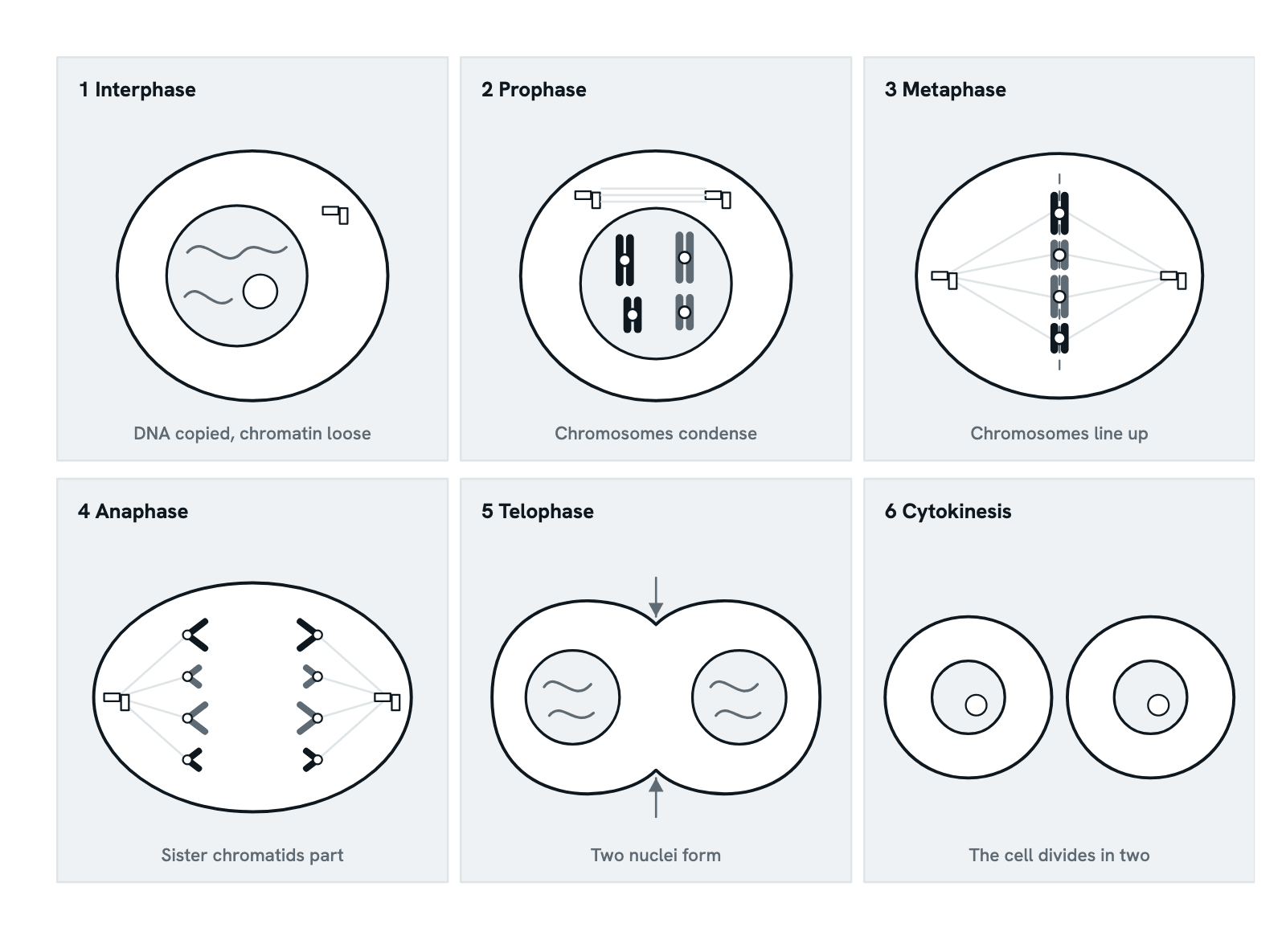
The stages of mitosis, from prophase to telophase and cytokinesis: how one cell's copied chromosomes are shared equally between two new cells.
Mitosis divides a cell's nucleus so that each of two new cells gets an identical, complete set of chromosomes. Before it starts, in interphase, every chromosome has been copied. The cell here has two pairs of chromosomes, one long and one short, so you can follow each one.
Also called Stages of mitosis or Phases of mitosis.
Step 1 of 8
Mitosis at a glance
Mitosis shares out a cell's copied chromosomes so that each of two daughter cells gets an identical, complete set. It runs through four phases, prophase, metaphase, anaphase and telophase, and the cell itself then divides in cytokinesis.
Use ← and → to move between steps.
Step 1 of 8: Mitosis at a glance
Download the diagramChecked against its sources on 25 October 2026.
Step by step
The steps of the Mitosis
01Mitosis at a glance
Mitosis shares out a cell's copied chromosomes so that each of two daughter cells gets an identical, complete set. It runs through four phases, prophase, metaphase, anaphase and telophase, and the cell itself then divides in cytokinesis.
02Interphase: before mitosis
Most of a cell's life is interphase. It grows, and in the S phase it copies every chromosome, so that each is now two identical sister chromatids. The DNA is still loose chromatin, and the centrosome has been copied too.
03Prophase: chromosomes condense
The chromatin coils up into compact chromosomes, each two sister chromatids joined at the centromere. The nucleolus fades, and the two centrosomes move apart as the spindle grows between them. Then, in prometaphase, the nuclear envelope breaks up and spindle fibres attach to the kinetochores, one on each sister chromatid.
04Metaphase: chromosomes line up
Pulled from both sides, the chromosomes line up on the metaphase plate, the cell's equator, with the sister chromatids of each facing opposite poles. A checkpoint holds the cell here until every chromosome is attached to both poles.
05Anaphase: sister chromatids part
The proteins holding sister chromatids together are cut, and each chromatid, now a chromosome in its own right, is pulled to the opposite pole as its spindle fibres shorten. The cell lengthens as the poles move apart.
06Telophase: two nuclei form
A set of chromosomes reaches each pole. A nuclear envelope forms round each set, the chromosomes loosen back into chromatin, nucleoli reappear and the spindle breaks down. The cell is already pinching in at the middle.
07Cytokinesis: the cell divides
A ring of actin and myosin tightens round the middle of the cell, deepening the cleavage furrow until the cell is pinched in two. Each daughter cell has the same chromosomes as the parent. Plant cells build a cell plate between the two nuclei instead.
08Two identical cells
Mitosis and cytokinesis end with two daughter cells, each with a complete copy of every chromosome, the same number as the parent cell. It is how the body grows and replaces cells; meiosis, which makes eggs and sperm, halves the number instead.
Parts
What each part of the mitosis does
- Interphase
- The time between divisions, when the cell grows and copies its DNA (in the S phase). It is not part of mitosis, but every chromosome must be copied before mitosis begins.
- Prophase
- Chromatin condenses into visible chromosomes, the nucleolus fades, and the two centrosomes move apart as the spindle begins to form between them.
- Metaphase
- Every chromosome is lined up on the metaphase plate, the cell's equator, held by spindle fibres from both poles.
- Anaphase
- The sister chromatids of each chromosome separate and are pulled to opposite poles, and the cell lengthens.
- Telophase
- A nuclear envelope forms round each set of chromosomes at the poles, the chromosomes loosen, and the spindle breaks down.
- Cytokinesis
- The division of the cytoplasm, which in animal cells pinches the cell in two. It usually begins in late anaphase or telophase.
- Chromosome
- A single long DNA molecule with its proteins. Copied before mitosis, it is two identical sister chromatids joined at the centromere.
- Centromere
- The constricted region where sister chromatids are held together. Each chromatid has its own kinetochore here, where spindle fibres attach.
- Spindle fibres
- Microtubules that grow from the centrosomes. Some attach to the chromosomes' kinetochores and pull the chromatids apart.
- Centrosome
- The cell's main organiser of microtubules, with a pair of centrioles. It is copied in interphase, and the two copies become the spindle's poles.
- Nuclear envelope
- The double membrane round the nucleus. It breaks up early in mitosis, so the spindle can reach the chromosomes, and forms again round each new nucleus.
- Nucleolus
- The part of the nucleus that makes ribosomes. It fades in prophase and reappears in each new nucleus.
- Metaphase plate
- The plane midway between the two poles where the chromosomes line up in metaphase. It is a position, not a structure.
- Cleavage furrow
- The groove where a ring of actin and myosin filaments tightens round the middle of an animal cell, pinching it in two.
- The cell
- The cell dividing here, and in the last panel the two daughter cells, each with the same chromosomes as the parent.
Dictionary
The terms to know
Practise it
The quizzes and cards that fit
- Cell Biology quizzes
- Characteristics of Life15 questions
- Lab Safety15 questions
- Cell Theory15 questions
- Genetics quizzes
- Incomplete Dominance and Codominance15 questions
- Pedigree Analysis15 questions
- Blood Types15 questions
- Cell Biology flashcards
The subject's terms as a ready-made deck, free to flip through.
Next to it
More diagrams
Sources