Animal Cell Diagram
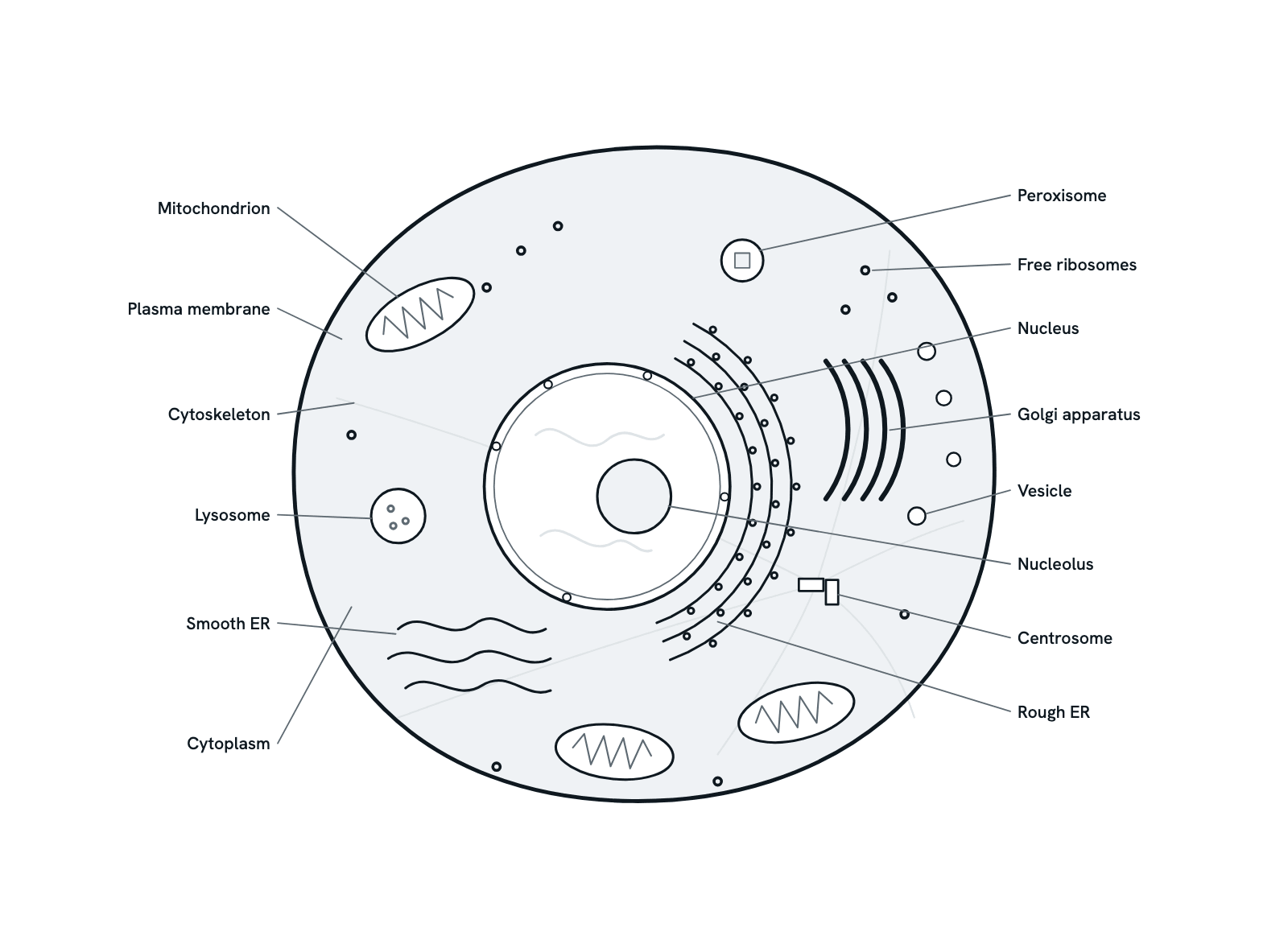
The parts of an animal cell and what each does: the nucleus, the endoplasmic reticulum, the Golgi apparatus, mitochondria, lysosomes and more.
An animal cell is a eukaryotic cell: its DNA is kept in a nucleus, and much of its work is split between membrane-bound organelles. Press any part to see what it is and what it does, or take the tour in order. Not to scale.
Also called Eukaryotic cell.
Press any part of the diagram, or pick one here, to see what it is and what it does.
Download the diagramChecked against its sources on 25 October 2026.
A tour
A tour of the animal cell
01The animal cell at a glance
An animal cell is a eukaryotic cell: its DNA is kept in a nucleus, and its work is split between organelles, most of them wrapped in membrane. Unlike a plant cell it has no cell wall, no chloroplasts and no large central vacuole.
02The plasma membrane
A double layer of phospholipids, with proteins set in it, surrounds the cell. It lets some substances through and keeps others out, and its proteins pump, transport and sense what is outside. Inside it, the cytoplasm holds the organelles in the watery cytosol.
03The nucleus and nucleolus
The nucleus holds the cell's DNA as chromatin, inside the double-membraned nuclear envelope, whose pores let messenger RNA out and proteins in. In the nucleolus, ribosomal RNA is made and built into ribosome subunits.
04Ribosomes and the rough ER
Ribosomes read messenger RNA and join amino acids into proteins. Those on the rough endoplasmic reticulum make proteins bound for membranes, lysosomes or export, which are threaded into the ER as they are made and fold there.
05The smooth ER
The smooth endoplasmic reticulum has no ribosomes. It makes lipids, including the phospholipids of membranes and steroid hormones, breaks down some drugs and poisons in liver cells, and stores calcium in muscle cells.
06The Golgi apparatus and vesicles
Vesicles carry proteins from the ER to the Golgi apparatus, which modifies them, sorts them and packs them into new vesicles: for the plasma membrane, for lysosomes, or to be released from the cell by exocytosis.
07Mitochondria
Mitochondria make most of the cell's ATP by aerobic respiration: the Krebs cycle runs in their matrix and oxidative phosphorylation on their folded inner membrane. They have their own DNA and grow and divide in two, but most of their proteins come from genes in the nucleus.
08Lysosomes and peroxisomes
Lysosomes hold digestive enzymes that work in acid; they break down worn-out organelles and material taken in by the cell. Peroxisomes break down fatty acids and turn harmful hydrogen peroxide into water and oxygen.
09The cytoskeleton and centrosome
Microtubules, actin filaments and intermediate filaments give the cell its shape and the tracks that vesicles and organelles move along. The centrosome organises the microtubules, and when the cell divides it builds the spindle that separates the chromosomes.
Parts
What each part of the animal cell does
- Plasma membrane
- A double layer of phospholipids with proteins in it, round the whole cell. It controls what enters and leaves, and carries the receptors the cell senses its surroundings with.
- Cytoplasm
- Everything inside the membrane but outside the nucleus: the watery cytosol and the organelles in it. Many reactions, such as glycolysis, happen in the cytosol.
- Nucleus
- Holds the cell's DNA as chromatin, inside a double membrane, the nuclear envelope. Pores in the envelope let RNA out and proteins in.
- Nucleolus
- A dense region of the nucleus where ribosomal RNA is made and joined with proteins into the two subunits of ribosomes.
- Ribosomes
- Make proteins by reading messenger RNA. Free ribosomes in the cytosol make proteins for the cytosol, nucleus, mitochondria and peroxisomes; others sit on the rough ER.
- Rough endoplasmic reticulum
- Folded membranes joined to the nuclear envelope, studded with ribosomes. Proteins for membranes, lysosomes and export are made here and fold inside it.
- Smooth endoplasmic reticulum
- Tubes of membrane with no ribosomes. It makes lipids and steroid hormones, breaks down some drugs and poisons (in the liver) and stores calcium (in muscle).
- Golgi apparatus
- A stack of flattened sacs that receives proteins from the ER, modifies them (adding sugar groups, for example), sorts them and packs them into vesicles.
- Vesicles
- Small membrane sacs that carry proteins and other cargo between organelles, or to the plasma membrane to be released from the cell.
- Mitochondria
- Make most of the cell's ATP by aerobic respiration, through the Krebs cycle and oxidative phosphorylation. Each has two membranes, the inner one folded into cristae, and its own DNA.
- Lysosome
- A sac of digestive enzymes that work in acid. It breaks down worn-out organelles and material the cell has taken in.
- Peroxisome
- A small organelle whose enzymes break down fatty acids by oxidation, which makes hydrogen peroxide; the enzyme catalase then destroys this harmful by-product.
- Cytoskeleton
- A network of protein fibres (microtubules, actin filaments and intermediate filaments) that gives the cell its shape, moves it, and serves as tracks for transport.
- Centrosome
- Near the nucleus, it organises the cell's microtubules and, when the cell divides, the spindle. In animal cells it holds a pair of centrioles at right angles.
Dictionary
The terms to know
Practise it
The quizzes and cards that fit
- Cell Biology quizzes
- Characteristics of Life15 questions
- Lab Safety15 questions
- Cell Theory15 questions
- Biochemistry quizzes
- Photosynthesis and Cellular Respiration15 questions
- Molarity and Dilutions15 questions
- ATP and Cellular Energy15 questions
- Cell Biology flashcards
The subject's terms as a ready-made deck, free to flip through.
Next to it
More diagrams
Sources
Where the facts come from
- Alberts and others, Molecular Biology of the Cell, 4th edition: The Compartmentalization of Cells (NCBI Bookshelf)
- Cooper, The Cell: A Molecular Approach, 2nd edition: The Endoplasmic Reticulum (NCBI Bookshelf)
- Cooper, The Cell: A Molecular Approach, 2nd edition: Peroxisomes (NCBI Bookshelf)
- NHGRI Talking Glossary: Cell
Drawn and written by biofideX from these sources.