Krebs Cycle Diagram
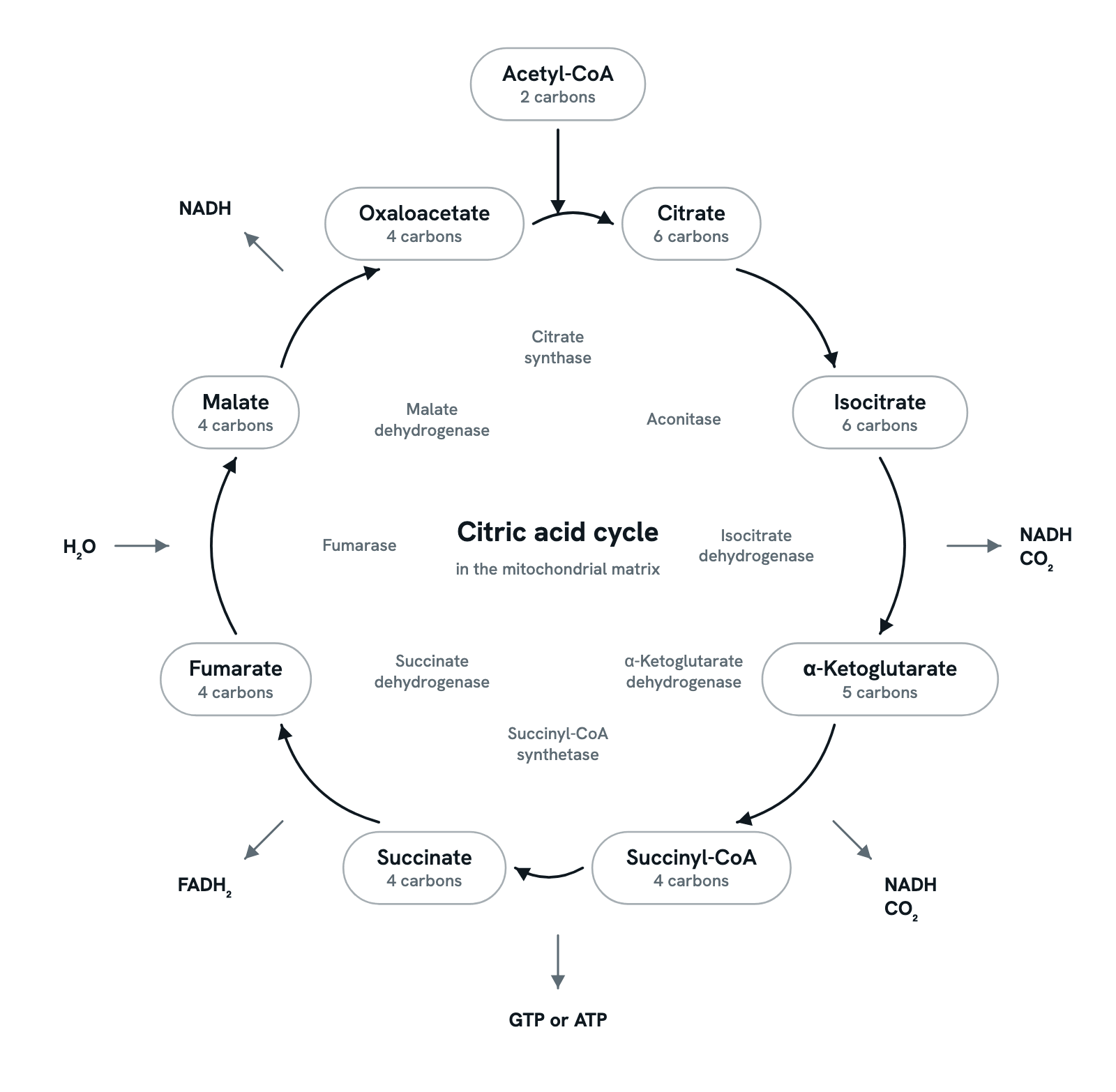
The Krebs cycle breaks the acetyl group of acetyl-CoA down to carbon dioxide and keeps its energy as NADH, FADH₂ and GTP, in eight steps.
Eight enzymes pass a molecule around a loop in the mitochondrial matrix. Each turn takes in two carbons as acetyl-CoA, gives off two as carbon dioxide, and hands the energy on to the electron transport chain. Step through it, or press any molecule or enzyme to see what it does.
Also called Citric acid cycle, TCA cycle or Tricarboxylic acid cycle.
Step 1 of 10
The cycle at a glance
The Krebs cycle runs in the mitochondrial matrix. Each turn takes in a two-carbon acetyl group and gives off two molecules of carbon dioxide, while keeping the energy as three NADH, one FADH₂ and one GTP or ATP. Oxaloacetate is used at the start and made again at the end, so the loop can turn again.
Use ← and → to move between steps.
Step 1 of 10: The cycle at a glance
Download the diagramChecked against its sources on 25 October 2026.
Step by step
The steps of the Krebs Cycle
01The cycle at a glance
The Krebs cycle runs in the mitochondrial matrix. Each turn takes in a two-carbon acetyl group and gives off two molecules of carbon dioxide, while keeping the energy as three NADH, one FADH₂ and one GTP or ATP. Oxaloacetate is used at the start and made again at the end, so the loop can turn again.
02Acetyl-CoA joins oxaloacetate
Citrate synthase joins the two-carbon acetyl group of acetyl-CoA to four-carbon oxaloacetate, making six-carbon citrate and freeing coenzyme A. The step releases a lot of energy, so it runs one way only, and it is one of the places the cycle is controlled.
03Citrate becomes isocitrate
Aconitase moves the hydroxyl group of citrate to the next carbon, making isocitrate by way of a short-lived intermediate, cis-aconitate. Nothing is gained or lost; the rearrangement sets the molecule up to be oxidised.
04The first carbon dioxide
Isocitrate dehydrogenase oxidises isocitrate and removes one carbon as CO₂, leaving five-carbon α-ketoglutarate. The electrons go to NAD⁺, making the first NADH. This is the cycle's main control point: ADP speeds it up, while ATP and NADH slow it down.
05The second carbon dioxide
The α-ketoglutarate dehydrogenase complex removes a second carbon as CO₂ and joins what is left to coenzyme A, making four-carbon succinyl-CoA and a second NADH. Both carbons the cycle gives off have now gone.
06GTP is made directly
Succinyl-CoA synthetase breaks the high-energy bond between succinyl and coenzyme A and uses the energy to make GTP or ATP, depending on the form of the enzyme, from GDP or ADP and phosphate. This substrate-level phosphorylation is the only step that makes one directly. Succinate is left.
07Succinate gives up two hydrogens
Succinate dehydrogenase removes two hydrogens from succinate, making fumarate and reducing FAD to FADH₂. It is the one enzyme of the cycle built into the inner mitochondrial membrane, where it is also complex II of the electron transport chain.
08Water is added
Fumarase, also called fumarate hydratase, adds a molecule of water across the double bond of fumarate, making malate.
09Oxaloacetate is made again
Malate dehydrogenase oxidises malate back to oxaloacetate, making the third NADH of the turn. The cycle is back where it began, with oxaloacetate ready for the next acetyl group.
10What one turn makes
One turn makes 3 NADH, 1 FADH₂, 1 GTP or ATP and 2 CO₂. A glucose molecule gives two acetyl-CoA, so it turns the cycle twice. The NADH and FADH₂ carry their electrons to the electron transport chain, where most of the cell's ATP is made.
Parts
What each part of the krebs cycle does
- Acetyl-CoA
- A two-carbon acetyl group carried by coenzyme A. Most of it comes from pyruvate, the end product of glycolysis, and from the breakdown of fatty acids.
- Oxaloacetate
- A four-carbon acid that takes up the acetyl group at the start of each turn and is made again at the end, so the cycle can keep turning.
- Citrate
- The six-carbon acid formed in the first step, which gives the citric acid cycle its name. It has three carboxyl groups, hence the tricarboxylic acid (TCA) cycle.
- Isocitrate
- A rearranged form of citrate, with its hydroxyl group moved so that the molecule can be oxidised in the next step.
- α-Ketoglutarate
- The five-carbon acid left after the first carbon dioxide is removed. It is also a starting point for making the amino acid glutamate.
- Succinyl-CoA
- A four-carbon group joined to coenzyme A by a high-energy bond, which the next step uses to make GTP or ATP.
- Succinate
- The four-carbon acid released when the bond to coenzyme A is broken.
- Fumarate
- The four-carbon acid with a double bond made when succinate gives up two hydrogens.
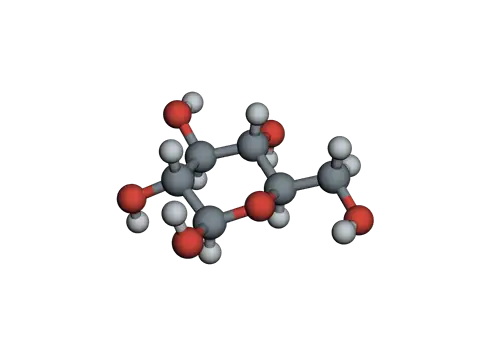
- Malate
- The four-carbon acid made when water is added to fumarate. Its oxidation remakes oxaloacetate.
- Citrate synthase
- Joins acetyl-CoA to oxaloacetate to make citrate. The reaction releases a lot of energy, so it runs one way, and the enzyme is slowed when the cell has plenty of ATP and NADH.
- Aconitase
- Turns citrate into isocitrate by taking off a water molecule and putting it back the other way round, through cis-aconitate.
- Isocitrate dehydrogenase
- Oxidises isocitrate and removes a carbon as carbon dioxide, making the first NADH. The main control point of the cycle: ADP speeds it up, ATP and NADH slow it down.
- α-Ketoglutarate dehydrogenase complex
- A complex of three enzymes that removes the second carbon dioxide and makes succinyl-CoA and the second NADH, much as the pyruvate dehydrogenase complex makes acetyl-CoA.
- Succinyl-CoA synthetase
- Uses the energy of the bond to coenzyme A to make GTP or ATP (it comes in a form for each) from GDP or ADP and phosphate: the cycle's one substrate-level phosphorylation.
- Succinate dehydrogenase
- Takes two hydrogens from succinate onto FAD. It is the only enzyme of the cycle built into the inner mitochondrial membrane, where it is also complex II of the electron transport chain.
- Fumarase
- Adds a water molecule across the double bond of fumarate to make malate. Also called fumarate hydratase.
- Malate dehydrogenase
- Oxidises malate back to oxaloacetate and makes the third NADH of the turn.
- NADH
- The reduced form of the coenzyme NAD⁺, made three times in each turn. It carries a pair of electrons to complex I of the electron transport chain.
- FADH₂
- The reduced form of FAD, made once in each turn and held by succinate dehydrogenase, which passes its electrons straight into the electron transport chain.
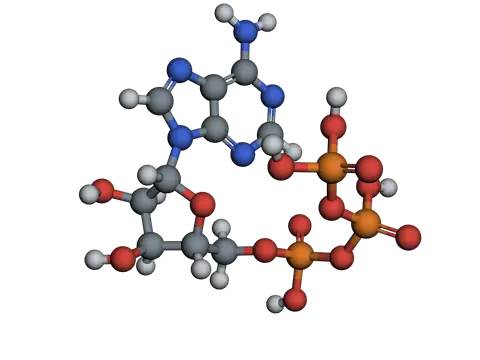
- GTP or ATP
- Made once in each turn. Tissues mix a GTP-making and an ATP-making form of the enzyme, and GTP can hand its phosphate on to make ATP.
- Water
- Taken in at the fumarase step. Water is also used when citrate is made, as the bond to coenzyme A is broken.
- Mitochondrial matrix
- The space inside the inner membrane of a mitochondrion, where all the cycle's enzymes but one are dissolved.
Dictionary
The terms to know
Practise it
The quizzes and cards that fit
- Biochemistry quizzes
- Photosynthesis and Cellular Respiration15 questions
- Molarity and Dilutions15 questions
- ATP and Cellular Energy15 questions
- Cell Biology quizzes
- Characteristics of Life15 questions
- Lab Safety15 questions
- Cell Theory15 questions
- Biochemistry flashcards
The subject's terms as a ready-made deck, free to flip through.
In 3D
The molecules, to turn and explore
Next to it
More diagrams
Sources