ATP 3D Structure
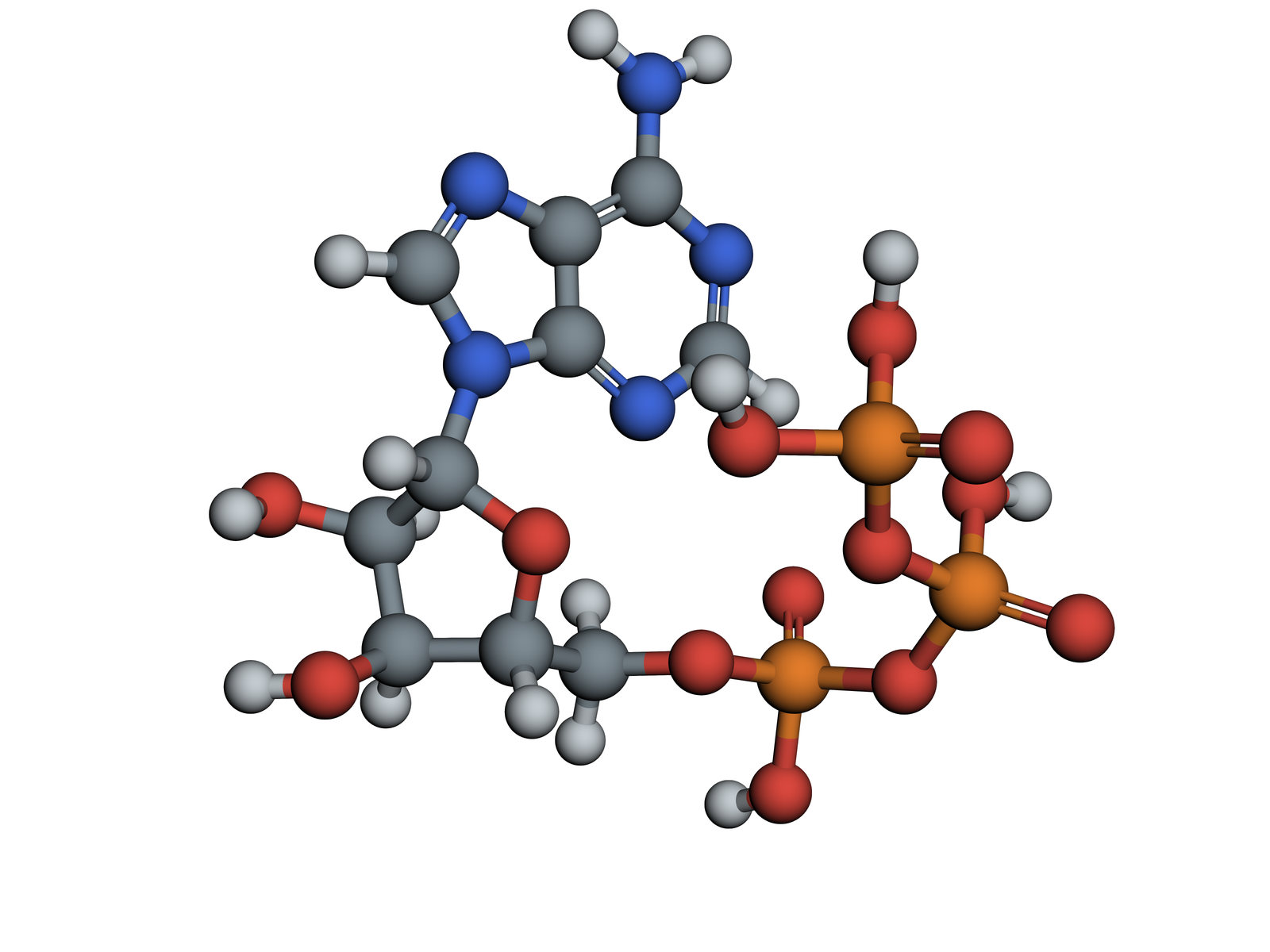
The cell's energy currency: adenine and a ribose sugar carrying a chain of three phosphates; splitting off the last one with water releases energy.
Almost every energy-using process in a cell, from muscle contraction to pumping ions and building proteins, is paid for with ATP. The cell makes it mostly in mitochondria, by ATP synthase, and spends it within seconds by removing the last phosphate, leaving ADP. It is also one of the four building blocks of RNA.
Also called Adenosine triphosphate or Adenosine 5′-triphosphate.
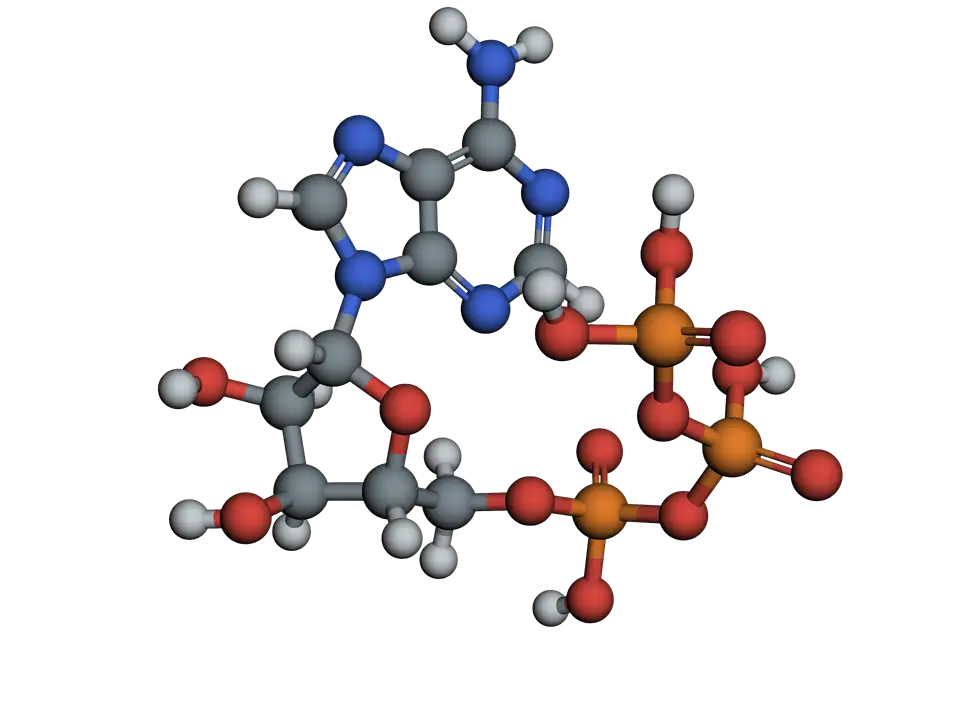
View 1 of 6
A base, a sugar and three phosphates
ATP is a nucleotide: adenine, the sugar ribose, and a chain of three phosphates. PubChem's model, shown here, is uncharged; in the cell the phosphates carry about four negative charges between them, and ATP usually travels with a magnesium ion bound to them.
Use ← and → to move between views. Drag the molecule to turn it; on a touch screen, press Turn it first.
View 1 of 6: A base, a sugar and three phosphates
Download the pictureDownload the atoms (SDF)Checked against its sources on 25 October 2026.
View by view
The ATP structure, explained
01A base, a sugar and three phosphates
ATP is a nucleotide: adenine, the sugar ribose, and a chain of three phosphates. PubChem's model, shown here, is uncharged; in the cell the phosphates carry about four negative charges between them, and ATP usually travels with a magnesium ion bound to them.
02Adenine
The flat double ring is adenine. The carriers NAD⁺, FAD and coenzyme A each contain the same adenine nucleotide, an AMP unit that the cell adds from ATP when it makes them.
03Ribose
Adenine is joined to carbon 1 of ribose; the phosphates to carbon 5. With its two hydroxyl groups at carbons 2 and 3, ribose is the sugar of RNA, not DNA.
04Three phosphates in a row
The phosphates are named alpha, beta and gamma, outwards from the sugar. Their negative charges repel each other, and the products of splitting them apart with water are more stable, which is why that reaction releases energy, even though breaking a bond on its own takes energy.
05Spending the last phosphate
Removing the gamma phosphate turns ATP into ADP and phosphate, releasing about 30.5 kilojoules per mole under standard conditions and more in the cell. Removing two phosphates at once gives AMP and pyrophosphate, used to drive reactions that need an extra push.
06Made and spent all day
A cell holds only a few seconds' to minutes' worth of ATP, so it is rebuilt from ADP continuously, mostly by ATP synthase in mitochondria. A person turns over roughly their own body weight of ATP in a day.
Parts
What each part does
- Adenine
- A purine base: two joined rings of carbon and nitrogen with an amino group. The same base pairs with thymine in DNA and with uracil in RNA.
- Ribose
- A five-carbon sugar in a five-membered ring. Adenine joined to ribose is adenosine; the phosphates hang from the sugar's fifth carbon.
- Alpha phosphate
- The first phosphate, joined to the ribose. When ATP is built into RNA, the alpha phosphate is the one that stays, in the backbone.
- Beta phosphate
- The middle phosphate, joined to the alpha and gamma phosphates by phosphoanhydride bonds.
- Gamma phosphate
- The last phosphate. Breaking its bond to the beta phosphate, by hydrolysis or by handing it to another molecule, is how ATP pays for work.
The structure
Where these atoms come from
- Compound
- PubChem CID 5957
- Formula
- C₁₀H₁₆N₅O₁₃P₃
- Molar mass
- 507.18 g/mol
- Atoms shown
- 47, hydrogens included
- IUPAC name
- [[(2R,3S,4R,5R)-5-(6-aminopurin-9-yl)-3,4-dihydroxyoxolan-2-yl]methoxy-hydroxyphosphoryl] phosphono hydrogen phosphate
- InChIKey
- ZKHQWZAMYRWXGA-KQYNXXCUSA-N
Coordinates from PubChem's computed 3D model, in the public domain. The model is one low-energy shape of the molecule; in water it flexes and turns about its single bonds.
Dictionary
The terms to know
Practise it
The quizzes and cards that fit
- Biochemistry quizzes
- Photosynthesis and Cellular Respiration15 questions
- Molarity and Dilutions15 questions
- ATP and Cellular Energy15 questions
- Cell Biology quizzes
- Characteristics of Life15 questions
- Lab Safety15 questions
- Cell Theory15 questions
- Biochemistry flashcards
The subject's terms as a ready-made deck, free to flip through.
See it at work
Diagrams it belongs to
Next to it
More molecules
Sources
Where the facts come from
- PubChem: Adenosine 5′-triphosphate (CID 5957)
- StatPearls: Physiology, Adenosine Triphosphate (NCBI Bookshelf)
- Yang and others, Visual representations of energy and chemical bonding in biology and chemistry textbooks: a case study of ATP hydrolysis, Biochem Mol Biol Educ 2025 (PMC)
Written by biofideX from these sources. Drawn with 3Dmol.js (Rego and Koes, Bioinformatics 2015).