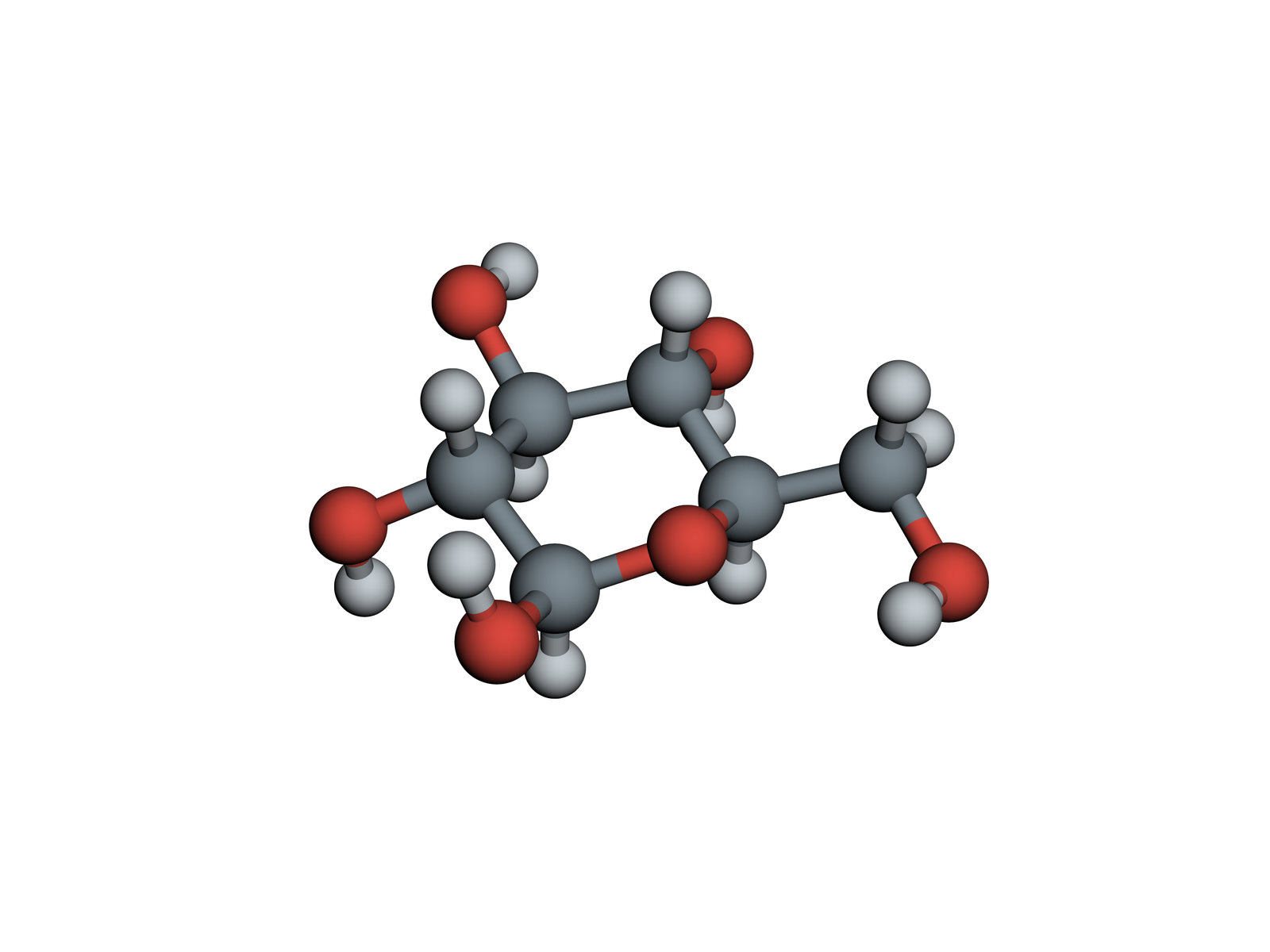
Glucose 3D Structure
The main sugar fuel of cells: six carbons, five of them closed into a ring with an oxygen, and a hydroxyl group on almost every carbon.
Glucose is the main fuel carried in the blood and the starting point of glycolysis. In water almost all of it is a six-membered ring, which forms when the oxygen at carbon 5 bonds to carbon 1. This is beta-D-glucose, the form with the hydroxyl at carbon 1 on the same side as carbon 6, which makes up about two thirds of glucose in solution.
Also called β-D-glucose, Dextrose or Blood sugar.
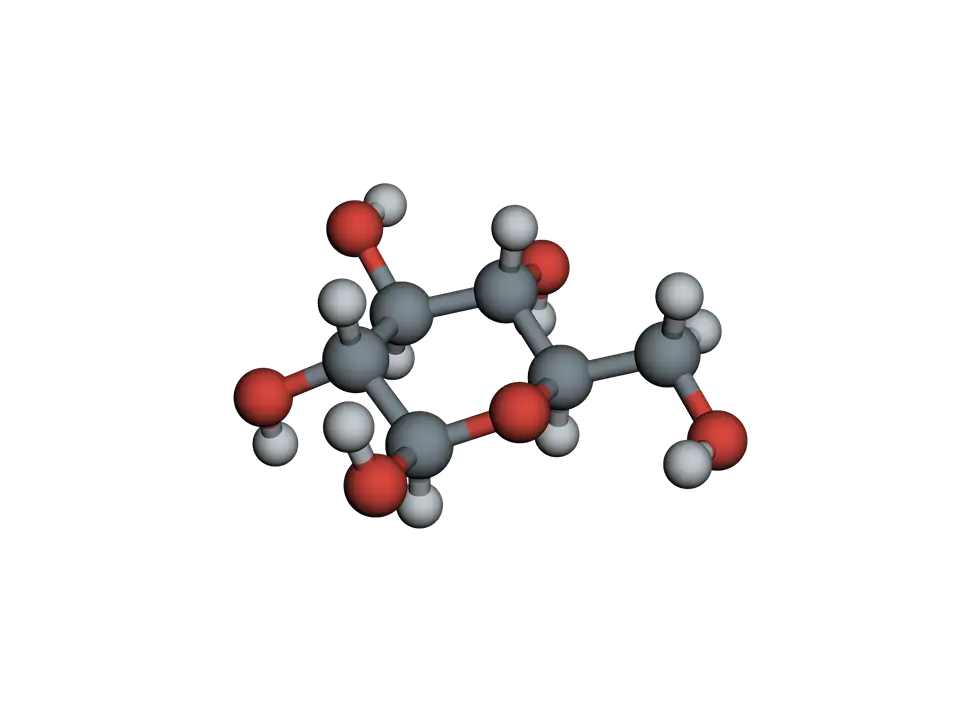
View 1 of 5
A ring of six atoms
Glucose, C6H12O6, is a hexose: a sugar with six carbons. In water nearly every molecule is in a ring form; well under one in a hundred is the open chain that textbooks often draw first.
Use ← and → to move between views. Drag the molecule to turn it; on a touch screen, press Turn it first.
View 1 of 5: A ring of six atoms
Download the pictureDownload the atoms (SDF)Checked against its sources on 25 October 2026.
View by view
The Glucose structure, explained
01A ring of six atoms
Glucose, C6H12O6, is a hexose: a sugar with six carbons. In water nearly every molecule is in a ring form; well under one in a hundred is the open chain that textbooks often draw first.
02A chair, not a flat hexagon
The ring of five carbons and an oxygen puckers into a chair, the shape that keeps its bonds at their natural angles. Drawn flat, as a Haworth projection, it hides this shape.
03How the ring closes
In the open chain, carbon 1 is an aldehyde. The hydroxyl oxygen of carbon 5 bonds to it, and the aldehyde oxygen becomes a new hydroxyl on carbon 1. The ring can open and close again in water, which is how alpha and beta change into each other.
04Beta: carbon 1's hydroxyl
In beta-D-glucose the hydroxyl on carbon 1 sits on the same side of the ring as carbon 6. In alpha it sits on the other side. Starch and glycogen are built of alpha glucose; cellulose is built of beta glucose, and human enzymes cannot break its links.
05Every group points outwards
In the chair of beta-D-glucose, every hydroxyl and the CH2OH group points outwards round the ring's edge, in equatorial positions, where they crowd each other least. This makes beta-D-glucose unusually stable among sugars.
Parts
What each part does
- Pyranose ring
- Five carbons and one oxygen in a six-membered ring, named after pyran. It is not flat but puckered into a chair.
- Ring oxygen
- The oxygen that was the hydroxyl of carbon 5 in the open chain. Bonding to carbon 1 closes the ring.
- Carbon 1, the anomeric carbon
- The carbon that was the aldehyde of the open chain. It carries the hydroxyl that decides alpha or beta, and it is the carbon that forms glycosidic bonds to other sugars.
- Hydroxyl groups
- Five OH groups, one on every carbon except carbon 5, which holds the ring oxygen. They form hydrogen bonds with water, which is why glucose dissolves so well.
- Carbon 6
- The CH2OH group outside the ring. In D-glucose drawn in the usual way it points up, and beta means the hydroxyl at carbon 1 points up too.
The structure
Where these atoms come from
- Compound
- PubChem CID 64689
- Formula
- C₆H₁₂O₆
- Molar mass
- 180.16 g/mol
- Atoms shown
- 24, hydrogens included
- IUPAC name
- (2R,3R,4S,5S,6R)-6-(hydroxymethyl)oxane-2,3,4,5-tetrol
- InChIKey
- WQZGKKKJIJFFOK-VFUOTHLCSA-N
Coordinates from PubChem's computed 3D model, in the public domain. The model is one low-energy shape of the molecule; in water it flexes and turns about its single bonds.
Dictionary
The terms to know
Practise it
The quizzes and cards that fit
- Biochemistry quizzes
- Photosynthesis and Cellular Respiration15 questions
- Molarity and Dilutions15 questions
- ATP and Cellular Energy15 questions
- Physiology quizzes
- Exercise Physiology15 questions
- Puberty15 questions
- Blood Clotting15 questions
- Biochemistry flashcards
The subject's terms as a ready-made deck, free to flip through.
See it at work
Diagrams it belongs to
Next to it
More molecules
Sources
Where the facts come from
- PubChem: beta-D-Glucose (CID 64689)
- StatPearls: Physiology, Glucose (NCBI Bookshelf)
- Essentials of Glycobiology, 4th edition: Monosaccharide Diversity (NCBI Bookshelf)
Written by biofideX from these sources. Drawn with 3Dmol.js (Rego and Koes, Bioinformatics 2015).