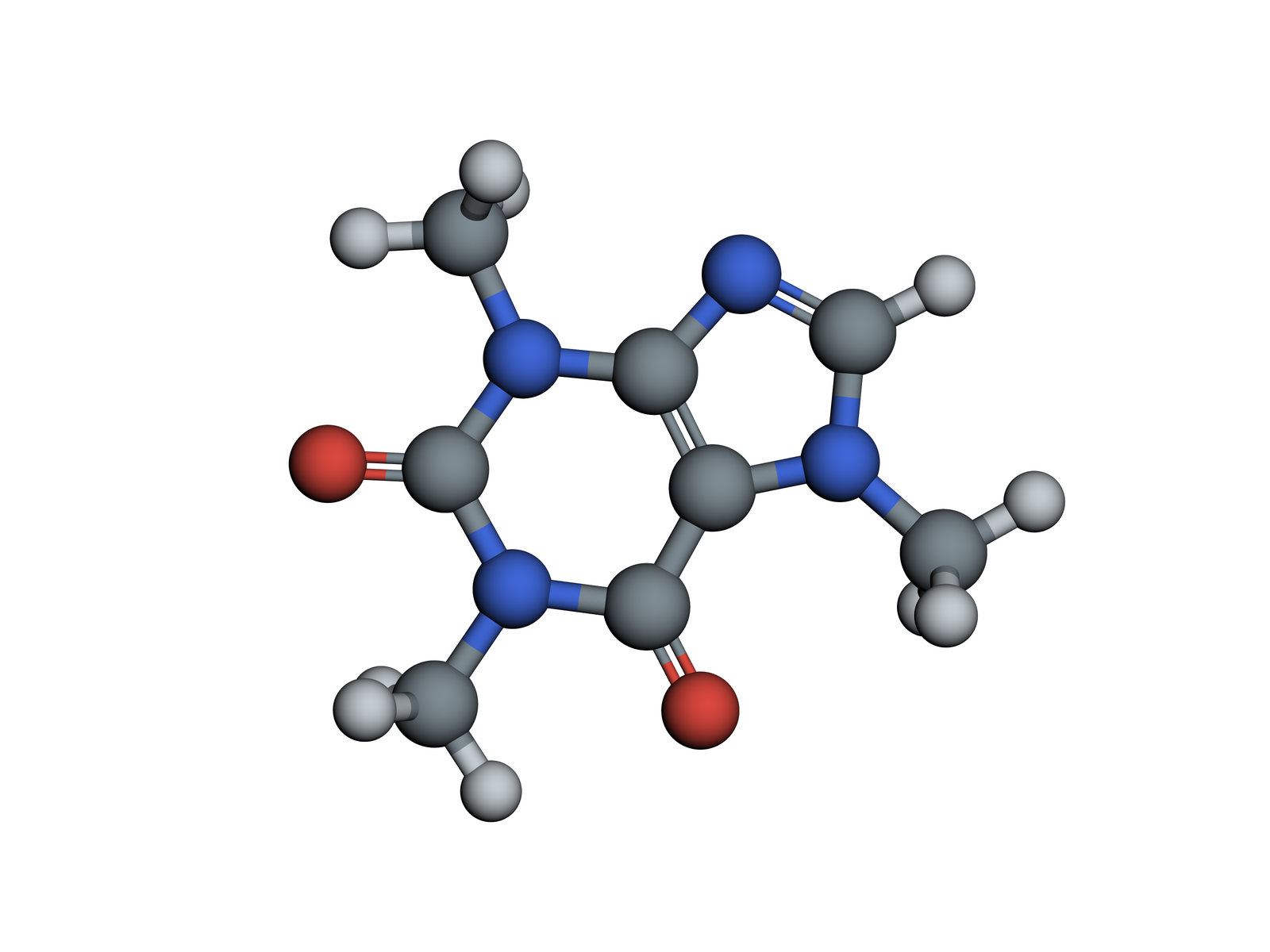
Caffeine 3D Structure
The stimulant in coffee and tea: a flat purine with three methyl groups, close enough in shape to adenosine to block its receptors.
Caffeine is the most widely used drug that acts on the brain. Plants such as coffee, tea and cacao make it, and in people it keeps drowsiness at bay by blocking the receptors of adenosine, a signal that builds up during waking hours. Chemically it is a xanthine, a purine like the adenine of DNA, with methyl groups on three of its nitrogens.
Also called 1,3,7-Trimethylxanthine.
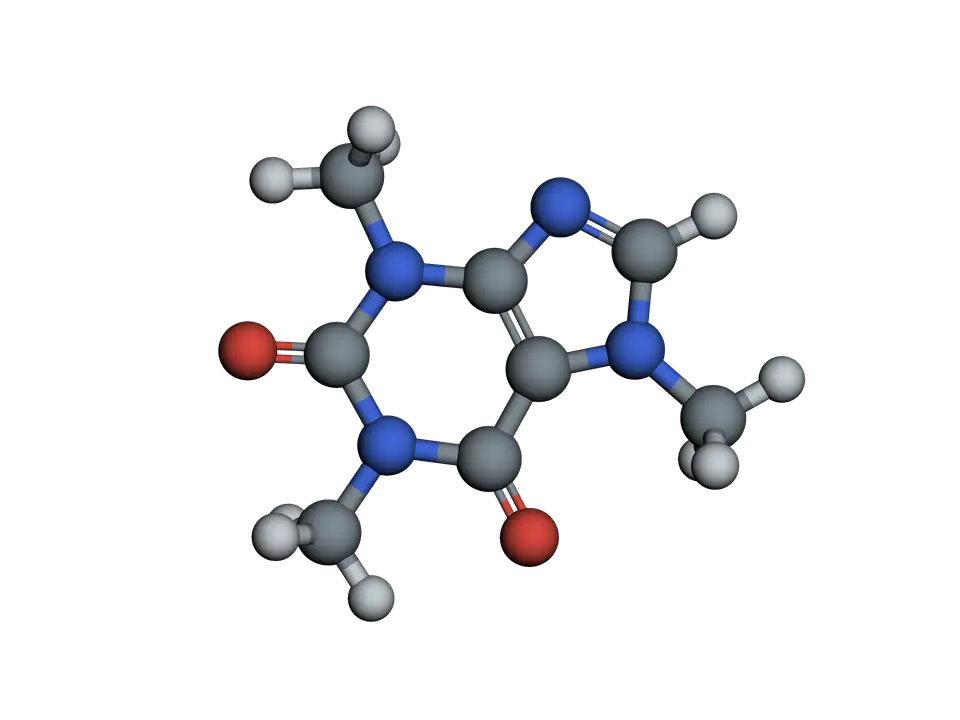
View 1 of 5
A flat purine
Caffeine is small, 194 daltons, and almost flat: two fused rings with two oxygens and three methyl groups. It dissolves in water and in fats, so it spreads through the body and into the brain within an hour of a cup of coffee.
Use ← and → to move between views. Drag the molecule to turn it; on a touch screen, press Turn it first.
View 1 of 5: A flat purine
Download the pictureDownload the atoms (SDF)Checked against its sources on 25 October 2026.
View by view
The Caffeine structure, explained
01A flat purine
Caffeine is small, 194 daltons, and almost flat: two fused rings with two oxygens and three methyl groups. It dissolves in water and in fats, so it spreads through the body and into the brain within an hour of a cup of coffee.
02Two rings, like adenine
The fused six- and five-membered rings are a purine skeleton, the same as adenine and guanine. Caffeine's rings carry two oxygens, which makes it a xanthine.
03Three methyl groups
Caffeine is 1,3,7-trimethylxanthine. Remove one methyl and it becomes paraxanthine, theophylline or theobromine, the three the liver makes from it. Theobromine is also the main alkaloid of cocoa.
04Why it keeps you awake
Adenosine builds up in the brain while you are awake and slows nerve cells through its receptors, which makes you feel tired. Caffeine fits the same receptors, mainly the A1 and A2A types, without switching them on, so it blocks part of adenosine's effect.
05How long it lasts
In healthy adults about half of a dose is cleared in roughly five hours, though this varies widely. Smoking speeds it up; pregnancy and some drugs slow it down, and newborns clear it very slowly, which is why caffeine citrate given to premature babies lasts so long.
Parts
What each part does
- Six-membered ring
- Four carbons and two nitrogens, the pyrimidine half of the purine. Its two carbonyl oxygens are what make caffeine a xanthine.
- Five-membered ring
- Three carbons and two nitrogens, the imidazole half of the purine, sharing one edge with the six-membered ring.
- Carbonyl oxygens
- Two oxygens double bonded to carbons 2 and 6 of the purine. Adenine has an amino group where carbon 6 carries this oxygen.
- Methyl groups
- Three CH3 groups on nitrogens 1, 3 and 7: the 1,3,7-trimethyl of its chemical name. The liver removes them one at a time, mostly by the enzyme CYP1A2.
The structure
Where these atoms come from
- Compound
- PubChem CID 2519
- Formula
- C₈H₁₀N₄O₂
- Molar mass
- 194.19 g/mol
- Atoms shown
- 24, hydrogens included
- IUPAC name
- 1,3,7-trimethylpurine-2,6-dione
- InChIKey
- RYYVLZVUVIJVGH-UHFFFAOYSA-N
Coordinates from PubChem's computed 3D model, in the public domain. The model is one low-energy shape of the molecule; in water it flexes and turns about its single bonds.
Dictionary
The terms to know
Practise it
The quizzes and cards that fit
- Pharmacology quizzes
- Medication Administration15 questions
- Psychiatric Medications15 questions
- Common Drug Classes15 questions
- Neuroscience quizzes
- Reflex Arc15 questions
- Spinal Cord15 questions
- Cognitive Neuroscience: Language & Lateralization15 questions
- Pharmacology flashcards
The subject's terms as a ready-made deck, free to flip through.
Next to it
More molecules
Sources
Where the facts come from
Written by biofideX from these sources. Drawn with 3Dmol.js (Rego and Koes, Bioinformatics 2015).