Aspirin 3D Structure
A painkiller that works by giving away part of itself: aspirin hands its acetyl group to the enzyme that makes prostaglandins, and stops it for good.
Aspirin eases pain, fever and inflammation, and in low doses it helps prevent heart attacks and strokes. It is salicylic acid, which the body makes from the salicin of willow bark, with an acetyl group added; it was first made as a medicine in 1897. Other non-steroidal anti-inflammatory drugs, such as ibuprofen, block the cyclooxygenase enzymes for a while; aspirin blocks them permanently.
Also called Acetylsalicylic acid or ASA.
View 1 of 5
A small acid with a spare part
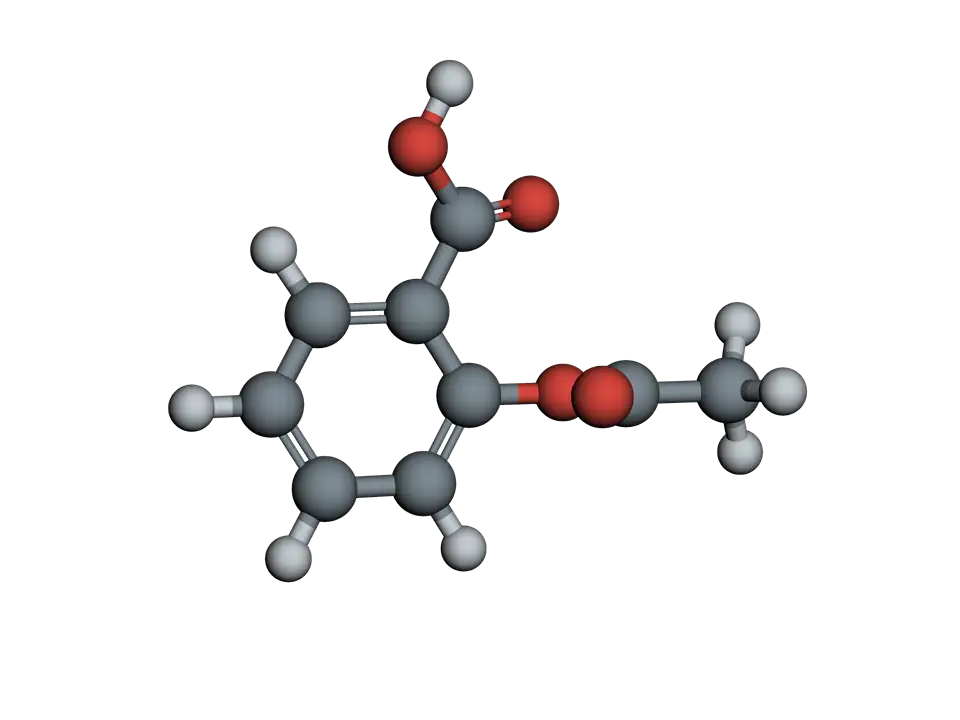
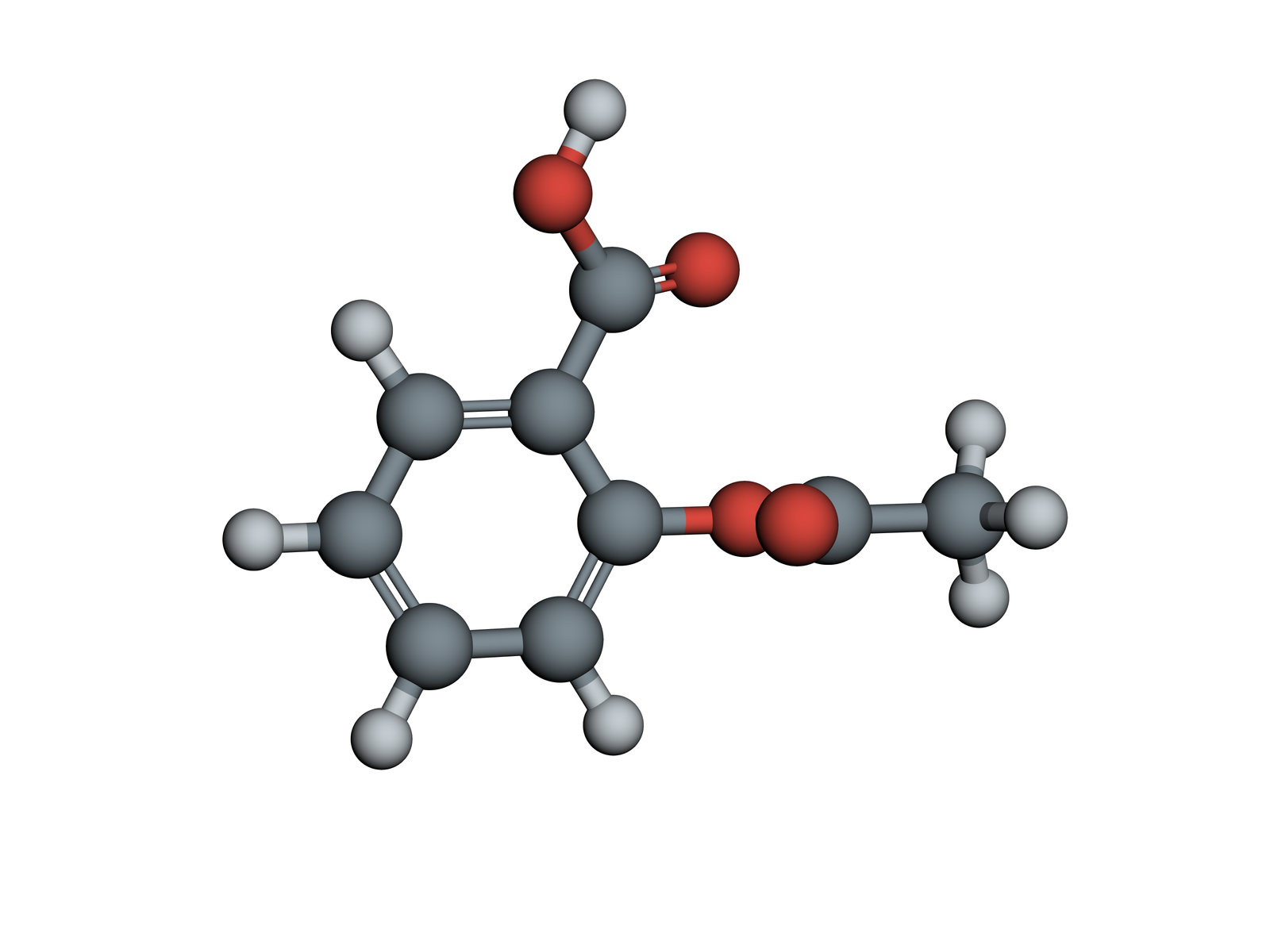
Aspirin, C9H8O4, is a benzene ring with two groups side by side: a carboxylic acid and an acetyl group held on through an oxygen. Its chemical name, acetylsalicylic acid, says exactly that.
Use ← and → to move between views. Drag the molecule to turn it; on a touch screen, press Turn it first.
View 1 of 5: A small acid with a spare part
Download the pictureDownload the atoms (SDF)Checked against its sources on 25 October 2026.
View by view
The Aspirin structure, explained
01A small acid with a spare part
Aspirin, C9H8O4, is a benzene ring with two groups side by side: a carboxylic acid and an acetyl group held on through an oxygen. Its chemical name, acetylsalicylic acid, says exactly that.
02The acid end
The carboxylic acid lets aspirin dissolve in the blood as a negative ion, and helps it bind in the channel of the cyclooxygenase enzyme that leads to its active site.
03The part it gives away
In the enzyme, aspirin passes its acetyl group to a serine near the active site, serine 530 in COX-1 by the usual sheep-enzyme numbering (529 in the human sequence). The acetyl blocks the channel, so arachidonic acid can no longer reach the site and be turned into prostaglandins.
04What is left
Once the acetyl group is gone, what remains is salicylic acid. The body also makes it from aspirin within minutes, by enzymes in the blood and liver, so salicylic acid carries much of aspirin's effect on pain and fever.
05Why a low dose protects the heart
Platelets have no nucleus, so they cannot make new cyclooxygenase. One dose of aspirin stops a platelet from making thromboxane A2, which makes platelets clump together, for the rest of its life, about 7 to 10 days. That is why a low daily dose lowers the risk of clots in arteries, at the cost of more bleeding.
Parts
What each part does
- Benzene ring
- Six carbons in a flat ring, with two groups on neighbouring carbons. The ring is the part aspirin shares with salicylic acid and its other relatives.
- Carboxylic acid
- A COOH group, which makes aspirin an acid. In the stomach it is mostly uncharged and passes into the cells of the stomach lining, one reason aspirin can irritate and damage it.
- Ester oxygen
- The oxygen that joins the acetyl group to the ring, where salicylic acid has a hydroxyl. The bond from it to the acetyl group is the one that breaks.
- Acetyl group
- CH3CO: the part aspirin gives away. Without it aspirin is salicylic acid, which eases pain and inflammation too but does not block cyclooxygenase permanently.
The structure
Where these atoms come from
- Compound
- PubChem CID 2244
- Formula
- C₉H₈O₄
- Molar mass
- 180.16 g/mol
- Atoms shown
- 21, hydrogens included
- IUPAC name
- 2-acetyloxybenzoic acid
- InChIKey
- BSYNRYMUTXBXSQ-UHFFFAOYSA-N
Coordinates from PubChem's computed 3D model, in the public domain. The model is one low-energy shape of the molecule; in water it flexes and turns about its single bonds.
Dictionary
The terms to know
Practise it
The quizzes and cards that fit
- Pharmacology quizzes
- Medication Administration15 questions
- Psychiatric Medications15 questions
- Common Drug Classes15 questions
- Pharmacology flashcards
The subject's terms as a ready-made deck, free to flip through.
- aspirin drug card
An NSAID that eases pain and fever at higher doses and, at low dose, stops platelets clumping to prevent heart attack and stroke.
Next to it
More molecules
Sources
Where the facts come from
- PubChem: Aspirin (CID 2244)
- StatPearls: Salicylic Acid (Aspirin) (NCBI Bookshelf)
- Loll, Picot and Garavito, The structural basis of aspirin activity inferred from the crystal structure of inactivated prostaglandin H2 synthase, Nat Struct Biol 1995
Written by biofideX from these sources. Drawn with 3Dmol.js (Rego and Koes, Bioinformatics 2015).