Insulin 3D Structure
The hormone that lowers blood glucose: a small protein of 51 amino acids in two chains, A and B, joined by disulfide bonds.
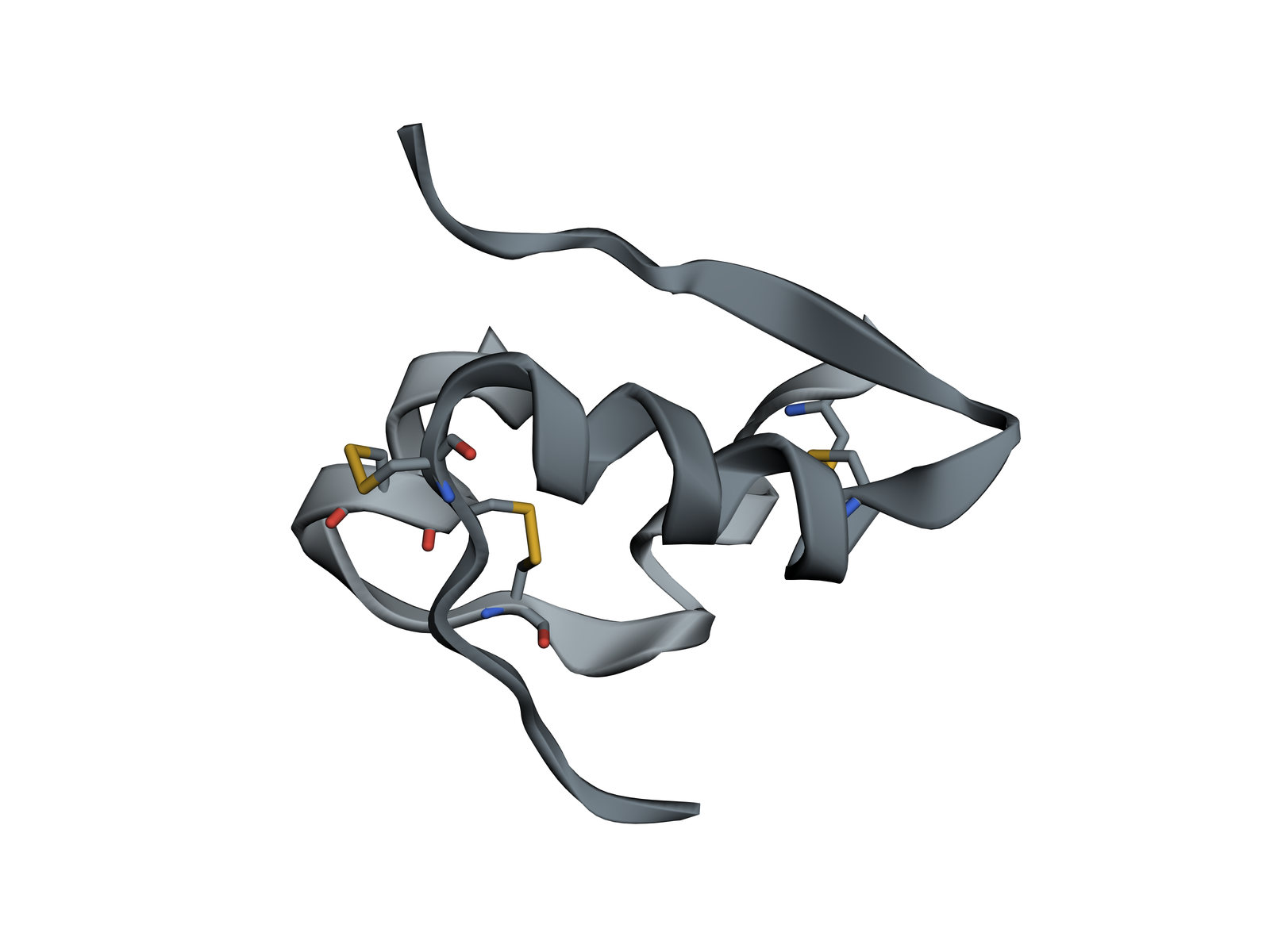
Insulin is made by the beta cells of the pancreas and released when blood glucose rises. It tells muscle, fat and liver cells to take up glucose and store fuel. Its two chains are cut from one longer chain, proinsulin, and held together by two disulfide bonds, with a third inside the A chain. This structure of human insulin was solved at 1.0 Å, fine enough to place almost every atom.
Also called Human insulin.
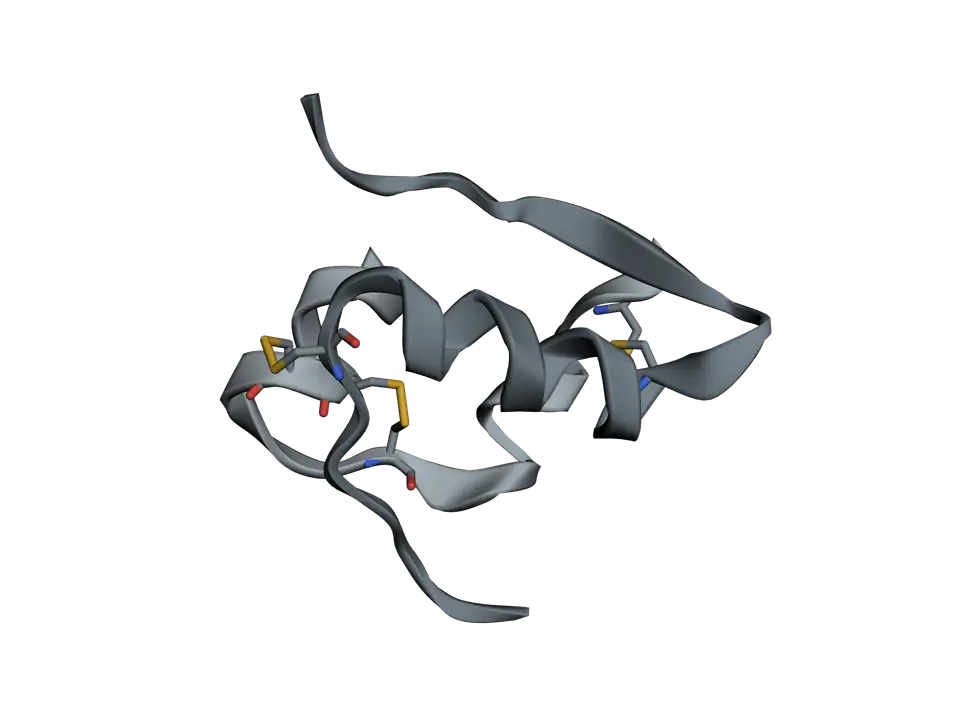
View 1 of 6
A small protein in two chains
Human insulin is 51 amino acids, in two chains: A, of 21, and B, of 30. Insulin was the first protein whose full sequence was worked out, by Frederick Sanger in the 1950s, using cattle insulin. Human insulin was sequenced in 1960.
Use ← and → to move between views. Drag the molecule to turn it; on a touch screen, press Turn it first.
View 1 of 6: A small protein in two chains
Download the pictureDownload the atoms (PDB)Checked against its sources on 25 October 2026.
View by view
The Insulin structure, explained
01A small protein in two chains
Human insulin is 51 amino acids, in two chains: A, of 21, and B, of 30. Insulin was the first protein whose full sequence was worked out, by Frederick Sanger in the 1950s, using cattle insulin. Human insulin was sequenced in 1960.
02The A chain
The A chain folds into two short helices joined by a turn. A disulfide bond within the chain, between cysteines A6 and A11, holds the turn closed.
03The B chain
The B chain has one long central helix. Parts of this helix, of the B chain's tail and of both ends of the A chain together make the surface that binds the insulin receptor.
04Three disulfide bonds
Insulin starts as one chain, proinsulin, which folds and forms its disulfide bonds before a middle stretch, the C-peptide, is cut out. The two bonds between the chains, A7 to B7 and A20 to B19, are what keep A and B together afterwards.
05Stored in sixes, active alone
Beta cells store insulin as hexamers: the ends of the B chains pair two insulins into a dimer, and three dimers gather round two zinc ions. Released into the blood, the hexamers fall apart, and single molecules bind the receptor.
06Changed by design
Insulin drugs change a few amino acids to alter how fast it acts. Insulin lispro swaps proline B28 and lysine B29, so it forms dimers and hexamers less readily and is absorbed faster after injection, which suits a dose at mealtime.
Parts
What each part does
- A chain
- 21 amino acids, folded into two short helices that lie side by side. It starts with glycine and ends with asparagine.
- B chain
- 30 amino acids, with one long central helix. Its last few amino acids form a strand that pairs with the same strand of a second insulin, making a dimer.
- Disulfide bonds
- Six cysteines make three disulfide bonds: two join the chains (A7 to B7 and A20 to B19) and one closes a loop within the A chain (A6 to A11).
- B chain helix
- The central helix of the B chain, from about B9 to B19. The A chain packs against it, and between them they bury a small core of water-repelling side chains.
- End of the B chain
- B24 to B30. In the pancreas this strand joins two insulins into a dimer, and three dimers gather round zinc ions into the hexamer insulin is stored as.
- Proline B28 and lysine B29
- Swapped in insulin lispro. The swap weakens the contacts between insulins, so the drug breaks up into single molecules faster after injection and acts sooner.
The structure
Where these atoms come from
- Structure
- PDB 1MSO
- What it is
- Human insulin, T6 form
- Organism
- Homo sapiens
- Method
- X-ray diffraction, 1 Å resolution
- Deposited
- 2002
- Atoms shown
- 405, without water or hydrogens
Coordinates from the Protein Data Bank, free of all copyright (CC0). Water and hydrogens are left out, and the molecule is turned to face you; every atom is where the experiment placed it.
Dictionary
The terms to know
Practise it
The quizzes and cards that fit
- Physiology quizzes
- Exercise Physiology15 questions
- Puberty15 questions
- Blood Clotting15 questions
- Biochemistry quizzes
- Photosynthesis and Cellular Respiration15 questions
- Molarity and Dilutions15 questions
- ATP and Cellular Energy15 questions
- Pharmacology quizzes
- Medication Administration15 questions
- Psychiatric Medications15 questions
- Common Drug Classes15 questions
- Physiology flashcards
The subject's terms as a ready-made deck, free to flip through.
- regular insulin drug card
Short-acting recombinant human insulin, injected before meals or given by IV infusion in hospital, as in diabetic ketoacidosis.
- insulin lispro drug card
A rapid-acting insulin analogue taken just before or right after meals, or used in insulin pumps, for type 1 and type 2 diabetes.
- insulin glargine drug card
A long-acting insulin analogue injected once daily as basal (background) insulin for type 1 and type 2 diabetes.
Next to it
More molecules
Sources
Where the facts come from
- RCSB Protein Data Bank: 1MSO, T6 human insulin at 1.0 Å resolution
- Smith and others, The structure of T6 human insulin at 1.0 Å resolution, Acta Crystallogr D 2003
- Nicol and Smith, Amino-acid sequence of human insulin, Nature 1960
- PDB-101 Molecule of the Month: Insulin
- StatPearls: Biochemistry, Insulin Metabolic Effects (NCBI Bookshelf)
Written by biofideX from these sources. Drawn with 3Dmol.js (Rego and Koes, Bioinformatics 2015).