Action Potential Diagram
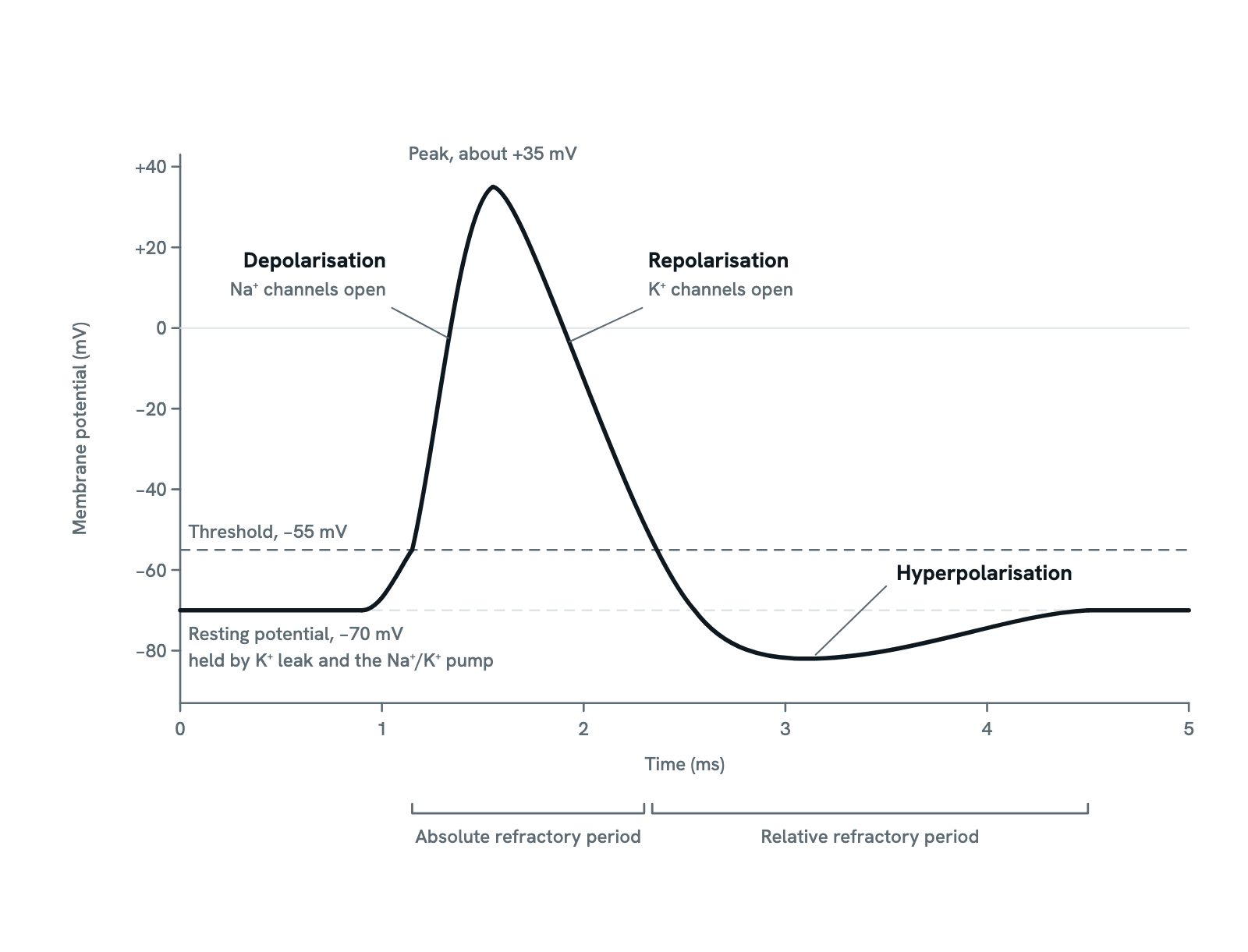
How a neuron fires: from rest at −70 mV to threshold, sodium rushing in, potassium flowing out, the undershoot and back, the spike itself over in 1 to 2 ms.
An action potential is the brief electrical signal a neuron sends along its axon. This graph follows the voltage across one patch of membrane as the signal passes, phase by phase, with the ion channels that cause each phase. The numbers are those of a typical neuron; they vary from cell to cell.
Also called Nerve impulse or Spike.
Step 1 of 9
The action potential at a glance
The graph shows the voltage across a neuron's membrane as an action potential passes: a fast rise and fall that take only 1 to 2 milliseconds, then a brief dip below rest that lasts a few milliseconds more. Sodium flowing in causes the rise; potassium flowing out causes the fall.
Use ← and → to move between steps.
Step 1 of 9: The action potential at a glance
Download the diagramChecked against its sources on 25 October 2026.
Step by step
The steps of the Action Potential
01The action potential at a glance
The graph shows the voltage across a neuron's membrane as an action potential passes: a fast rise and fall that take only 1 to 2 milliseconds, then a brief dip below rest that lasts a few milliseconds more. Sodium flowing in causes the rise; potassium flowing out causes the fall.
02Resting potential
At rest the inside of the neuron is about −70 mV relative to the outside. Potassium leaks out through channels that are always open, and the sodium-potassium pump keeps the gradients, moving 3 Na⁺ out for every 2 K⁺ in.
03A stimulus reaches threshold
Input from other neurons makes the inside less negative. If it reaches threshold, about −55 mV, enough voltage-gated sodium channels open to start an action potential. Below threshold nothing follows, so the signal is all or none.
04Depolarisation: sodium rushes in
Voltage-gated sodium channels open, and Na⁺ rushes in down its gradient. Each opening depolarises the membrane further and opens more channels, so the potential shoots up to about +35 mV in under a millisecond.
05The peak
Within about a millisecond the sodium channels close by inactivation, and voltage-gated potassium channels, which respond more slowly, open. The rise stops at about +30 to +40 mV.
06Repolarisation: potassium flows out
With the potassium channels open, K⁺ flows out of the cell, and the potential falls back towards rest.
07Hyperpolarisation: the undershoot
The potassium channels close slowly, so for a moment more K⁺ leaves than at rest and the membrane dips below −70 mV, to about −80 mV.
08The refractory periods
While the sodium channels are inactivated, no stimulus can fire another action potential: the absolute refractory period. During the undershoot only a stronger stimulus than usual can: the relative refractory period. This is why the signal travels one way along the axon.
09Back to rest
As the potassium channels close, the leak channels bring the membrane back to rest, ready to fire again; the pump works over the long run, not spike by spike. The signal has moved on to the next patch of membrane along the axon.
Parts
What each part of the action potential does
- Resting potential
- About −70 mV inside compared with outside. Potassium leaks out through channels that are always open, leaving the inside negative.
- Sodium-potassium pump
- Moves 3 Na⁺ out for every 2 K⁺ it brings in, using ATP. It keeps the concentration gradients that every action potential runs on.
- Threshold
- About −55 mV. A stimulus that brings the membrane this far opens enough sodium channels to set off an action potential; a smaller one dies away.
- Depolarisation
- The fast rise, as sodium ions rush in through voltage-gated sodium channels and the inside turns positive.
- Voltage-gated sodium channels
- Open quickly when the membrane reaches threshold, then shut by an inactivation gate within about a millisecond, and cannot open again until the membrane is back near rest.
- Peak
- About +30 to +40 mV, as the sodium channels close and the potassium channels open.
- Repolarisation
- The fall, as potassium ions flow out through voltage-gated potassium channels and the inside turns negative again.
- Voltage-gated potassium channels
- Open more slowly than the sodium channels, at about the time of the peak, and close slowly, which causes the undershoot.
- Hyperpolarisation
- The undershoot below rest, to about −80 mV, while the slow potassium channels are still open.
- Refractory periods
- In the absolute refractory period no stimulus can fire the cell again; in the relative one only a stronger stimulus than usual can. This keeps the signal moving one way.
Dictionary
The terms to know
Practise it
The quizzes and cards that fit
- Neuroscience quizzes
- Reflex Arc15 questions
- Spinal Cord15 questions
- Cognitive Neuroscience: Language & Lateralization15 questions
- Physiology quizzes
- Exercise Physiology15 questions
- Puberty15 questions
- Blood Clotting15 questions
- Neuroscience flashcards
The subject's terms as a ready-made deck, free to flip through.
In 3D
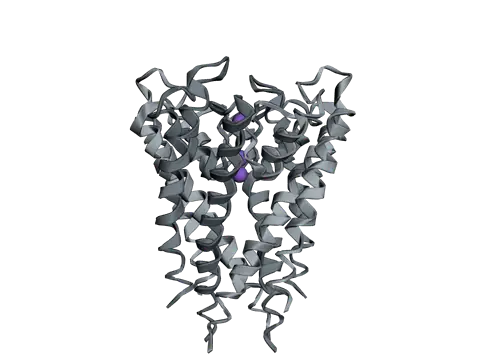
The molecules, to turn and explore
Next to it
More diagrams
Sources
Where the facts come from
- StatPearls: Physiology, Action Potential (NCBI Bookshelf)
- Purves and others, Neuroscience, 2nd edition: Electrical Signals of Nerve Cells (NCBI Bookshelf)
- Purves and others, Neuroscience, 2nd edition: Voltage-Dependent Membrane Permeability (NCBI Bookshelf)
Drawn and written by biofideX from these sources.