DNA Replication Diagram
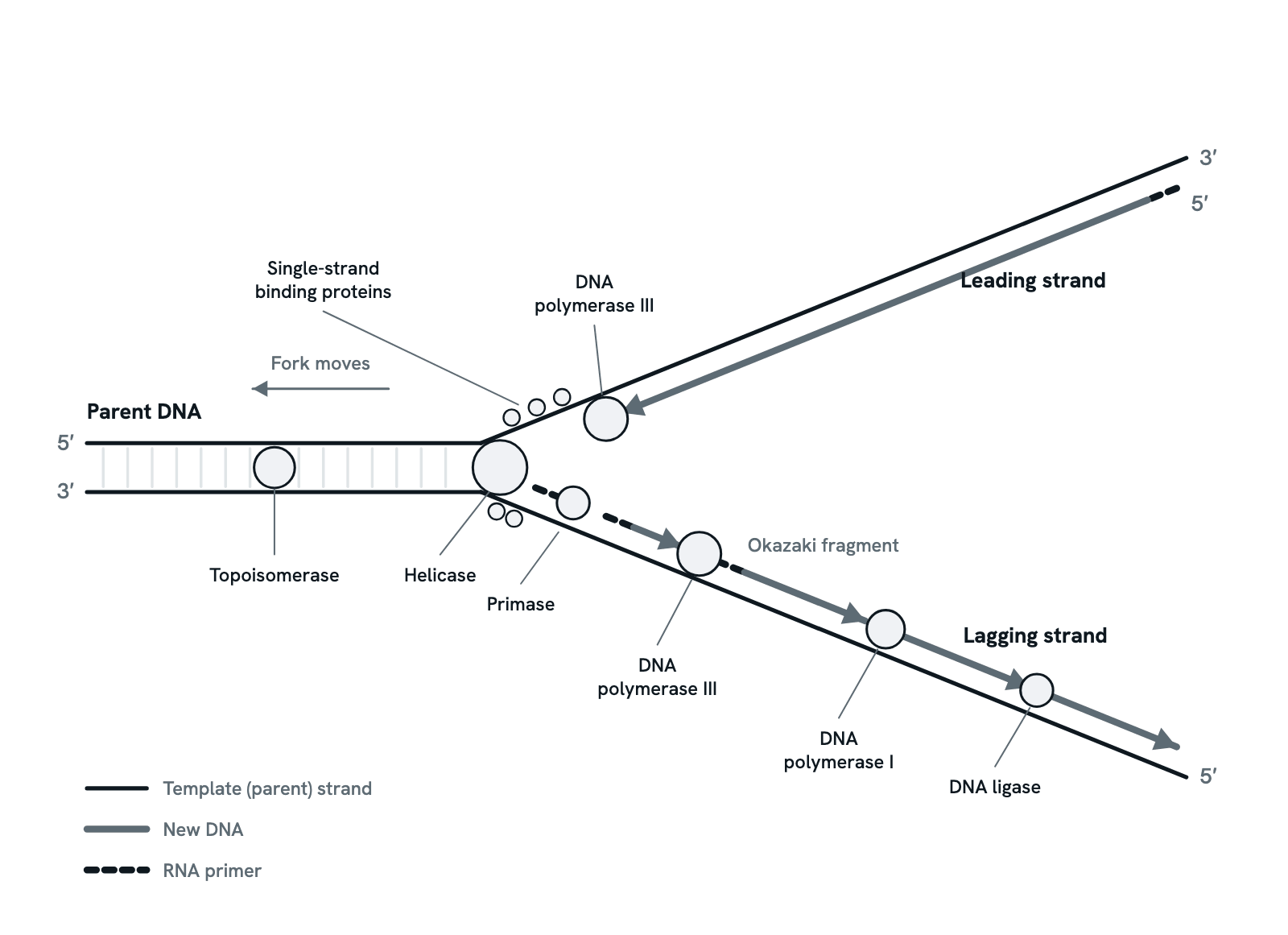
How a replication fork copies DNA: helicase opens the helix, primase lays primers, and DNA polymerase builds a leading and a lagging strand.
Before a cell divides, it copies every chromosome. At each replication fork the two strands of the double helix are pulled apart, and each becomes the template for a new one. This is the fork as it works in a bacterium such as E. coli; eukaryotes do the same with their own versions of most of these enzymes.
Also called Replication fork or DNA synthesis.
Step 1 of 10
The fork at a glance
DNA is copied at a replication fork, where the double helix is opened and each parent strand becomes the template for a new one. DNA polymerase can only build a strand 5′ to 3′, and the two templates run in opposite directions, so one new strand is made in one piece and the other in short fragments.
Use ← and → to move between steps.
Step 1 of 10: The fork at a glance
Download the diagramChecked against its sources on 25 October 2026.
Step by step
The steps of the DNA Replication
01The fork at a glance
DNA is copied at a replication fork, where the double helix is opened and each parent strand becomes the template for a new one. DNA polymerase can only build a strand 5′ to 3′, and the two templates run in opposite directions, so one new strand is made in one piece and the other in short fragments.
02Helicase opens the double helix
Helicase moves along the DNA and unwinds it, using ATP to break the hydrogen bonds between base pairs. The two strands part into the arms of the fork.
03Topoisomerase relieves the strain
Unwinding one part of the helix overwinds the part ahead of it. A topoisomerase, in bacteria mainly DNA gyrase, cuts the DNA backbone, lets the twist out and joins it again, so the fork can keep moving.
04Single strands are held apart
Single-strand binding proteins coat the separated strands, so they do not snap back together or fold up on themselves before they are copied.
05Primase lays RNA primers
DNA polymerase cannot start a strand from nothing; it needs an end to add to. Primase makes a short RNA primer, about 10 nucleotides long, on the template. The leading strand needs one; the lagging strand needs one for every fragment.
06The leading strand is made in one piece
On the upper template, DNA polymerase III adds nucleotides to the 3′ end of the primer in the same direction as the fork moves. It can follow the fork all the way, so the leading strand grows continuously.
07The lagging strand is made in fragments
The lower template runs the other way, so its new strand has to be built away from the fork. DNA polymerase III makes it in short Okazaki fragments, each from its own primer, starting again as the fork opens more template.
08Primers are swapped for DNA
When a fragment reaches the primer of the one before it, DNA polymerase I takes over. It removes the RNA primer a nucleotide at a time and fills the gap with DNA.
09DNA ligase joins the fragments
A nick is left in the backbone where two fragments meet. DNA ligase seals it by forming the missing phosphodiester bond, so the lagging strand becomes one continuous strand.
10Two helices, each half old and half new
Each new double helix has one parent strand and one new strand, so replication is semiconservative. The polymerases proofread as they go, and mismatch repair checks the new strand afterwards; together they leave about one error in a billion bases.
Parts
What each part of the dna replication does
- Parent DNA
- The double helix being copied. Its two strands run in opposite directions (antiparallel), and each is read as a template for a new strand.
- Replication fork
- The Y-shaped region where the helix is being opened and copied. Forks move away from each origin of replication in both directions.
- Helicase
- Unwinds the double helix at the fork, using energy from ATP to break the hydrogen bonds between the base pairs.
- Topoisomerase
- Works ahead of the fork, where unwinding twists the DNA tighter. It cuts the backbone, lets the strain out and joins it again. In bacteria it is mainly DNA gyrase.
- Single-strand binding proteins
- Coat the opened single strands so they do not pair up again or fold back on themselves before they are copied.
- Primase
- Makes the short RNA primers that every new strand starts from, since DNA polymerase can only add to an existing end.
- RNA primer
- A short stretch of RNA, about 10 nucleotides long, that gives DNA polymerase a 3′ end to build from. Each is later replaced with DNA.
- DNA polymerase III
- The main copying enzyme of bacteria. It adds nucleotides to the 3′ end of a strand, so it builds 5′ to 3′, and it proofreads as it goes.
- Leading strand
- The new strand made in the same direction as the fork moves, so it can be built continuously from a single primer.
- Lagging strand
- The new strand whose template runs the other way. It is built away from the fork, a fragment at a time, and joined afterwards.
- Okazaki fragment
- One short piece of the lagging strand: about 1,000 to 2,000 nucleotides in bacteria and 100 to 200 in eukaryotes.
- DNA polymerase I
- Removes each RNA primer, a nucleotide at a time, and fills the gap with DNA. In eukaryotes other enzymes, such as RNase H and FEN1, take the primers out.
- DNA ligase
- Seals the nick left between two fragments by forming the last phosphodiester bond in the backbone.
Dictionary
The terms to know
Practise it
The quizzes and cards that fit
- Molecular Biology quizzes
- Epigenetics & Chromatin Remodeling20 questions
- DNA Replication Machinery15 questions
- Recombinant DNA Technology15 questions
- Genetics quizzes
- Incomplete Dominance and Codominance15 questions
- Pedigree Analysis15 questions
- Blood Types15 questions
- Cell Biology quizzes
- Characteristics of Life15 questions
- Lab Safety15 questions
- Cell Theory15 questions
- Molecular Biology flashcards
The subject's terms as a ready-made deck, free to flip through.
In 3D
The molecules, to turn and explore
Next to it
More diagrams
Sources
Where the facts come from
- Alberts and others, Molecular Biology of the Cell, 4th edition: DNA Replication Mechanisms (NCBI Bookshelf)
- Cooper, The Cell: A Molecular Approach, 2nd edition: DNA Replication (NCBI Bookshelf)
- Ashley and others, Activities of gyrase and topoisomerase IV on positively supercoiled DNA, Nucleic Acids Res 2017 (PMC)
Drawn and written by biofideX from these sources.