PCR Diagram
How PCR copies one stretch of DNA: heat the strands apart, cool so primers bind, let Taq build new strands, and repeat until the copies number billions.
The polymerase chain reaction makes millions to billions of copies of one chosen stretch of DNA from a tiny starting amount. A thermal cycler takes the tube through the same three temperatures again and again, and each cycle doubles the copies. Step through one cycle, then what repeating it does.
Also called Polymerase chain reaction.
Step 1 of 7
PCR at a glance
PCR copies one stretch of DNA again and again. Each cycle has three temperatures: hot to separate the strands, cooler for primers to bind, and warm for the polymerase to build new strands. Every cycle doubles the copies.
Use ← and → to move between steps.
Step 1 of 7: PCR at a glance
Download the diagramChecked against its sources on 25 October 2026.
Step by step
The steps of the PCR
01PCR at a glance
PCR copies one stretch of DNA again and again. Each cycle has three temperatures: hot to separate the strands, cooler for primers to bind, and warm for the polymerase to build new strands. Every cycle doubles the copies.
02What goes in the tube
The tube holds the template DNA, two primers, a heat-stable DNA polymerase such as Taq, the four dNTPs, and a buffer with magnesium ions, which the polymerase needs. A thermal cycler then heats and cools it.
03Denaturation at about 95 °C
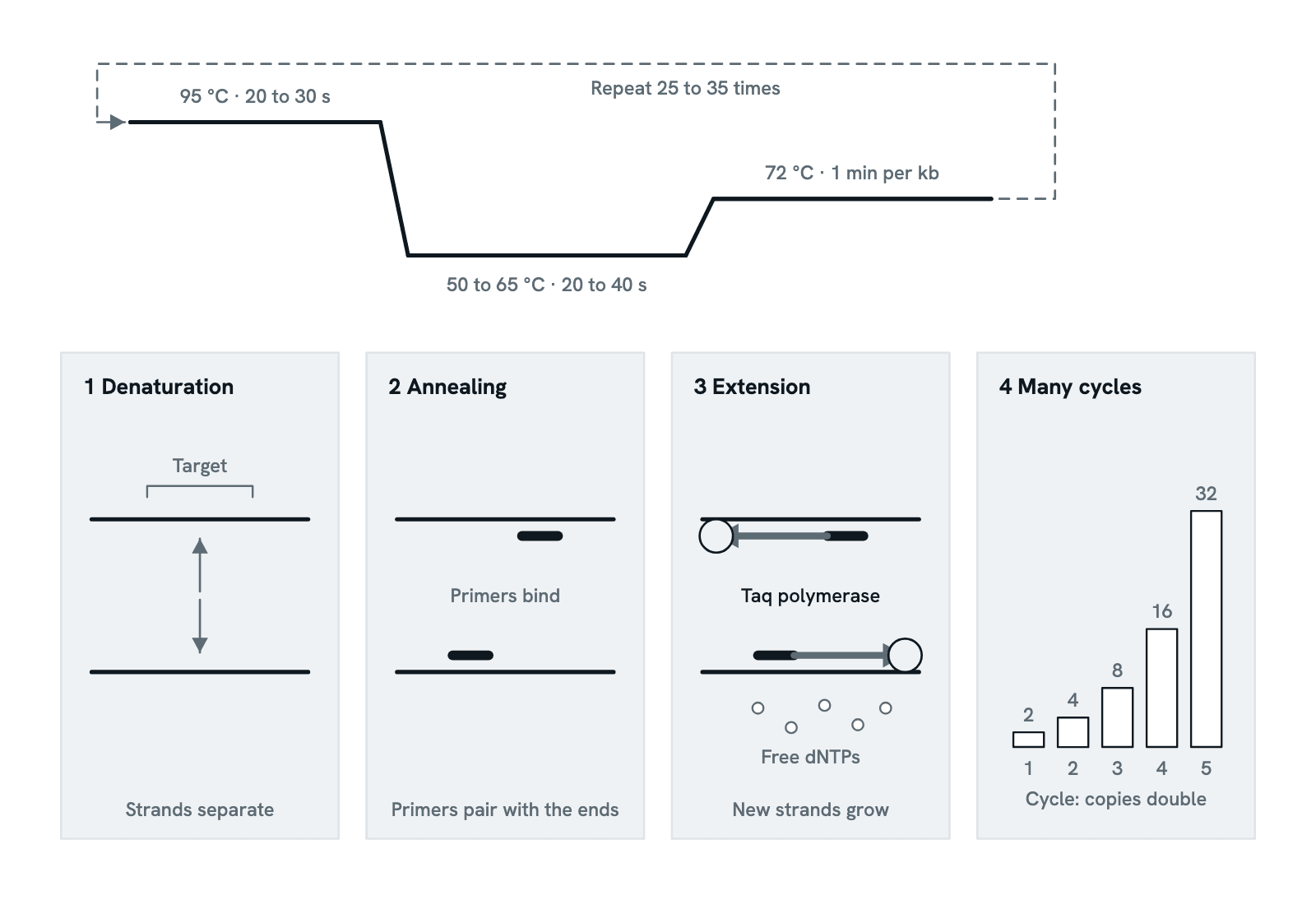
Heating to 94 to 98 °C for 20 to 30 seconds breaks the hydrogen bonds between the two strands, and the double helix separates into single strands. The first cycle often starts with a longer heat, of a few minutes.
04Annealing at about 55 °C
Cooling to about 50 to 65 °C, usually a few degrees below the primers' melting temperature, lets the primers bind to their matching sequences, one at each end of the target and one on each strand.
05Extension at 72 °C
At 72 °C, close to the best temperature for Taq, the polymerase adds dNTPs to the 3′ end of each primer, building a new strand that matches the template. About a minute is allowed for every 1,000 bases.
06Each cycle doubles the copies
Every new strand is a template in the next cycle, so the copies double each time: up to 2ⁿ after n cycles, about a billion after 30. Copies exactly the length of the target first appear in the third cycle and soon make up nearly all the product.
07The end of the run
Late in the run the reaction slows to a plateau: reagents run low, product strands pair with each other, not with primers, and the polymerase loses activity. A final few minutes at 72 °C finish any part-made strands, and the product is usually checked by gel electrophoresis as a band of the expected size.
Parts
What each part of the pcr does
- Template DNA
- The DNA that holds the stretch to be copied. A few nanograms can be enough, since every cycle doubles what there is.
- Target sequence
- The stretch of DNA between the two primers, often a few hundred to a few thousand base pairs long. It is what the reaction copies.
- Primers
- Two short single strands of DNA, usually 18 to 25 nucleotides, made to match the two ends of the target: one for each strand. They decide what gets copied.
- Taq polymerase
- A DNA polymerase from the hot-spring bacterium Thermus aquaticus. It survives the 95 °C steps and works best at about 70 to 80 °C.
- dNTPs
- The four deoxynucleotide triphosphates (dATP, dCTP, dGTP and dTTP), the building blocks the polymerase adds to the growing strands.
- New strands
- Built from each primer's 3′ end, complementary to the template. In later cycles they become templates themselves.
- Denaturation
- At 94 to 98 °C the hydrogen bonds between the strands break, and the double helix separates into two single strands.
- Annealing
- At about 50 to 65 °C, a few degrees below the primers' melting temperature, the primers bind to their matching sequences.
- Extension
- At 72 °C Taq polymerase extends each primer; protocols allow a minute per 1,000 bases.
- Thermal cycle
- One round of the three temperatures, a few minutes long. A thermal cycler repeats it 25 to 35 times.
- Exponential copying
- Each cycle doubles the copies of the target, so n cycles give up to 2ⁿ copies of each template molecule: 30 cycles, about a billion.
Dictionary
The terms to know
Practise it
The quizzes and cards that fit
- Molecular Biology quizzes
- Epigenetics & Chromatin Remodeling20 questions
- DNA Replication Machinery15 questions
- Recombinant DNA Technology15 questions
- Biotechnology quizzes
- Bioethics & Regulatory Affairs10 questions
- Restriction Enzymes & DNA Ligation15 questions
- Plant Biotechnology & GMOs10 questions
- Genetics quizzes
- Incomplete Dominance and Codominance15 questions
- Pedigree Analysis15 questions
- Blood Types15 questions
- Molecular Biology flashcards
The subject's terms as a ready-made deck, free to flip through.
- Primer Tm Calculator and Checker
Melting temperature by the nearest-neighbour method with salt and magnesium corrections, plus GC, runs, hairpins and dimers, and where a pair sits on a template.
- GC Content Calculator
GC content, base counts, length and molecular weight of a DNA or RNA sequence, with GC along the sequence in a sliding window.
In 3D
The molecules, to turn and explore
Next to it
More diagrams
Sources