Chain of Infection Diagram
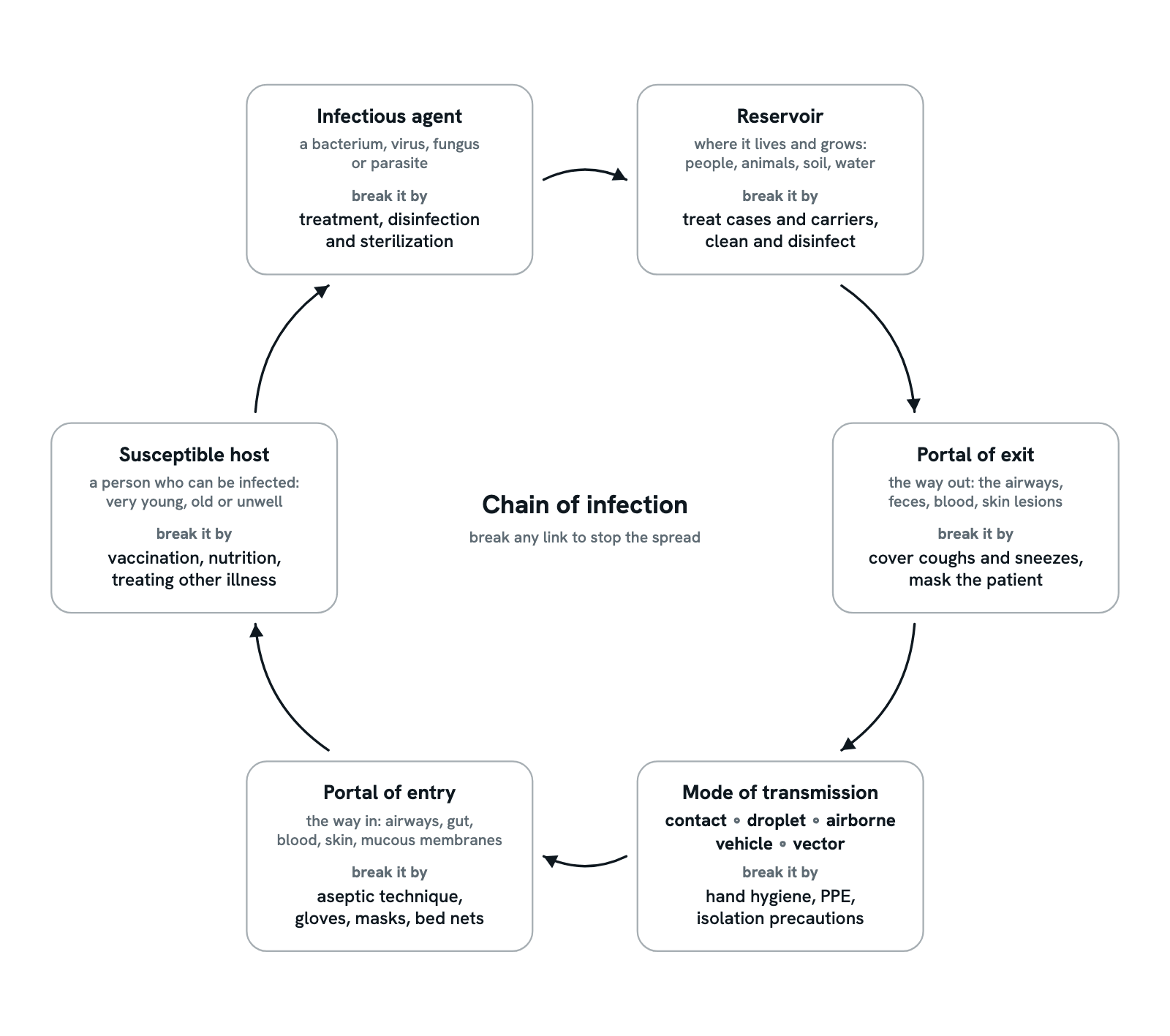
The six links of the chain of infection, from infectious agent to susceptible host, and how hand hygiene, PPE, cleaning and vaccination break each one.
An infection spreads only when six links join: an agent, a place where it lives, a way out, a way to travel, a way in and a host it can infect. Break any one link and the chain stops. Step through each link and the measures that break it, or press a link or one of the five routes of transmission.
Also called Chain of transmission or Infection chain.
Step 1 of 8
Six links, one chain
An infection spreads when six things line up: an infectious agent, a reservoir where it lives, a way out, a way to travel, a way in and a host who can be infected. Each is a link in a chain. Breaking any one link stops the spread, and control measures aim at whichever link is easiest to break.
Use ← and → to move between steps.
Step 1 of 8: Six links, one chain
Download the diagramChecked against its sources on 29 October 2026.
Step by step
The steps of the Chain of Infection
01Six links, one chain
An infection spreads when six things line up: an infectious agent, a reservoir where it lives, a way out, a way to travel, a way in and a host who can be infected. Each is a link in a chain. Breaking any one link stops the spread, and control measures aim at whichever link is easiest to break.
02The infectious agent
The agent is the pathogen itself: a bacterium, virus, fungus, protozoan or parasitic worm. Whether it causes disease depends on the dose and on how well it can invade and harm. Finding and treating the infection, and disinfecting or sterilizing what it may be on, break this link.
03The reservoir
The reservoir is where the agent normally lives and multiplies: people, animals, or the environment, such as soil and water. Human reservoirs include carriers, who are infected but have no symptoms and may not know it. Infections that pass naturally from animals to people are zoonoses.
04The portal of exit
The agent leaves its reservoir by a portal of exit, usually the site where it lives: the airways for influenza and tuberculosis, feces for cholera, and blood for agents carried off by biting insects. Covering coughs and putting a mask on a coughing patient block this link.
05The mode of transmission
Direct transmission passes the agent straight on, by touch or by droplets sprayed a short distance by coughing, sneezing or talking. Indirect transmission uses something in between: particles that stay suspended in the air, a vehicle such as food, water, blood or an object, or a vector such as a mosquito or tick.
06The portal of entry
The portal of entry is how the agent gets into a new host: the airways, the gut, broken skin, mucous membranes or the blood. Medical devices such as urinary catheters and central lines bypass the body's defences and open new ways in, which is why aseptic technique matters.
07The susceptible host
Whether an exposed person falls ill depends on the host: immunity from past infection or vaccination, and defences such as intact skin, mucous membranes, stomach acid and cilia. Very young or old age, diabetes, cancer, HIV and some medicines make infection more likely. Vaccination is the main way to protect the host.
08Breaking the chain in health care
Standard Precautions are used for every patient: hand hygiene, PPE when contact with infectious material is expected, respiratory hygiene, safe injections and sharps, and cleaning and disinfecting equipment and surfaces. Transmission-Based Precautions add more by route: gloves and gown for contact, a mask for droplets, and an N95 respirator and isolation room for airborne agents.
Parts
What each part of the chain of infection does
- Infectious agent
- The pathogen that causes the disease: a bacterium, virus, fungus, protozoan or parasitic worm. Break it by finding and treating the infection, and by disinfecting or sterilizing equipment and surfaces it may be on.
- Reservoir
- Where the agent normally lives, grows and multiplies: people, animals, or the environment, such as soil and water. Carriers, infected but without symptoms, often spread infection because they do not know they have it. Break it by treating cases and carriers and by cleaning.
- Portal of exit
- How the agent leaves its reservoir, usually from the site where it lives: the airways, feces, blood taken up by a biting insect, skin lesions, or across the placenta. Covering coughs and sneezes, and a mask on a coughing patient, block it.
- Mode of transmission
- How the agent travels to a new host: directly, by contact or droplets, or indirectly, through the air, on a vehicle or by a vector. Some agents use more than one route. Hand hygiene, PPE and isolation precautions block it.
- Contact transmission
- Spread by touch, directly from person to person, or indirectly on contaminated hands, equipment and surfaces. It is the commonest route in health care, as with Staphylococcus aureus. Hand hygiene, gloves and a gown block it.
- Droplet transmission
- Droplets from coughing, sneezing or talking travel a short distance from the airways onto the nose, eyes or mouth of someone nearby, as with influenza and whooping cough. A mask on the patient and on staff blocks it.
- Airborne transmission
- Tiny particles that stay suspended in the air and can spread over longer distances, as with tuberculosis, measles and chickenpox. An airborne infection isolation room and a fitted N95 respirator block it.
- Vehicle-borne transmission
- A non-living carrier such as food, water, blood or an object (a fomite). The vehicle may simply carry the agent, or let it grow or make toxin. Safe food and water, and cleaning and disinfecting equipment, block it.
- Vector-borne transmission
- A living carrier, usually an insect or tick. Flies can carry Shigella on their bodies, while the malaria parasite must develop inside a mosquito before it can infect a person. Vector control and bed nets block it.
- Portal of entry
- How the agent gets into a new host: the airways, the gut, broken skin, mucous membranes or the blood. Wounds, catheters and central lines open new ways in. Aseptic technique, gloves, masks and bed nets block it.
- Susceptible host
- A person the agent can infect. Immunity from past infection or vaccination protects, as do intact skin, mucous membranes, stomach acid and cilia. Very young or old age, diabetes, cancer, HIV, some medicines and indwelling devices raise the risk.
Dictionary
The terms to know
Practise it
The quizzes and cards that fit
- Epidemiology quizzes
- Bias and Confounding15 questions
- Epidemiological Study Designs15 questions
- Measures of Disease Frequency15 questions
- Microbiology quizzes
- Gut Microbiome15 questions
- Tuberculosis15 questions
- Protists15 questions
- Public Health quizzes
- Medicine quizzes
- Labor and Delivery15 questions
- IV Fluids15 questions
- Sepsis15 questions
- Epidemiology flashcards
The subject's terms as a ready-made deck, free to flip through.
Next to it
More diagrams
Sources
Where the facts come from
- CDC: Principles of Epidemiology in Public Health Practice, Lesson 1, Section 10: Chain of Infection
- CDC: 2007 Guideline for Isolation Precautions: Preventing Transmission of Infectious Agents in Healthcare Settings
- CDC: Standard Precautions for All Patient Care
- CDC: Transmission-Based Precautions
Drawn and written by biofideX from these sources.