Protein Synthesis Diagram
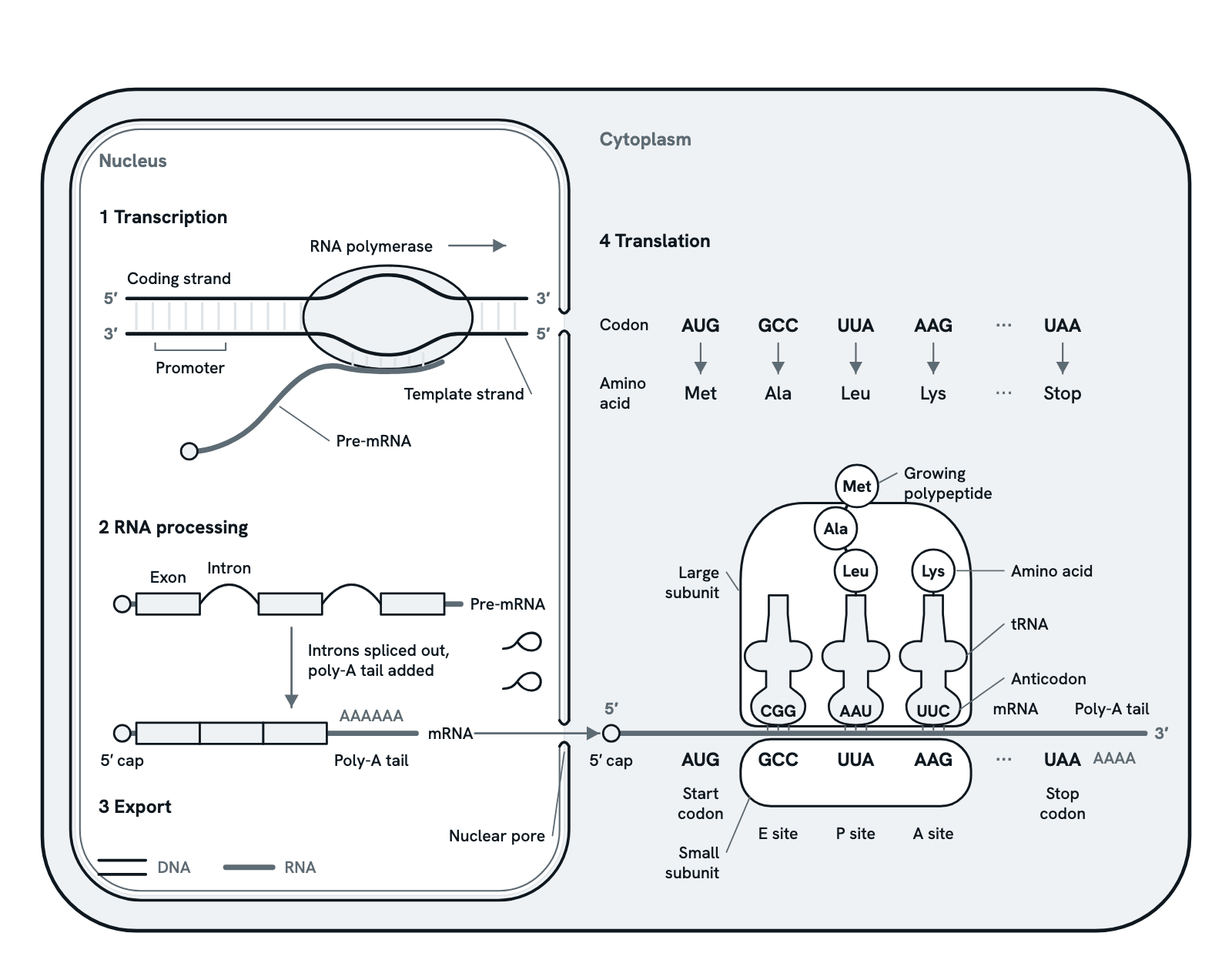
How a cell makes a protein: a gene is transcribed into mRNA in the nucleus, processed and exported, then translated by a ribosome.
A protein is made in two stages. In the nucleus, a gene is copied into RNA (transcription), and the RNA is trimmed and finished. In the cytoplasm, a ribosome reads the finished mRNA three bases at a time and joins amino acids in that order (translation). This is a eukaryotic cell, drawn schematically and not to scale.
Also called Transcription and translation or Gene expression.
Step 1 of 10
From gene to protein
A gene is a stretch of DNA that holds the code for a protein. The cell copies the gene into RNA in the nucleus (transcription), finishes the RNA, and sends it out to the cytoplasm, where ribosomes read it and join amino acids into a chain (translation).
Use ← and → to move between steps.
Step 1 of 10: From gene to protein
Download the diagramChecked against its sources on 29 October 2026.
Step by step
The steps of the Protein Synthesis
01From gene to protein
A gene is a stretch of DNA that holds the code for a protein. The cell copies the gene into RNA in the nucleus (transcription), finishes the RNA, and sends it out to the cytoplasm, where ribosomes read it and join amino acids into a chain (translation).
02RNA polymerase binds the promoter
Transcription starts at the promoter, a stretch of DNA just upstream of the gene. In eukaryotes, proteins called general transcription factors assemble there and position RNA polymerase II. The polymerase opens a short stretch of the double helix to expose the bases of the template strand.
03RNA is made 5′ to 3′
RNA polymerase moves along the gene, reading the template strand from 3′ to 5′ and adding ribonucleotides to the 3′ end of the new RNA, so the RNA grows 5′ to 3′. It pairs U with A, so the RNA has the same sequence as the coding strand, with U in place of T. Behind the polymerase the RNA peels away and the DNA closes up.
04A cap and a tail
Once about 25 nucleotides of RNA have been made, a cap of 7-methylguanosine is added to its 5′ end. At the far end of the gene the RNA is cut, and poly-A polymerase adds about 200 adenine nucleotides to the new 3′ end. The two ends show the cell that the message is whole before it is exported, and the tail helps keep the mRNA stable and get it translated.
05Splicing removes the introns
The pre-mRNA holds both exons and introns. The spliceosome, made of small nuclear RNAs and proteins, cuts out each intron as a loop called a lariat and joins the exons on either side. What is left is mRNA: the exons in order, between the cap and the tail.
06Export through a nuclear pore
Finished mRNA leaves the nucleus through nuclear pore complexes in the envelope. Only mRNAs carrying the right set of proteins, a sign that they are capped, spliced and tailed, are let through; cut-out introns and faulty RNAs stay behind.
07The genetic code
The mRNA is read in codons of three bases, from 5′ to 3′. There are 64 codons: 61 stand for amino acids and 3 are stop signals. Here the message AUG GCC UUA AAG codes for methionine, alanine, leucine and lysine, and UAA, further on, means stop.
08Translation starts at AUG
The small ribosomal subunit, carrying an initiator tRNA with methionine, binds the mRNA at its 5′ cap and moves along it to the first AUG, the start codon. The large subunit then joins, with the initiator tRNA in the P site. So every new protein begins with methionine.
09Elongation: one codon at a time
A tRNA whose anticodon pairs with the codon in the A site brings the next amino acid, here lysine for AAG. The large subunit joins the growing chain onto it with a peptide bond. The ribosome then moves three bases along: the tRNAs shift from A to P and from P to E, and the empty tRNA leaves.
10A stop codon ends it
When a stop codon (UAA, UAG or UGA) reaches the A site, no tRNA matches it. A release factor binds instead, and the bond holding the chain to the last tRNA is broken. The new polypeptide is let go to fold into a protein, and the two subunits come apart, ready to start again.
Parts
What each part of the protein synthesis does
- Nucleus
- Holds the cell's DNA. Its envelope is two membranes with pores in them, so transcription and RNA processing happen apart from translation, in the cytoplasm.
- Cytoplasm
- Everything inside the cell membrane but outside the nucleus. Ribosomes in the cytosol, or on the rough endoplasmic reticulum, translate mRNA into protein here.
- Coding strand
- The DNA strand that is not read. Its sequence matches the RNA made from the gene, with T wherever the RNA has U.
- Template strand
- The DNA strand RNA polymerase reads, from its 3′ end towards its 5′ end. Each new RNA base pairs with the base opposite it: A with U, T with A, G with C, C with G.
- Promoter
- A stretch of DNA just upstream of a gene where transcription factors and RNA polymerase bind, and where transcription of the gene begins.
- RNA polymerase
- The enzyme that makes RNA. It opens the double helix, reads the template strand and joins ribonucleotides in order, building the RNA 5′ to 3′. In eukaryotes, RNA polymerase II makes mRNA.
- Pre-mRNA
- The first copy of the gene, with every exon and intron in it. It is processed in the nucleus before it can leave as mRNA.
- 5′ cap
- A modified guanine nucleotide (7-methylguanosine) added to the 5′ end of the RNA soon after transcription starts. It helps the RNA through processing and export, and the ribosome binds there to begin translation.
- Exons
- The parts of a gene kept in the finished mRNA, joined end to end by splicing. They hold the code for the protein, along with untranslated stretches at each end.
- Introns
- Stretches of a gene that are copied into pre-mRNA but cut out before it leaves the nucleus. The spliceosome removes each as a loop (a lariat). In many genes they are much longer than the exons.
- Poly-A tail
- A string of about 200 adenine nucleotides added to the 3′ end after the RNA is cut there. It is not copied from DNA. It helps keep the mRNA stable and helps it to be translated.
- Messenger RNA (mRNA)
- The finished message: capped, spliced and with its tail. It carries the gene's code out of the nucleus to the ribosomes, read 5′ to 3′ in codons of three bases.
- Nuclear pore
- A channel through both membranes of the nuclear envelope that controls traffic in and out of the nucleus. Of the mRNAs, only finished ones carrying the right proteins are let out into the cytoplasm.
- Ribosome
- The machine that makes proteins, built of ribosomal RNA and proteins in a large and a small subunit. The two come together on an mRNA at its start codon and part again at the stop codon.
- A, P and E sites
- The three places a tRNA can sit in the ribosome: the A site takes the tRNA bringing the next amino acid, the P site holds the tRNA carrying the chain, and the E site is the exit.
- Codon
- Three bases of mRNA read together. Of the 64 codons, 61 stand for an amino acid and 3 are stop signals. Here GCC codes for alanine, UUA for leucine and AAG for lysine.
- Start codon
- AUG, the codon where translation begins, usually the first AUG from the 5′ end. It codes for methionine, so every new protein starts with methionine, often removed later.
- Stop codon
- UAA, UAG or UGA. No tRNA matches a stop codon; a release factor binds to it instead, and the finished chain is let go.
- Transfer RNA (tRNA)
- A small folded RNA that brings one kind of amino acid, carried on its 3′ end. An enzyme (an aminoacyl-tRNA synthetase) loads each tRNA with the right amino acid.
- Anticodon
- Three bases at the bottom of a tRNA that pair with a codon in the mRNA, running the opposite way: the anticodon 3′-AAU-5′, for example, pairs with the codon 5′-UUA-3′.
- Amino acid
- One of the 20 building blocks of proteins. Each tRNA carries the amino acid that matches its anticodon; here lysine arrives for the codon AAG.
- Growing polypeptide
- The chain of amino acids, joined by peptide bonds. It grows from its first amino acid, methionine, at the N-terminal end, and folds into a protein.
Dictionary
The terms to know
Practise it
The quizzes and cards that fit
- Molecular Biology quizzes
- Epigenetics & Chromatin Remodeling20 questions
- DNA Replication Machinery15 questions
- Recombinant DNA Technology15 questions
- Genetics quizzes
- Incomplete Dominance and Codominance15 questions
- Pedigree Analysis15 questions
- Blood Types15 questions
- Cell Biology quizzes
- Characteristics of Life15 questions
- Lab Safety15 questions
- Cell Theory15 questions
- Molecular Biology flashcards
The subject's terms as a ready-made deck, free to flip through.
- DNA to Protein Translation
Translate DNA or RNA into protein in any of the six frames, with the standard or a mitochondrial or bacterial code, and get the protein's mass and pI.
- ORF Finder
Every open reading frame in all six frames, with its position, length and protein, from ATG or any start codon.
Next to it
More diagrams
Sources
Where the facts come from
- Alberts and others, Molecular Biology of the Cell, 4th edition: From DNA to RNA (NCBI Bookshelf)
- Alberts and others, Molecular Biology of the Cell, 4th edition: From RNA to Protein (NCBI Bookshelf)
- Cooper, The Cell: A Molecular Approach, 2nd edition: RNA Processing and Turnover (NCBI Bookshelf)
- Cooper, The Cell: A Molecular Approach, 2nd edition: Translation of mRNA (NCBI Bookshelf)
- NHGRI Talking Glossary: Transcription
- NHGRI Talking Glossary: Translation
- NHGRI Talking Glossary: Codon
Drawn and written by biofideX from these sources.