Nucleosome 3D Structure
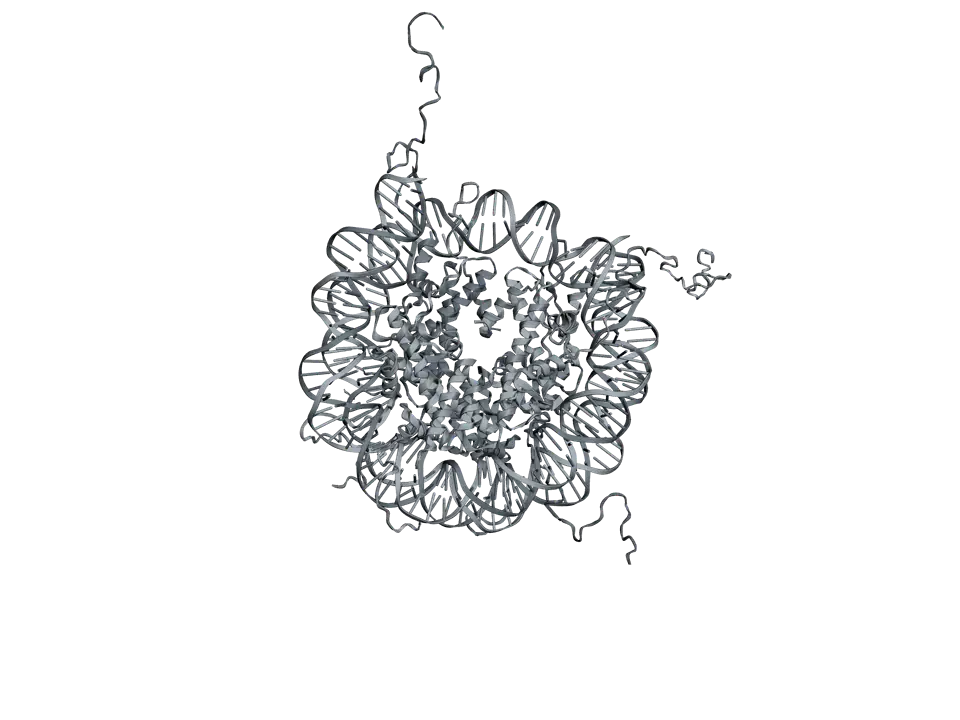
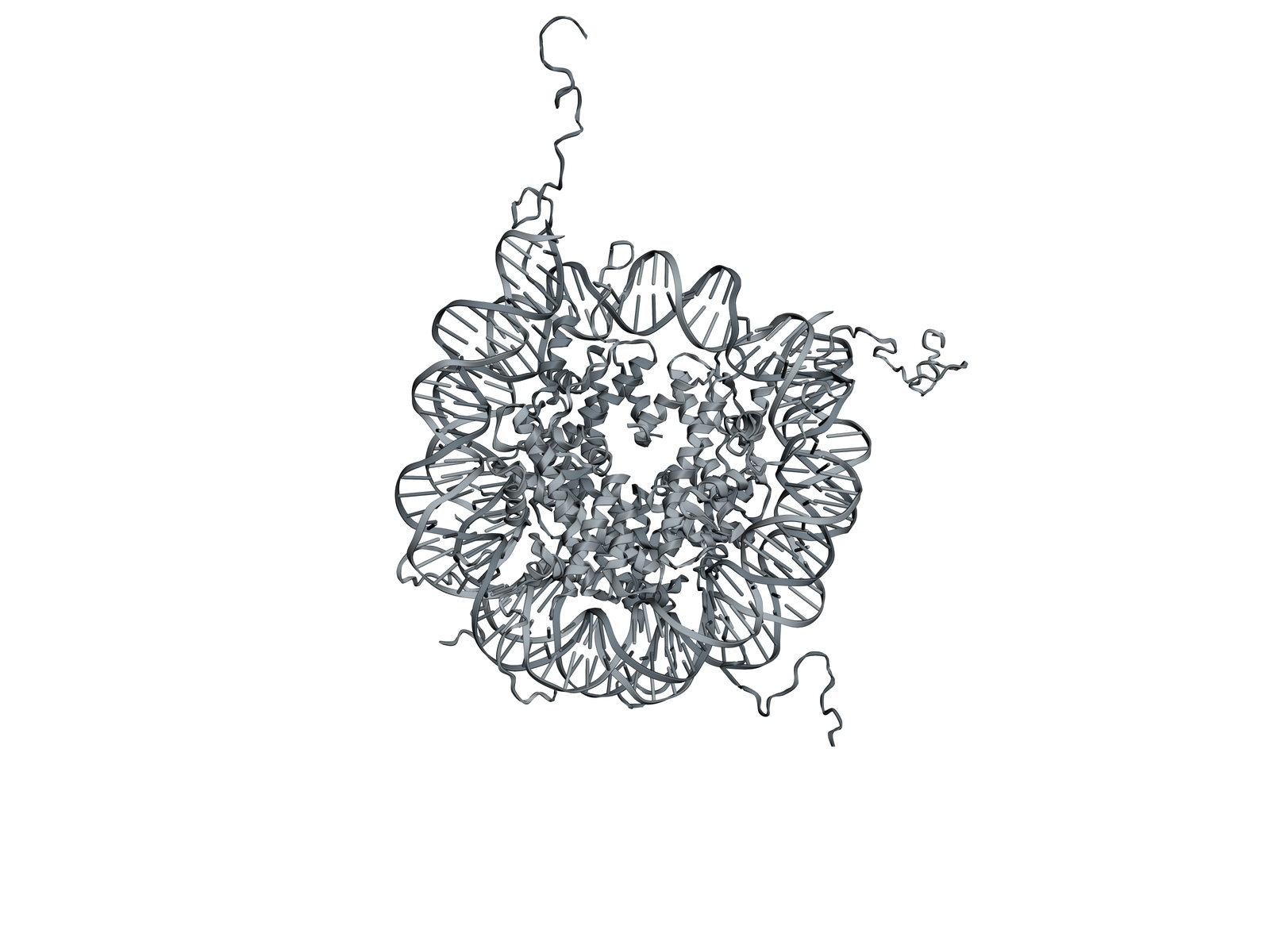
The first step in packing DNA into chromosomes: 147 base pairs of DNA wrapped almost twice round a core of eight histone proteins.
The DNA of one human cell would stretch about two metres. To fit it into a nucleus a few micrometres across, cells wind it round histone proteins, one nucleosome about every 200 base pairs, like thread on spools. How tightly nucleosomes pack, and how their histones are marked, helps decide which genes can be read. This structure shows the core particle in fine detail.
Also called Nucleosome core particle.
View 1 of 6
DNA wound on a spool
Seen face on, the nucleosome core particle is a disc about 11 nanometres across and 6 nanometres thick. The histones make the disc; the DNA runs round its rim almost twice.
Use ← and → to move between views. Drag the molecule to turn it; on a touch screen, press Turn it first.
View 1 of 6: DNA wound on a spool
Download the pictureDownload the atoms (PDB)Checked against its sources on 25 October 2026.
View by view
The Nucleosome structure, explained
01DNA wound on a spool
Seen face on, the nucleosome core particle is a disc about 11 nanometres across and 6 nanometres thick. The histones make the disc; the DNA runs round its rim almost twice.
02147 base pairs, almost two turns
The DNA makes about 1.7 turns round the histones, bent tightly all the way. Between neighbouring nucleosomes, a stretch of linker DNA leads on to the next, giving the beads on a string seen in electron micrographs.
03Eight histones
The core is an octamer: two each of H2A, H2B, H3 and H4. All four are small, about 100 to 135 amino acids, and rich in the positive amino acids lysine and arginine, which bind the negative phosphates of DNA.
04H3 and H4 at the centre
Two H3 and H4 pairs join through their H3s into a tetramer that holds the central 60 or so base pairs of DNA, and H3 also grips both ends. When new DNA is copied, this tetramer is laid down first.
05H2A and H2B either side
Two H2A and H2B dimers bind to either side of the tetramer and hold the outer stretches of the DNA; H3 holds the very ends. They come off and go back on more easily than H3 and H4.
06Tails that carry marks
Each histone has a tail that reaches out past the DNA. Acetyl groups on their lysines loosen the packing, and methyl groups can loosen or tighten it, depending on where they are. Such marks are a large part of epigenetic control.
Parts
What each part does
- DNA
- 147 base pairs, wrapped in about 1.7 left-handed turns round the histone core. It bends sharply all the way round, held by contacts every ten base pairs or so where its minor groove faces the histones.
- Histone H3
- Two copies. The two H3s meet each other at the centre of the core, joining two H3 and H4 pairs into a tetramer.
- Histone H4
- Two copies, each paired with an H3. H4's sequence is one of the most conserved of any protein: pea and cow H4 differ at only two of 102 positions.
- Histone H2A
- Two copies, each paired with an H2B into a dimer. The two H2A and H2B dimers sit either side of the H3 and H4 tetramer.
- Histone H2B
- Two copies, each paired with an H2A. Its tail passes out between the two turns of DNA.
- Histone tails
- The ends of the histone chains that reach out beyond the core and between the turns of DNA. Enzymes add and remove marks on them, acetyl and methyl groups among others, that help open or close the chromatin.
The structure
Where these atoms come from
- Structure
- PDB 1KX5
- What it is
- Nucleosome core particle, NCP147
- Organism
- Xenopus laevis histones, human DNA sequence
- Method
- X-ray diffraction, 1.94 Å resolution
- Deposited
- 2002
- Atoms shown
- 13,607, without water or hydrogens
Coordinates from the Protein Data Bank, free of all copyright (CC0). Water and hydrogens are left out, and the molecule is turned to face you; every atom is where the experiment placed it.
Dictionary
The terms to know
Practise it
The quizzes and cards that fit
- Molecular Biology quizzes
- Epigenetics & Chromatin Remodeling20 questions
- DNA Replication Machinery15 questions
- Recombinant DNA Technology15 questions
- Genetics quizzes
- Incomplete Dominance and Codominance15 questions
- Pedigree Analysis15 questions
- Blood Types15 questions
- Cell Biology quizzes
- Characteristics of Life15 questions
- Lab Safety15 questions
- Cell Theory15 questions
- Molecular Biology flashcards
The subject's terms as a ready-made deck, free to flip through.
Next to it
More molecules
Sources
Where the facts come from
- RCSB Protein Data Bank: 1KX5, the nucleosome core particle at 1.9 Å resolution
- Davey and others, Solvent mediated interactions in the structure of the nucleosome core particle at 1.9 Å resolution, J Mol Biol 2002
- PDB-101 Molecule of the Month: Nucleosome
- Alberts and others, Molecular Biology of the Cell, 4th edition: Chromosomal DNA and Its Packaging in the Chromatin Fiber (NCBI Bookshelf)
- Kniazeva, Armeev and Shaytan, H2A-H2B histone dimer plasticity and its functional implications, Cells 2022 (PMC)
Written by biofideX from these sources. Drawn with 3Dmol.js (Rego and Koes, Bioinformatics 2015).