Amino Acid Chart
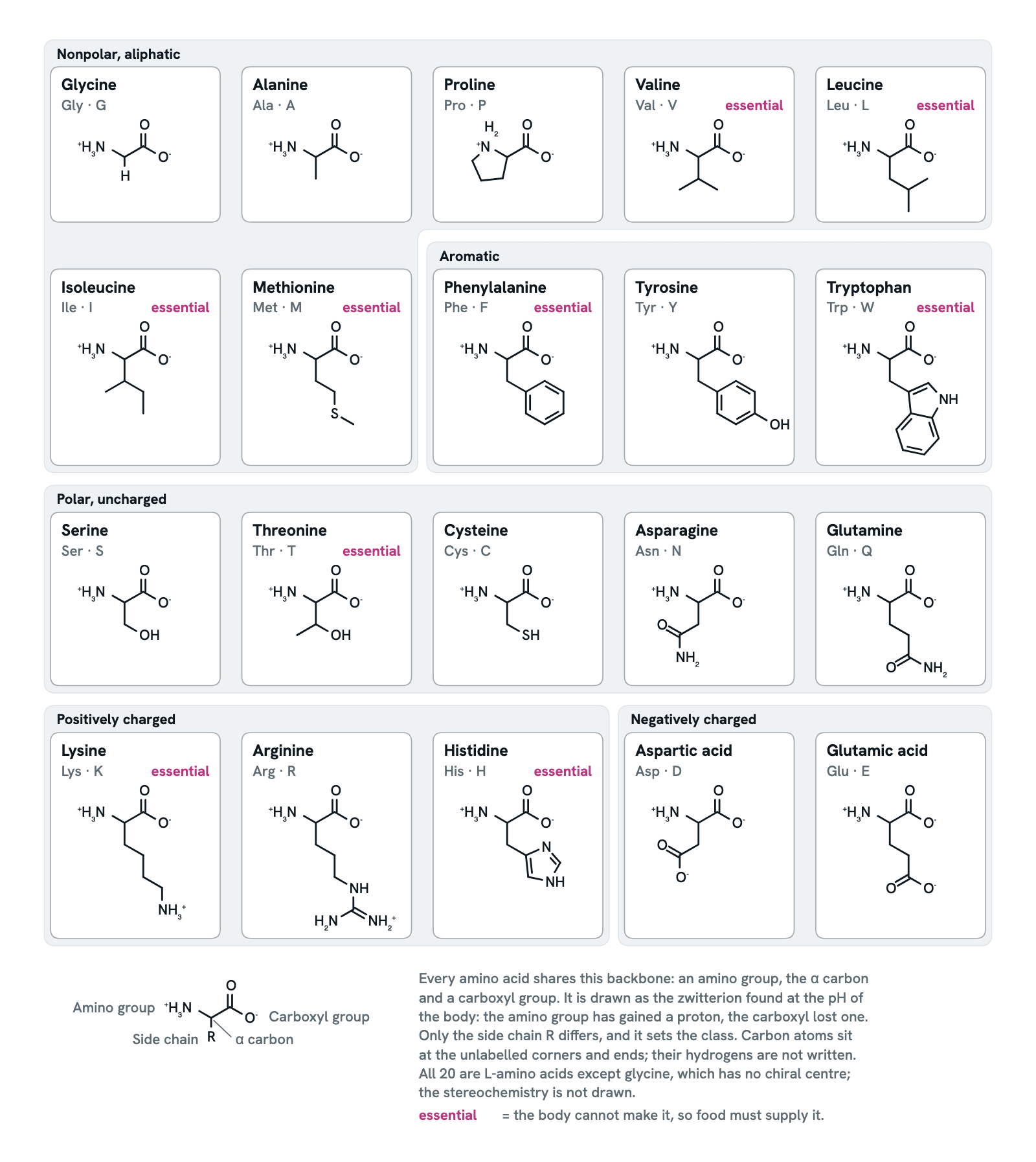
All 20 amino acids as skeletal structures in Lehninger's five classes, with their three-letter and one-letter codes and the nine essential ones marked.
An amino acid chart lays out the 20 amino acids proteins are built from, each drawn as the zwitterion at the pH of the body, with its three-letter and one-letter abbreviation. They are grouped by side chain into Lehninger's five classes, since the side chain is all that differs and is what decides how a protein folds. The nine the body cannot make are tagged essential. Press any one for what its structure means.
Also called Amino acid structures, Amino acid table, 20 amino acids or Amino acid abbreviations.
Press any part of the diagram, or pick one here, to see what it is and what it does.
Download the chartChecked against its sources on 5 November 2026.
How to read it
How to read the amino acid chart
01What an amino acid is
Every one of the 20 is built the same way: an amino group, a carboxyl group and a hydrogen on one carbon, the alpha carbon, plus a fourth group, the side chain R, which is what differs. At the pH of the body the carboxyl group has lost its proton and the amino group has gained one, so a free amino acid is a zwitterion, drawn here as ⁺H₃N and COO⁻. Glycine's R is a hydrogen; proline's loops back onto the nitrogen.
02Five classes of side chain
Lehninger sorts the 20 by their side chains into five classes: nonpolar aliphatic, aromatic, polar uncharged, positively charged and negatively charged. The division that matters most for folding is between hydrophobic side chains, which hide from water inside a protein, and hydrophilic ones, which face it; the interactions between side chains are what fold a chain into its shape.
03Nonpolar, aliphatic: Gly, Ala, Pro, Val, Leu, Ile, Met
Glycine, alanine, proline, valine, leucine, isoleucine and methionine have hydrocarbon side chains, or in methionine a thioether, with no charge and no group that hydrogen-bonds with water. Valine, leucine and isoleucine are the branched-chain amino acids. Proline's side chain closes a ring onto the backbone nitrogen, so it alone has a secondary amine. Glycine's single hydrogen leaves it without a chiral centre.
04Aromatic: Phe, Tyr, Trp
Phenylalanine carries a benzene ring, tyrosine the same ring with a hydroxyl, a phenol, and tryptophan an indole, two fused rings with a nitrogen. Their rings absorb ultraviolet light: a protein's absorbance at 280 nm comes from its tryptophan and tyrosine, and a little from its disulfide bonds, with tryptophan absorbing nearly four times as strongly, which is how protein concentration is measured in the lab. Tyrosine is made from phenylalanine.
05Polar, uncharged: Ser, Thr, Cys, Asn, Gln
Serine and threonine carry a hydroxyl, cysteine a thiol, asparagine and glutamine an amide: groups that hydrogen-bond with water but carry no charge at the pH of the body. The hydroxyls of serine, threonine and tyrosine are where kinases attach phosphate to switch proteins on and off; most phosphorylation is on serine. Two cysteine thiols can be oxidised into a disulfide bond, which ties a folded protein together.
06Positively charged: Lys, Arg, His
Lysine's side chain ends in an amino group and arginine's in a guanidinium, with pKa values of about 10.4 and 13.8, so both hold a proton, and a positive charge, at any pH a cell sees. Histidine's imidazole has a pKa of about 6.5, close to the pH of the body, so a share of histidines are charged and the ring can take up or hand on a proton, which is why it is so often found in enzyme active sites.
07Negatively charged: Asp, Glu
Aspartate and glutamate each carry a second carboxyl group, with pKa values of about 3.7 and 4.3 in a peptide, so at the pH of the body they have lost their proton and carry a negative charge. Their names in this form end in -ate; the free acids are aspartic acid and glutamic acid. In a folded protein the pKa of an acidic or basic side chain can shift by a unit or more, depending on what surrounds it.
08The nine essential amino acids
Nine are essential: histidine, isoleucine, leucine, lysine, methionine, phenylalanine, threonine, tryptophan and valine. Human cells cannot build their carbon skeletons, so food must supply them. Cysteine and tyrosine are made from methionine and phenylalanine, so they depend on those two. Arginine, glutamine, glycine and proline are conditionally essential: the body makes them, but not enough in a newborn, in illness or after injury; some lists add glutamate.
09The one-letter code
The one-letter code was made for writing long sequences. Eleven letters are the first letter of the name. The other nine have to be learned: F phenylalanine (the sound), W tryptophan (the double ring), Y tyrosine, K lysine (the letter beside L), Q glutamine, N asparagine, D aspartate, E glutamate and R arginine. B stands for Asp or Asn and Z for Glu or Gln when the two cannot be told apart, and X for any amino acid.
10Joining them: the peptide bond, and chirality
In a protein the carboxyl group of one amino acid is joined to the amino group of the next by a peptide bond, an amide, so only the side chains and the two ends of the chain keep their charges. The order comes from the gene, three bases per amino acid: the codon chart gives the code and the protein synthesis diagram shows the ribosome at work. All 20 are L-amino acids, and all but glycine have a chiral alpha carbon; their mirror images, D-amino acids, do not go into proteins.
Entries
What each part of the amino acid chart shows
- Glycine (Gly, G)
- Glycine (Gly, G). The side chain is a single hydrogen, so glycine is the smallest amino acid and the only one with no chiral centre. Classed as nonpolar aliphatic. The body makes it, but not always enough: it is conditionally essential.
- Alanine (Ala, A)
- Alanine (Ala, A). The side chain is a methyl group, the simplest carbon side chain. Nonpolar aliphatic, and made in the body from glucose and a source of nitrogen, so it is not essential.
- Proline (Pro, P)
- Proline (Pro, P). Its three-carbon side chain bends back and bonds to the backbone nitrogen, closing a five-membered pyrrolidine ring, so proline alone has a secondary amine. Nonpolar aliphatic; conditionally essential.
- Valine (Val, V)
- Valine (Val, V). A branched side chain: one carbon carrying two methyl groups, an isopropyl group. Nonpolar aliphatic, and essential: the body cannot build its carbon skeleton.
- Leucine (Leu, L)
- Leucine (Leu, L). Valine's side chain with one more carbon: a CH₂, then the isopropyl fork. Nonpolar aliphatic and essential. Leucine and isoleucine share the formula C₆H₁₃NO₂ and a molar mass of 131.2.
- Isoleucine (Ile, I)
- Isoleucine (Ile, I). Four carbons branched at the first: a methyl and an ethyl group on the beta carbon, which is a second chiral centre. Nonpolar aliphatic and essential.
- Methionine (Met, M)
- Methionine (Met, M). A sulfur in the chain, as a thioether: CH₂, CH₂, S, CH₃. Nonpolar aliphatic and essential. As S-adenosylmethionine it hands methyl groups to other molecules, and its sulfur is the source of cysteine's.
- Phenylalanine (Phe, F)
- Phenylalanine (Phe, F). Alanine with a benzene ring on its methyl: a phenyl group. Aromatic and essential. The body turns it into tyrosine, so a child who lacks the enzyme for that step needs tyrosine from food too.
- Tyrosine (Tyr, Y)
- Tyrosine (Tyr, Y). Phenylalanine's ring with a hydroxyl at the far position, a phenol, which loses its proton only at high pH (pKa 9.84). Aromatic; made from phenylalanine, so conditionally essential. It absorbs ultraviolet light at 280 nm and is the source of thyroid hormones, adrenaline and melanin.
- Tryptophan (Trp, W)
- Tryptophan (Trp, W). The largest side chain: a CH₂ carrying an indole, a benzene ring fused to a five-membered ring with an NH. Aromatic and essential. Of the 20 it absorbs most strongly at 280 nm, which is why a protein's concentration is read at that wavelength.
- Serine (Ser, S)
- Serine (Ser, S). A CH₂ carrying a hydroxyl group. Polar, uncharged and not essential. The hydroxyl is where kinases attach phosphate: most of the phosphorylation in human proteins is on serine.
- Threonine (Thr, T)
- Threonine (Thr, T). Serine with a methyl on the same carbon, so its beta carbon carries a hydroxyl and a methyl and is a second chiral centre. Polar, uncharged and essential; its hydroxyl is phosphorylated like serine's.
- Cysteine (Cys, C)
- Cysteine (Cys, C). A CH₂ carrying a thiol, SH, which loses its proton near pH 8.5 and can bond to a second cysteine's across a protein as a disulfide bridge. Polar, uncharged; made with methionine's sulfur, so conditionally essential.
- Asparagine (Asn, N)
- Asparagine (Asn, N). Aspartate's side chain with an amide, CONH₂, in place of the carboxylate. Polar, uncharged and not essential. Asx, or B, means Asp or Asn when the two cannot be told apart.
- Glutamine (Gln, Q)
- Glutamine (Gln, Q). Glutamate's side chain with an amide at its end, one carbon longer than asparagine's. Polar and uncharged; conditionally essential, since the body makes it but not always enough in illness. Glx, or Z, means Glu or Gln.
- Lysine (Lys, K)
- Lysine (Lys, K). A four-carbon chain ending in an amino group, which holds a proton at the pH of the body (pKa 10.40), so the side chain carries a positive charge. Essential.
- Arginine (Arg, R)
- Arginine (Arg, R). A three-carbon chain ending in a guanidinium group, three nitrogens on one carbon that share a positive charge. Its pKa is about 13.8, so it stays charged at any pH a cell meets. Conditionally essential: adults make enough, newborns do not.
- Histidine (His, H)
- Histidine (His, H). A CH₂ carrying an imidazole ring, two nitrogens in a five-membered ring. Its pKa of about 6.5 is close to the pH of the body, so the ring can take up or give up a proton, which many enzymes use in their active sites. Essential.
- Aspartic acid (aspartate) (Asp, D)
- Aspartic acid (Asp, D). A CH₂ carrying a second carboxyl group, which has lost its proton at the pH of the body (pKa 3.67): the side chain is a carboxylate, aspartate, with a negative charge. Not essential.
- Glutamic acid (glutamate) (Glu, E)
- Glutamic acid (Glu, E). Two CH₂ then a carboxyl group, one carbon longer than aspartate's, charged negative at the pH of the body (pKa 4.25): glutamate. Not essential, though some lists count it conditionally essential in illness. Glutamate and aspartate are the acidic amino acids.
- Nonpolar, aliphatic side chains
- Glycine, alanine, proline, valine, leucine, isoleucine and methionine: hydrocarbon side chains, or in methionine a thioether, with no charge and no pull on water. They gather away from water in the core of a folded protein, and these hydrophobic interactions are among the forces that hold a protein's shape.
- Aromatic side chains
- Phenylalanine, tyrosine and tryptophan: a benzene ring, a phenol or an indole on a CH₂. They are largely nonpolar, and tryptophan and tyrosine absorb ultraviolet light at 280 nm, which is how a protein's concentration is usually measured.
- Polar, uncharged side chains
- Serine, threonine, cysteine, asparagine and glutamine: hydroxyl, thiol or amide groups that hydrogen-bond with water but carry no charge at the pH of the body. The hydroxyls of serine and threonine are where kinases attach phosphate; two cysteines can join as a disulfide bridge.
- Positively charged side chains
- Lysine, arginine and histidine: an amino group, a guanidinium and an imidazole ring that hold a proton at the pH of the body, lysine and arginine almost always, histidine only in part. The basic amino acids.
- Negatively charged side chains
- Aspartate and glutamate: a second carboxyl group that has lost its proton at the pH of the body, leaving a carboxylate. The acidic amino acids, named aspartic acid and glutamic acid as the free acids.
- The backbone every amino acid shares
- An amino group and a carboxyl group on one carbon, the alpha carbon, which also carries a hydrogen and the side chain R. At the pH of the body the amino group holds a proton and the carboxyl group has lost one, so the molecule is a zwitterion: charged at both ends, neutral overall.
As a table
The amino acid chart as a table
The 20 amino acids in the chart's order, with their abbreviations, the class of their side chain, the pKa of the side chains that ionise, their molar mass and whether the diet must supply them.
Glycine
- Abbreviations
- Gly, G
- Side chain
- Nonpolar, aliphatic
- Molar mass (g/mol)
- 75.1
- In the diet
- Conditionally essential
Alanine
- Abbreviations
- Ala, A
- Side chain
- Nonpolar, aliphatic
- Molar mass (g/mol)
- 89.1
- In the diet
- Not essential
Proline
- Abbreviations
- Pro, P
- Side chain
- Nonpolar, aliphatic
- Molar mass (g/mol)
- 115.1
- In the diet
- Conditionally essential
Valine
- Abbreviations
- Val, V
- Side chain
- Nonpolar, aliphatic
- Molar mass (g/mol)
- 117.1
- In the diet
- Essential
Leucine
- Abbreviations
- Leu, L
- Side chain
- Nonpolar, aliphatic
- Molar mass (g/mol)
- 131.2
- In the diet
- Essential
Isoleucine
- Abbreviations
- Ile, I
- Side chain
- Nonpolar, aliphatic
- Molar mass (g/mol)
- 131.2
- In the diet
- Essential
Methionine
- Abbreviations
- Met, M
- Side chain
- Nonpolar, aliphatic
- Molar mass (g/mol)
- 149.2
- In the diet
- Essential
Phenylalanine
- Abbreviations
- Phe, F
- Side chain
- Aromatic
- Molar mass (g/mol)
- 165.2
- In the diet
- Essential
Tyrosine
- Abbreviations
- Tyr, Y
- Side chain
- Aromatic
- Side-chain pKa
- 9.84
- Molar mass (g/mol)
- 181.2
- In the diet
- Conditionally essential
Tryptophan
- Abbreviations
- Trp, W
- Side chain
- Aromatic
- Molar mass (g/mol)
- 204.2
- In the diet
- Essential
Serine
- Abbreviations
- Ser, S
- Side chain
- Polar, uncharged
- Molar mass (g/mol)
- 105.1
- In the diet
- Not essential
Threonine
- Abbreviations
- Thr, T
- Side chain
- Polar, uncharged
- Molar mass (g/mol)
- 119.1
- In the diet
- Essential
Cysteine
- Abbreviations
- Cys, C
- Side chain
- Polar, uncharged
- Side-chain pKa
- 8.55
- Molar mass (g/mol)
- 121.2
- In the diet
- Conditionally essential
Asparagine
- Abbreviations
- Asn, N
- Side chain
- Polar, uncharged
- Molar mass (g/mol)
- 132.1
- In the diet
- Not essential
Glutamine
- Abbreviations
- Gln, Q
- Side chain
- Polar, uncharged
- Molar mass (g/mol)
- 146.1
- In the diet
- Conditionally essential
Lysine
- Abbreviations
- Lys, K
- Side chain
- Positively charged
- Side-chain pKa
- 10.40
- Molar mass (g/mol)
- 146.2
- In the diet
- Essential
Arginine
- Abbreviations
- Arg, R
- Side chain
- Positively charged
- Side-chain pKa
- 13.8
- Molar mass (g/mol)
- 174.2
- In the diet
- Conditionally essential
Histidine
- Abbreviations
- His, H
- Side chain
- Positively charged
- Side-chain pKa
- 6.54
- Molar mass (g/mol)
- 155.2
- In the diet
- Essential
Aspartic acid (aspartate)
- Abbreviations
- Asp, D
- Side chain
- Negatively charged
- Side-chain pKa
- 3.67
- Molar mass (g/mol)
- 133.1
- In the diet
- Not essential
Glutamic acid (glutamate)
- Abbreviations
- Glu, E
- Side chain
- Negatively charged
- Side-chain pKa
- 4.25
- Molar mass (g/mol)
- 147.1
- In the diet
- Not essential
Side-chain pKa values are those measured in a blocked alanine pentapeptide at 25 °C by Thurlkill and others (2006), except arginine's, from Fitch and others (2015); in a folded protein each can shift by a unit or more. Molar masses are PubChem's molecular weights. Side chains are classed as in Lehninger Principles of Biochemistry.
Dictionary
The terms to know
Practise it
The quizzes and cards that fit
- Biochemistry quizzes
- Photosynthesis and Cellular Respiration15 questions
- Molarity and Dilutions15 questions
- ATP and Cellular Energy15 questions
- Molecular Biology quizzes
- Epigenetics & Chromatin Remodeling20 questions
- DNA Replication Machinery15 questions
- Recombinant DNA Technology15 questions
- Food Nutrition quizzes
- The Digestive System and Nutrient Absorption15 questions
- Energy Metabolism and Caloric Balance10 questions
- Protein Synthesis and Amino Acid Metabolism15 questions
- Biochemistry flashcards
The subject's terms as a ready-made deck, free to flip through.
- DNA to Protein Translation
Translate DNA or RNA into protein in any of the six frames, with the standard or a mitochondrial or bacterial code, and get the protein's mass and pI.
Next to it
More diagrams
Sources
Where the facts come from
- IUPAC-IUBMB Joint Commission on Biochemical Nomenclature: Nomenclature and Symbolism for Amino Acids and Peptides (names, symbols, systematic names and formulas of the 20)
- PubChem compound records for the 20 amino acids: structures, formulas and molecular weights (CIDs 750, 5950, 145742, 6287, 6106, 6306, 6137, 6140, 6057, 6305, 5951, 6288, 5862, 6267, 5961, 5962, 6322, 6274, 5960, 33032)
- StatPearls: Biochemistry, Essential Amino Acids, archived chapter (NCBI Bookshelf)
- Watford and Wu: Protein, Advances in Nutrition 2018 (PubMed), on the indispensable and conditionally indispensable amino acids
- Thurlkill, Grimsley, Scholtz and Pace: pK values of the ionizable groups of proteins, Protein Science 2006 (PMC)
- Grimsley, Scholtz and Pace: A summary of the measured pK values of the ionizable groups in folded proteins, Protein Science 2009 (PMC)
- Fitch and others: Arginine, its pKa value revisited, Protein Science 2015 (PubMed)
- Pace and others: How to measure and predict the molar absorption coefficient of a protein, Protein Science 1995 (PMC), on absorbance at 280 nm
- Ardito and others: The crucial role of protein phosphorylation in cell signaling, International Journal of Molecular Medicine 2017 (PMC), on serine, threonine and tyrosine phosphorylation
Drawn and written by biofideX from these sources.