Cell Cycle Diagram
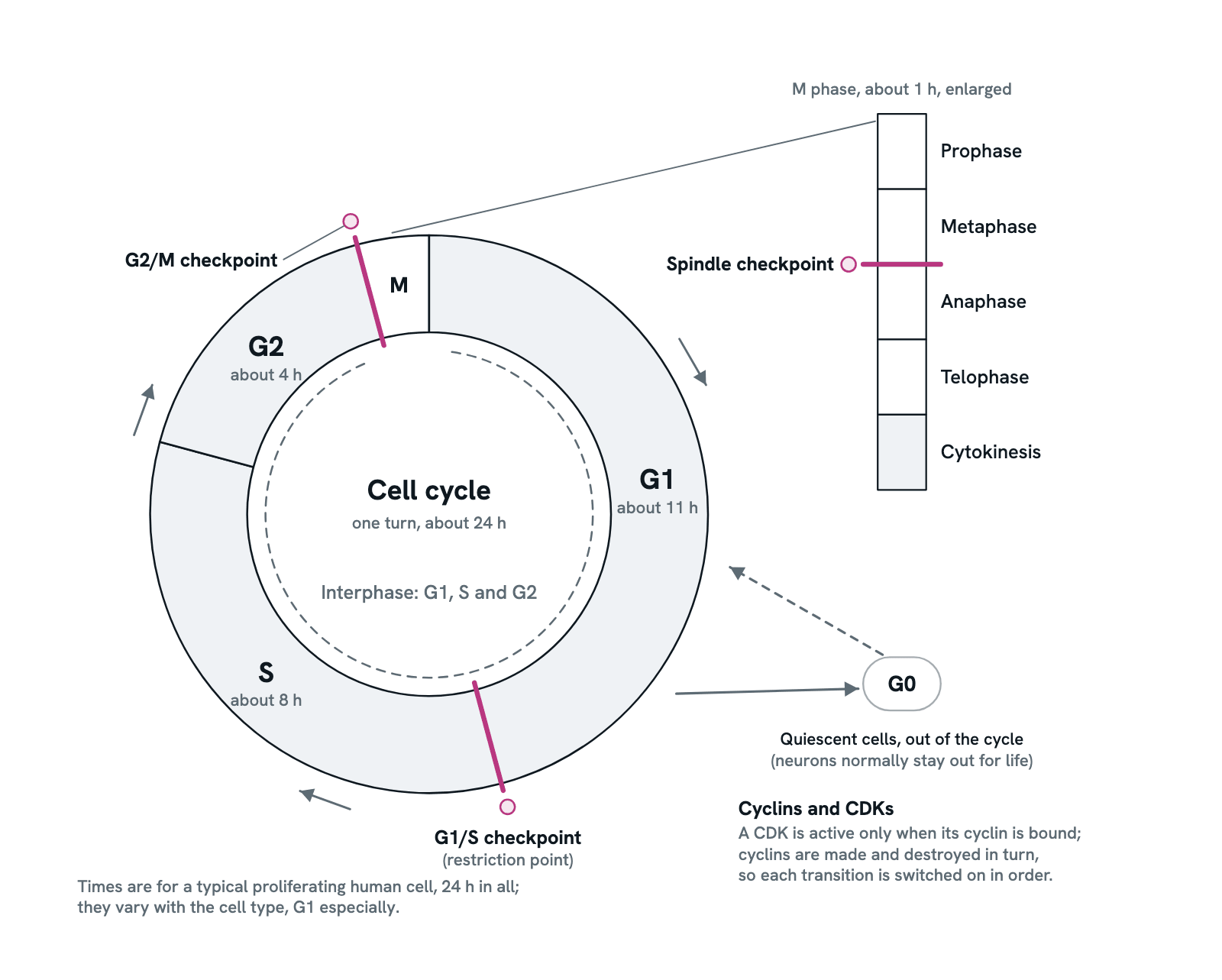
The cell cycle as a clock: G1, S and G2 make up interphase, M phase is mitosis and cytokinesis, with the three checkpoints and the exit to G0 marked.
A dividing cell goes round a cycle: it grows (G1), copies its DNA (S), grows again and checks the copy (G2), then divides its chromosomes and itself (M). The arcs here are to scale for a typical proliferating human cell, about 24 hours in all, which is why M is so thin. Step through the phases, or press a checkpoint to see what it tests.
Also called Cell cycle phases, Stages of the cell cycle or G1, S, G2 and M.
Step 1 of 9
The cycle at a glance
The cell cycle is the series of events in which a cell doubles its contents and then shares them between two daughter cells. Most of the time is interphase, the phases G1, S and G2; M phase, mitosis and cytokinesis, is short. A typical proliferating human cell goes round in about 24 hours: G1 about 11, S 8, G2 4 and M about 1.
Use ← and → to move between steps.
Step 1 of 9: The cycle at a glance
Download the diagramChecked against its sources on 5 November 2026.
Step by step
The steps of the Cell Cycle
01The cycle at a glance
The cell cycle is the series of events in which a cell doubles its contents and then shares them between two daughter cells. Most of the time is interphase, the phases G1, S and G2; M phase, mitosis and cytokinesis, is short. A typical proliferating human cell goes round in about 24 hours: G1 about 11, S 8, G2 4 and M about 1.
02G1: growth and the decision to divide
The first gap phase is the longest, and its length varies with the cell type. The cell grows, and whether it goes on depends on growth factors (mitogens) from outside. Late in G1 lies the restriction point: a cell that passes it no longer needs the mitogens and is committed to finishing the cycle. Without them it leaves for G0 instead.
03S: the DNA is copied
S is for synthesis. Over about 8 hours the cell replicates all of its DNA, so that every chromosome becomes two identical sister chromatids, joined along their length by cohesin. The cell now holds a complete extra set of its genetic material, and the copy must be finished and intact before mitosis can start.
04G2: checks before mitosis
In the second gap phase the cell keeps growing, begins to condense its chromosomes and prepares to divide. DNA damage, or a replication fork that has stalled, arrests the cycle here: the checkpoint kinase Chk1 keeps the mitotic CDK inactive until the problem is repaired, so a cell does not enter mitosis with broken or half-copied chromosomes.
05M: mitosis and cytokinesis
M phase takes about an hour, a sliver of the ring, so the bar enlarges it. In prophase the copied chromosomes condense; in prometaphase the nuclear envelope breaks up and the spindle catches them; in metaphase they line up at the equator; in anaphase the sister chromatids are pulled to opposite poles; in telophase two nuclei form. Cytokinesis then divides the cytoplasm, and two cells, each with a full set of chromosomes, enter G1.
06G0: leaving the cycle
Not every cell keeps cycling. In G1, a cell that lacks growth factors can leave for G0, a quiescent state with a lower metabolism, and many return to G1 when the signals come back. Cells that have differentiated for a special job, neurons among them, are post-mitotic and normally stay in G0 for the rest of their lives; senescence is the other exit from the cycle.
07Three checkpoints guard the cycle
Checkpoints hold a transition until a check passes. At G1/S the cell asks whether growth factors are present and the DNA is intact: damage here activates p53, which switches on the CDK inhibitor p21 and stops the G1 cyclin-CDKs. At G2/M, damaged or unreplicated DNA keeps the mitotic CDK off. The spindle checkpoint stops anaphase until every kinetochore is attached to the spindle and under tension.
08Cyclins and CDKs drive it
The engines of the cycle are the cyclin-dependent kinases (CDKs). A CDK is inactive until a cyclin binds it, and cyclins are made and then destroyed in turn, so each class switches on one transition. In G1, growth factors assemble D-type cyclins with CDK4 and CDK6, which phosphorylate RB and open the way to S phase; as anaphase begins the APC/C destroys the mitotic cyclins, and CDK activity collapses.
09Cancer: the cycle out of control
When the controls fail, cells divide when they should not. Pardee proposed in 1974 that malignant cells have lost restriction point control, and the loss of p53, arguably the most common genetic defect in cancer, removes the G1 arrest and the apoptosis or senescence that damaged cells should meet. Drugs that inhibit CDK4 and CDK6 (palbociclib, ribociclib, abemaciclib) are now used to arrest cancer cells in G1.
Parts
What each part of the cell cycle does
- G1 phase
- The first gap, the longest phase at about 11 of the 24 hours. The cell grows and, with growth factors present, passes the restriction point late in G1 and commits to copying its DNA.
- S phase
- DNA synthesis, about 8 hours: every chromosome is copied, so each is now two identical sister chromatids held together by cohesin until anaphase.
- G2 phase
- The second gap, about 4 hours. The cell grows, begins to condense its chromosomes and prepares to divide, and the G2/M checkpoint holds it back if DNA is damaged or still being copied.
- M phase (mitosis)
- About an hour. In prophase, metaphase, anaphase and telophase the copied chromosomes are shared between two new nuclei, each with a complete set, and cytokinesis then splits the cell.
- Cytokinesis
- The division of the cytoplasm that ends M phase, leaving two daughter cells. Each then begins its own G1, so the cycle can turn again.
- G0 (quiescence)
- A resting state outside the cycle, entered from G1 when growth factors are missing. Many cells re-enter G1 when the signals return; neurons, once differentiated, normally stay out of the cycle for life.
- Interphase
- G1, S and G2 together: the time between divisions, when the cell grows, copies its chromosomes and prepares to divide. It takes most of the cycle, about 23 of 24 hours here.
- G1/S checkpoint (restriction point)
- Late in G1. Growth factors must be present and the DNA undamaged for the cell to commit; past this point it no longer needs the growth factors and completes the cycle.
- G2/M checkpoint
- Before mitosis. Damaged DNA or unfinished replication keeps the mitotic cyclin-CDK switched off, through the checkpoint kinase Chk1, until repair is done.
- Spindle checkpoint
- At metaphase. Anaphase cannot begin until every kinetochore is attached to the spindle and under tension; until then the checkpoint blocks the APC/C, which triggers chromatid separation.
- Cyclins and CDKs
- Cyclin-dependent kinases are the engines of the cycle. Each is inactive until its cyclin binds, and because cyclins are made and then destroyed in turn, each transition is switched on in order.
Dictionary
The terms to know
Practise it
The quizzes and cards that fit
- Cell Biology quizzes
- Characteristics of Life15 questions
- Lab Safety15 questions
- Cell Theory15 questions
- Genetics quizzes
- Incomplete Dominance and Codominance15 questions
- Pedigree Analysis15 questions
- Blood Types15 questions
- Oncology quizzes
- Basics of Cancer Biology15 questions
- Principles of Chemotherapy20 questions
- Oncogenes & Tumor Suppressors25 questions
- Cell Biology flashcards
The subject's terms as a ready-made deck, free to flip through.
Next to it
More diagrams
Sources
Where the facts come from
- Wang, Regulation of Cell Cycle Progression by Growth Factor-Induced Cell Signaling, Cells 2021 (PMC)
- Barnum and O'Connell, Cell cycle regulation by checkpoints, Methods in Molecular Biology 2014 (PMC)
- Pardee, A restriction point for control of normal animal cell proliferation, PNAS 1974 (PMC)
- Engeland, Cell cycle arrest through indirect transcriptional repression by p53, Cell Death and Differentiation 2018 (PMC)
- Nussinov and others, Mitogen signaling strength and duration can control cell cycle decisions, Science Advances 2024 (PMC)
- Frade and Ovejero-Benito, Neuronal cell cycle: the neuron itself and its circumstances, Cell Cycle 2015 (PMC)
- NHGRI Talking Glossary: Cell Cycle
Drawn and written by biofideX from these sources.