Chloroplast Diagram
The parts of a chloroplast and what each does: the double envelope, the stroma, the thylakoids stacked into grana, the lumen, starch grains and its own DNA.
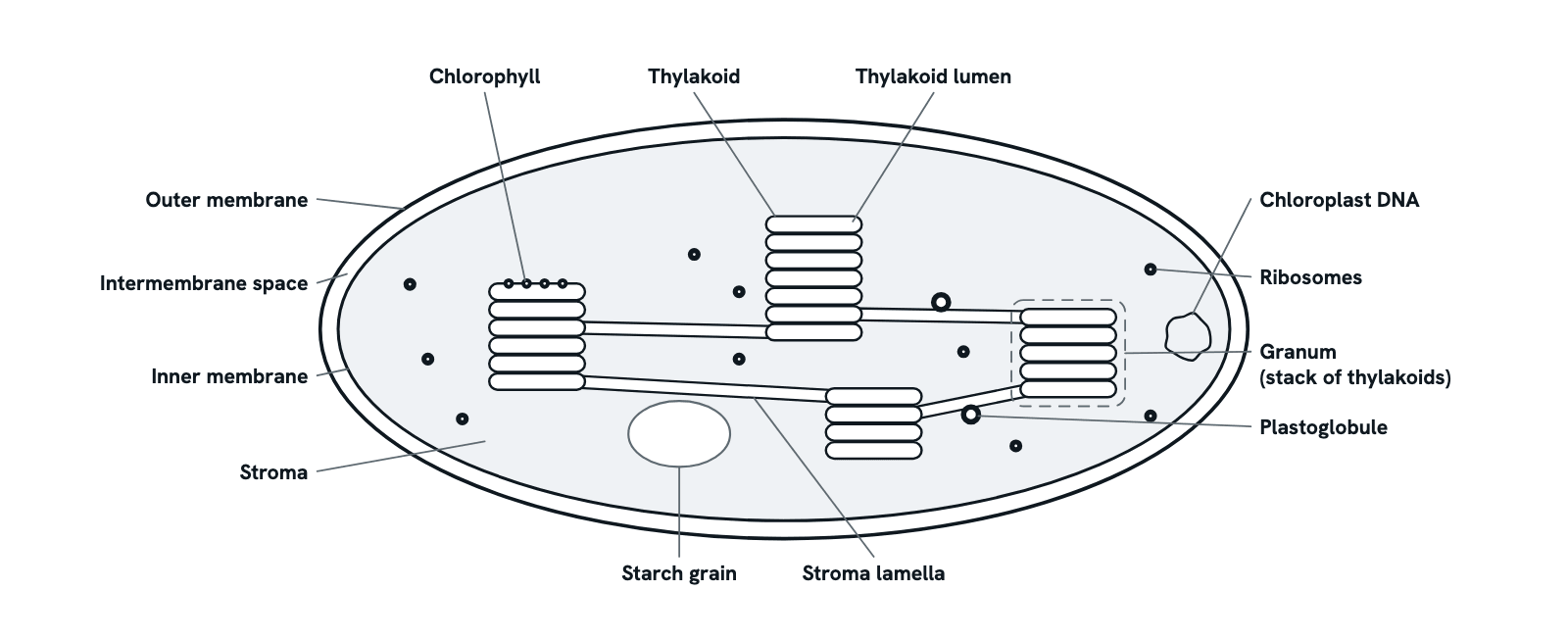
A chloroplast cut lengthways, not to scale. Two envelope membranes enclose the stroma, where the Calvin cycle makes sugar and starch is stored; inside it, flattened thylakoids stacked into grana and linked by stroma lamellae carry chlorophyll and the light reactions of photosynthesis. Press any part to see what it is and what it does, or take the tour in order.
Also called Chloroplast structure or Chloroplast diagram.
Press any part of the diagram, or pick one here, to see what it is and what it does.
Download the diagramChecked against its sources on 5 November 2026.
A tour
A tour of the chloroplast
01The chloroplast at a glance
A chloroplast cut lengthways, as in a leaf's mesophyll cell: a sunlight-driven factory that makes the sugar the rest of the plant, and most other life, runs on. Two envelope membranes enclose the stroma, and inside the stroma a third membrane system, the thylakoids, stacks into grana linked by stroma lamellae. Not to scale.
02The envelope: two membranes and a gap
The envelope has an outer and an inner membrane with a narrow intermembrane space between them. The inner membrane controls what crosses: the triose-phosphate/phosphate translocator exports the sugar phosphate the Calvin cycle makes in exchange for phosphate, and K⁺/H⁺ antiporters set the stroma's pH. When the chloroplast divides, an FtsZ ring inside the inner membrane marks the site and proteins across the gap link it to a dynamin ring on the outer membrane.
03The thylakoid membrane holds the light reactions
The thylakoid membrane holds the light-dependent reactions. Chlorophyll sits in the light-harvesting antennae and reaction centres of photosystems II and I; the cytochrome b₆f complex passes electrons between them, with plastocyanin carrying them through the lumen, and ATP synthase uses the proton gradient. Photosystem II and its antenna crowd the stacked grana membranes; photosystem I and ATP synthase sit mainly in the stroma lamellae and the ends of the stacks.
04Grana and stroma lamellae
In land plants the thylakoids have two parts: grana, cylindrical stacks of discs, and stroma lamellae, unstacked thylakoids wound round the stacks in right-handed helices at 20 to 25 degrees and joined to them by slit-like openings. Light-harvesting proteins on facing membranes are thought to stick a stack together, and CURT1 proteins at its margins set the number and width of its discs. The system reshapes with light: grana change in size, unstack, and the lumen swells.
05The lumen and the proton gradient
The light reactions pump protons into the lumen and leave the stroma alkaline: in a lit leaf the stroma sits near pH 8 and the lumen near pH 6, lower in bright light, and both drift back towards pH 7.4 in the dark. This proton-motive force, part pH gradient and part electric field, drives ATP synthase. Lumen pH is also a signal: when it falls, photoprotection switches on and the b₆f complex slows electron flow, sparing photosystem I from lasting damage.
06The stroma: the Calvin cycle and starch
The stroma holds the Calvin cycle, shown step by step in the photosynthesis diagram: RuBisCO fixes carbon dioxide, and ATP and NADPH from the thylakoids reduce it to sugar phosphate, which leaves through the inner membrane. The alkaline stroma of a lit leaf keeps the Calvin cycle enzymes switched on. Sugar that is not exported is stored as grains of transitory starch, which enzymes such as β-amylase 3 break down at night to keep the plant supplied until morning.
07Its own DNA and ribosomes: a cyanobacterium's legacy
Chloroplasts descend from a cyanobacterium taken in by an early eukaryote, and keep a genome of their own: in flowering plants usually a circular molecule of 120 to 160 kilobases, in many copies per cell, read by the chloroplast's own bacterial-type 70S ribosomes. Most of the ancestor's genes have moved to the nucleus, so most of its proteins are encoded there. Like a bacterium, the chloroplast divides by fission, constricted by an FtsZ ring of cyanobacterial descent.
08Where chloroplasts are, and how many
Chloroplasts fill a leaf's mesophyll cells: an Arabidopsis mesophyll cell holds about 80 to 120, and as the cell grows its chloroplasts divide to keep pace, so their total area stays a steady share of the cell's. Leaves grown in strong light make more chloroplasts per cell and more photosystem II, cytochrome b₆f and ATP synthase per chlorophyll, but the same photosystem I. Plastoglobules swell under stresses such as high light or a shortage of nitrogen.
09Chloroplast and mitochondrion
Chloroplast and mitochondrion are cousins: both have two membranes, a circular genome and ribosomes of their own, and both began as bacteria inside another cell, a cyanobacterium and an alphaproteobacterium. Both make ATP from a proton gradient. The chloroplast has a third membrane system, the thylakoids; the mitochondrion folds its inner membrane into cristae instead. One captures light to build sugar from carbon dioxide; the other burns sugar for ATP.
Parts
What each part of the chloroplast does
- Outer membrane
- The outer of the two envelope membranes, the chloroplast's boundary with the cytosol. When the chloroplast divides, a ring of dynamin-related protein forms on its outer face and PDV proteins in it link the outer and inner division machinery across the intermembrane space.
- Intermembrane space
- The narrow gap between the two envelope membranes. Proteins reach across it: when the chloroplast divides, PDV2 in the outer membrane meets ARC6 in the inner membrane here, so the two membranes pinch in together.
- Inner membrane
- The inner envelope membrane, which encloses the stroma. Its transporters control traffic with the cytosol: the triose-phosphate/phosphate translocator exports the sugar phosphate the Calvin cycle makes in exchange for phosphate, and K⁺/H⁺ antiporters in it help set the pH of the stroma.
- Stroma
- The fluid inside the inner membrane, around the thylakoids. It holds the Calvin cycle enzymes, including RuBisCO, the chloroplast's DNA and ribosomes, and its starch. In the light it becomes alkaline, near pH 8, which with magnesium and thioredoxin switches the Calvin cycle enzymes on.
- Thylakoid
- A flattened membrane sac in the stroma. Its membrane holds chlorophyll, the two photosystems, the cytochrome b₆f complex and ATP synthase, so the light reactions run here. Thylakoids stack into grana and run between the stacks as stroma lamellae.
- Thylakoid lumen
- The space inside a thylakoid. In the light, protons pumped into it bring it to about pH 6, lower in bright light, against about pH 8 in the stroma; the gradient drives ATP synthase, and the acidity switches on photoprotection. Plastocyanin diffuses through it, and in the light it swells, easing that diffusion.
- Granum
- A stack of thylakoid discs, piled like coins. The stacked membranes hold photosystem II with its light-harvesting antenna; adhesion between those antenna proteins on facing membranes is thought to hold the stack together, and CURT1 proteins at the margins set the number and size of its discs.
- Stroma lamella
- An unstacked thylakoid that runs through the stroma from one granum to the next, wound round the stacks in a helix and joined to them by slit-like openings. Photosystem I and ATP synthase sit mainly here and in the end membranes of the grana.
- Chlorophyll
- The green pigment, held in the light-harvesting antennae and reaction centres of the two photosystems in the thylakoid membrane, drawn here as particles in one membrane. Leaves grown in stronger light carry more chlorophyll per unit area and a higher ratio of chlorophyll a to b.
- Starch grain
- A grain of transitory starch in the stroma, a store of the sugar made in photosynthesis. At night, enzymes such as β-amylase 3 break it down in the mesophyll cells to keep the plant supplied until morning.
- Plastoglobule
- A lipid droplet attached to a thylakoid, bounded by a single layer of lipid, with about 30 core proteins. It stores and processes prenyl lipids such as tocopherols and plastoquinone, helps recycle thylakoid lipids as leaves age, and grows under stresses such as high light.
- Chloroplast DNA
- The chloroplast's own genome: in flowering plants usually a circular molecule of 120 to 160 kilobases holding 110 to 130 genes, in which two inverted repeats separate a large and a small single-copy region. It descends from a cyanobacterium's genome, and most of the ancestor's genes have since moved to the nucleus.
- Ribosomes
- The chloroplast's own ribosomes, which translate its genes. They are bacterial-type 70S ribosomes, and its protein synthesis still works much as a bacterium's does, though both have gained features of their own: one more sign of where the organelle came from.
Dictionary
The terms to know
Practise it
The quizzes and cards that fit
- Botany quizzes
- Chloroplasts15 questions
- Parts of a Flower15 questions
- Plant Hormones15 questions
- Cell Biology quizzes
- Characteristics of Life15 questions
- Lab Safety15 questions
- Cell Theory15 questions
- Biochemistry quizzes
- Photosynthesis and Cellular Respiration15 questions
- Molarity and Dilutions15 questions
- ATP and Cellular Energy15 questions
- Botany flashcards
The subject's terms as a ready-made deck, free to flip through.
Next to it
More diagrams
Sources
Where the facts come from
- Pribil, Labs and Leister, Structure and dynamics of thylakoids in land plants, Journal of Experimental Botany, 2014 (PubMed)
- Austin and Staehelin, Three-dimensional architecture of grana and stroma thylakoids of higher plants as determined by electron tomography, Plant Physiology, 2011 (PubMed)
- Kirchhoff, Chloroplast ultrastructure in plants, New Phytologist, 2019 (PubMed)
- Schöttler and Tóth, Photosynthetic complex stoichiometry dynamics in higher plants, Frontiers in Plant Science, 2014 (PubMed Central)
- Didaran and others, Proton motive force partitioning links energy and redox balance to photoprotection and carbon gain, Frontiers in Plant Science, 2026 (PubMed Central)
- Kirchhoff and others, Dynamic control of protein diffusion within the granal thylakoid lumen, PNAS, 2011 (PubMed Central)
- Rodríguez-Rosales and others, Chloroplast envelope K+/H+ antiporters are involved in cytosol pH regulation, Physiologia Plantarum, 2024 (PubMed)
- Daniell and others, Chloroplast genomes: diversity, evolution, and applications in genetic engineering, Genome Biology, 2016 (PubMed Central)
- Cauz-Santos, Beyond conservation: the landscape of chloroplast genome rearrangements in angiosperms, New Phytologist, 2025 (PubMed Central)
- Zoschke and Bock, Chloroplast Translation: Structural and Functional Organization, Operational Control, and Regulation, The Plant Cell, 2018 (PubMed)
- Bieri and others, The complete structure of the chloroplast 70S ribosome in complex with translation factor pY, The EMBO Journal, 2017 (PubMed Central)
- van Wijk and Kessler, Plastoglobuli: Plastid Microcompartments with Integrated Functions in Metabolism, Plastid Developmental Transitions, and Environmental Adaptation, Annual Review of Plant Biology, 2017 (PubMed)
- Lee and others, Plant organelle division orchestrated by the mosaic machinery of endosymbiotic relics and eukaryotic host factors, Plant Physiology, 2026 (PubMed Central)
- Zeeman, Kossmann and Smith, Starch: its metabolism, evolution, and biotechnological modification in plants, Annual Review of Plant Biology, 2010 (PubMed)
- Pfister and Zeeman, Formation of starch in plant cells, Cellular and Molecular Life Sciences, 2016 (PubMed Central)
- Nagler and others, Integrative molecular profiling indicates a central role of transitory starch breakdown in establishing a stable C/N homeostasis during cold acclimation in two natural accessions of Arabidopsis thaliana, BMC Plant Biology, 2015 (PubMed Central)
- Archibald, Endosymbiosis and Eukaryotic Cell Evolution, Current Biology, 2015 (PubMed)
Drawn and written by biofideX from these sources.