Mitochondrion Diagram
The parts of a mitochondrion and what each does: the two membranes, the cristae with the electron transport chain and ATP synthase, the matrix and its own DNA.
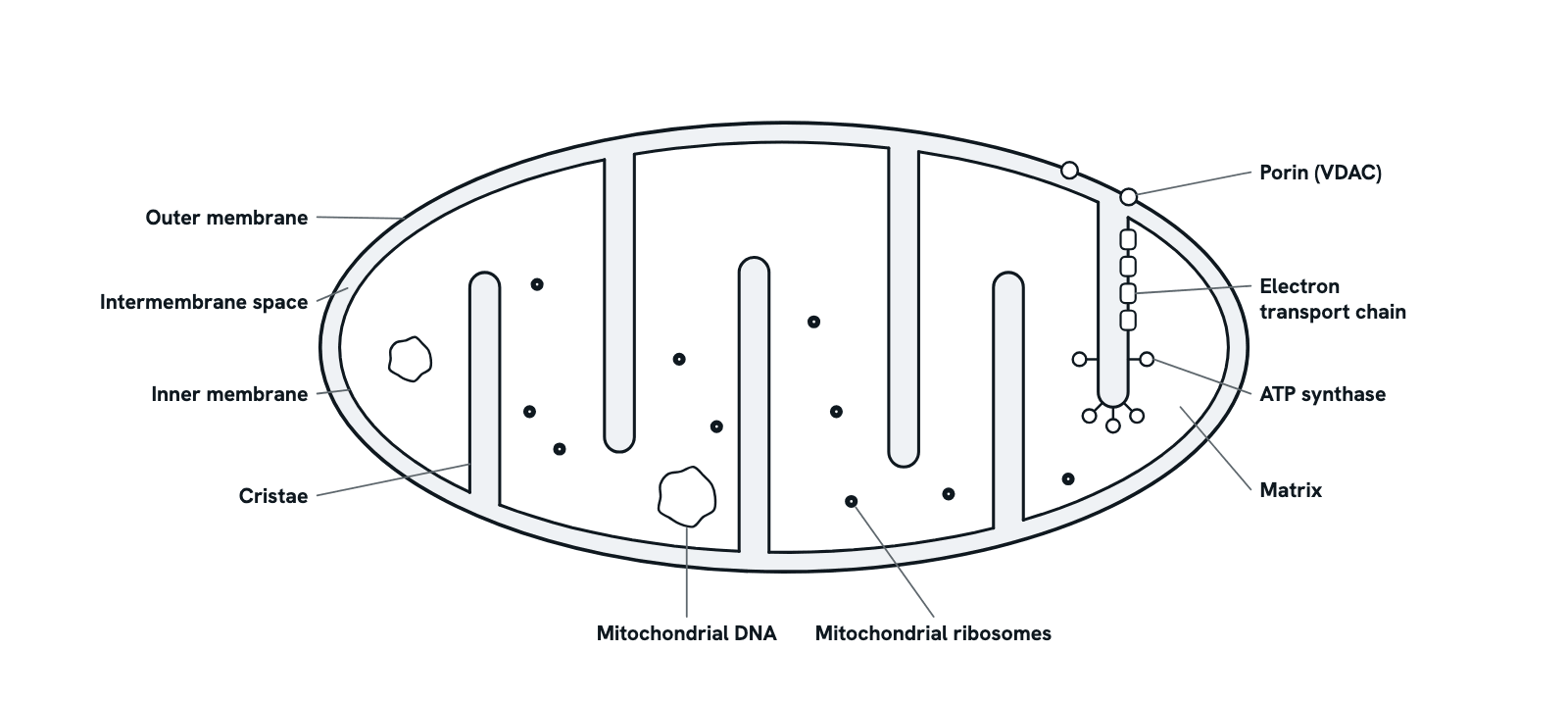
A mitochondrion cut lengthways, not to scale. Two membranes enclose it: the outer one is smooth, the inner one folds into cristae that carry the electron transport chain and ATP synthase, and the matrix inside holds the Krebs cycle and the organelle's own circular DNA and ribosomes. Press any part to see what it is and what it does, or take the tour in order.
Also called Mitochondria, Mitochondria diagram or Powerhouse of the cell.
Press any part of the diagram, or pick one here, to see what it is and what it does.
Download the diagramChecked against its sources on 5 November 2026.
A tour
A tour of the mitochondrion
01The mitochondrion at a glance
A mitochondrion is wrapped in two membranes. The smooth outer membrane encloses the whole organelle; the inner membrane folds inwards into cristae and encloses the matrix, with the narrow intermembrane space between the two. Here the cell burns fuel with oxygen to make ATP, its main energy currency. A cell holds hundreds to thousands of mitochondria; this one is cut lengthways and not to scale.
02Two membranes, two kinds of gate
The outer membrane is leaky to small molecules: channel proteins of the VDAC family, the porins, are the main route for metabolites in and out, and the cell can regulate them. The inner membrane is impermeable to most solutes: they cross it through dedicated transporters, many of them carriers of the SLC25 family, 53 of them in humans, such as the ADP/ATP carrier. That tightness lets it hold the proton gradient that drives ATP synthesis.
03The matrix: fuel into electrons
The matrix is the space inside the inner membrane. Here the citric acid cycle, the Krebs cycle, and fatty acid oxidation strip electrons from food molecules and load them onto the carriers NADH and FADH₂, which hand them to the electron transport chain in the inner membrane. The organelle's own DNA and ribosomes lie here too.
04Cristae: the folds that carry the chain
The cristae are folds of the inner membrane that reach into the matrix, each joined to the rest of the membrane at a narrow cristae junction, and they carry the complexes of oxidative phosphorylation. As electrons from NADH and FADH₂ pass along the electron transport chain to oxygen, the complexes pump protons out of the matrix into the space inside the cristae, which opens into the intermembrane space. Models predict that more cristae surface means faster ATP production.
05ATP synthase and chemiosmosis
Pumping protons into the cristae builds an electrochemical gradient across the inner membrane, the proton-motive force. Protons flow back into the matrix through ATP synthase, and the flow turns ADP and phosphate into ATP: Mitchell's chemiosmotic theory. Measured yields are about 2.5 ATP for each NADH and 1.5 for each FADH₂, so one glucose molecule, fully oxidised, gives about 30 to 32 ATP. Rows of ATP synthase dimers also help bend the membrane into the cristae.
06Mitochondrial DNA: 37 genes, from the mother
The matrix holds copies of a small circular chromosome. Human mitochondrial DNA is 16,569 base pairs long and carries 37 genes: 13 encode proteins of the oxidative phosphorylation complexes, and the other 24 encode the 22 transfer RNAs and 2 ribosomal RNAs needed to make them on the mitochondrion's own ribosomes. Mitochondria, and so their DNA, are generally inherited only from the mother, so mitochondrial DNA can trace a maternal line back through the generations.
07When mitochondrial DNA goes wrong
Mitochondrial DNA is easily damaged by reactive oxygen species made beside it and repairs itself poorly. Its mutations cause many mitochondrial diseases, felt most where energy demand is high: brain, muscle, heart and eye. Leber hereditary optic neuropathy comes from complex I genes, MELAS mostly from the A3243G change in a transfer RNA gene and Kearns-Sayre syndrome from one large deletion. A fifth of Leigh syndrome cases come from mtDNA, most often MT-ATP6.
08An ancient bacterium inside the cell
Mitochondria descend from a free-living bacterium of the alphaproteobacteria that was taken into an archaeal host cell and stayed: the endosymbiotic theory. The idea of symbiotic origins goes back over a century, to Konstantin Mereschkowsky; Lynn Margulis made the case for mitochondria in 1967. The evidence is in the picture: two membranes, a circular chromosome of its own, and its own ribosomes and protein synthesis. Chloroplasts arose the same way, from a cyanobacterium.
09Many where energy is needed, and a say in cell death
The cells that work hardest have the most mitochondria: muscle, liver, kidney and brain, and endurance training makes muscle build more of them. Mitochondria also help decide whether a cell dies. Cytochrome c normally works in the electron transport chain; when a cell receives an apoptotic signal, the outer membrane becomes permeable to small proteins, cytochrome c escapes into the cytosol and triggers apoptosis, under the control of the BCL-2 family of proteins.
Parts
What each part of the mitochondrion does
- Outer membrane
- The smooth outer boundary of the organelle. Channel proteins in it let small molecules through, so it is a regulated sieve rather than a tight barrier; when it becomes permeable to small proteins, apoptosis follows.
- Porin (VDAC)
- A channel protein of the voltage-dependent anion channel family, the main pathway for metabolites across the outer membrane. The cell regulates these channels to adjust the mitochondrion's metabolism to its needs.
- Intermembrane space
- The narrow space between the two membranes, which runs on into the inside of every crista. The electron transport chain pumps protons into it, so it is more acidic than the matrix and the inner membrane is negative on its matrix side.
- Inner membrane
- The inner boundary membrane, impermeable to most solutes: they cross it through dedicated transporters, many of them carriers of the SLC25 family, 53 kinds in humans, such as the ADP/ATP carrier. Its tightness lets it hold the proton gradient that powers ATP synthesis.
- Cristae
- Folds of the inner membrane that reach into the matrix, each joined to the boundary membrane at a narrow cristae junction. They carry the complexes of oxidative phosphorylation and give them a large surface area.
- Electron transport chain
- Complexes I to IV in the membrane of the cristae. They pass electrons from NADH and FADH₂ along the chain to oxygen, and complexes I, III and IV use the energy released to pump protons out of the matrix. Complex IV, cytochrome c oxidase, is the last step before ATP is made.
- ATP synthase
- Complex V, drawn as knobs on the matrix face of the cristae. Protons flowing back into the matrix through it drive the synthesis of ATP from ADP and phosphate. Its dimers line up in rows along the cristae and help bend the membrane into its folds.
- Matrix
- The space inside the inner membrane. The citric acid cycle and fatty acid oxidation run here, loading electrons onto NADH and FADH₂ for the electron transport chain, and the mitochondrion's own DNA and ribosomes lie here.
- Mitochondrial DNA
- A circular chromosome of 16,569 base pairs in humans, present in several copies, with 37 genes: 13 for proteins of the oxidative phosphorylation complexes, 22 for transfer RNAs and 2 for ribosomal RNAs. It is inherited from the mother.
- Mitochondrial ribosomes
- The organelle's own ribosomes, which make the 13 proteins its DNA encodes, all of them parts of the oxidative phosphorylation complexes. The human mitoribosome has 80 proteins and three RNAs, the 12S and 16S ribosomal RNAs and a valine transfer RNA, and differs from both bacterial and cytosolic ribosomes.
Dictionary
The terms to know
Practise it
The quizzes and cards that fit
- Cell Biology quizzes
- Characteristics of Life15 questions
- Lab Safety15 questions
- Cell Theory15 questions
- Biochemistry quizzes
- Photosynthesis and Cellular Respiration15 questions
- Molarity and Dilutions15 questions
- ATP and Cellular Energy15 questions
- Physiology quizzes
- Exercise Physiology15 questions
- Puberty15 questions
- Blood Clotting15 questions
- Cell Biology flashcards
The subject's terms as a ready-made deck, free to flip through.
Next to it
More diagrams
Sources
Where the facts come from
- MedlinePlus Genetics: Mitochondrial DNA
- NHGRI Talking Glossary of Genomic and Genetic Terms: Mitochondria
- NHGRI Talking Glossary of Genomic and Genetic Terms: Mitochondrial DNA
- NCBI Reference Sequence NC_012920.1: Homo sapiens mitochondrion, complete genome
- Joubert and Puff, Mitochondrial Cristae Architecture and Functions: Lessons from Minimal Model Systems, Membranes, 2021 (PubMed Central)
- Ruprecht and Kunji, The SLC25 Mitochondrial Carrier Family: Structure and Mechanism, Trends in Biochemical Sciences, 2020 (PubMed Central)
- Colombini, VDAC: the channel at the interface between mitochondria and the cytosol, Molecular and Cellular Biochemistry, 2004 (PubMed)
- Hinkle, P/O ratios of mitochondrial oxidative phosphorylation, Biochimica et Biophysica Acta, 2005 (PubMed)
- Amunts and others, The structure of the human mitochondrial ribosome, Science, 2015 (PubMed Central)
- Ow and others, Cytochrome c: functions beyond respiration, Nature Reviews Molecular Cell Biology, 2008 (PubMed)
- Archibald, Endosymbiosis and Eukaryotic Cell Evolution, Current Biology, 2015 (PubMed)
- Zachar and Szathmáry, Breath-giving cooperation: critical review of origin of mitochondria hypotheses, Biology Direct, 2017 (PubMed Central)
- Deshpande and Mohiuddin, Biochemistry, Oxidative Phosphorylation, StatPearls (NCBI Bookshelf)
- MedlinePlus Genetics: Leigh syndrome
Drawn and written by biofideX from these sources.