Plant Cell Diagram
The parts of a plant cell and what each does: the cell wall, chloroplasts, the central vacuole, the nucleus, the ER and more.
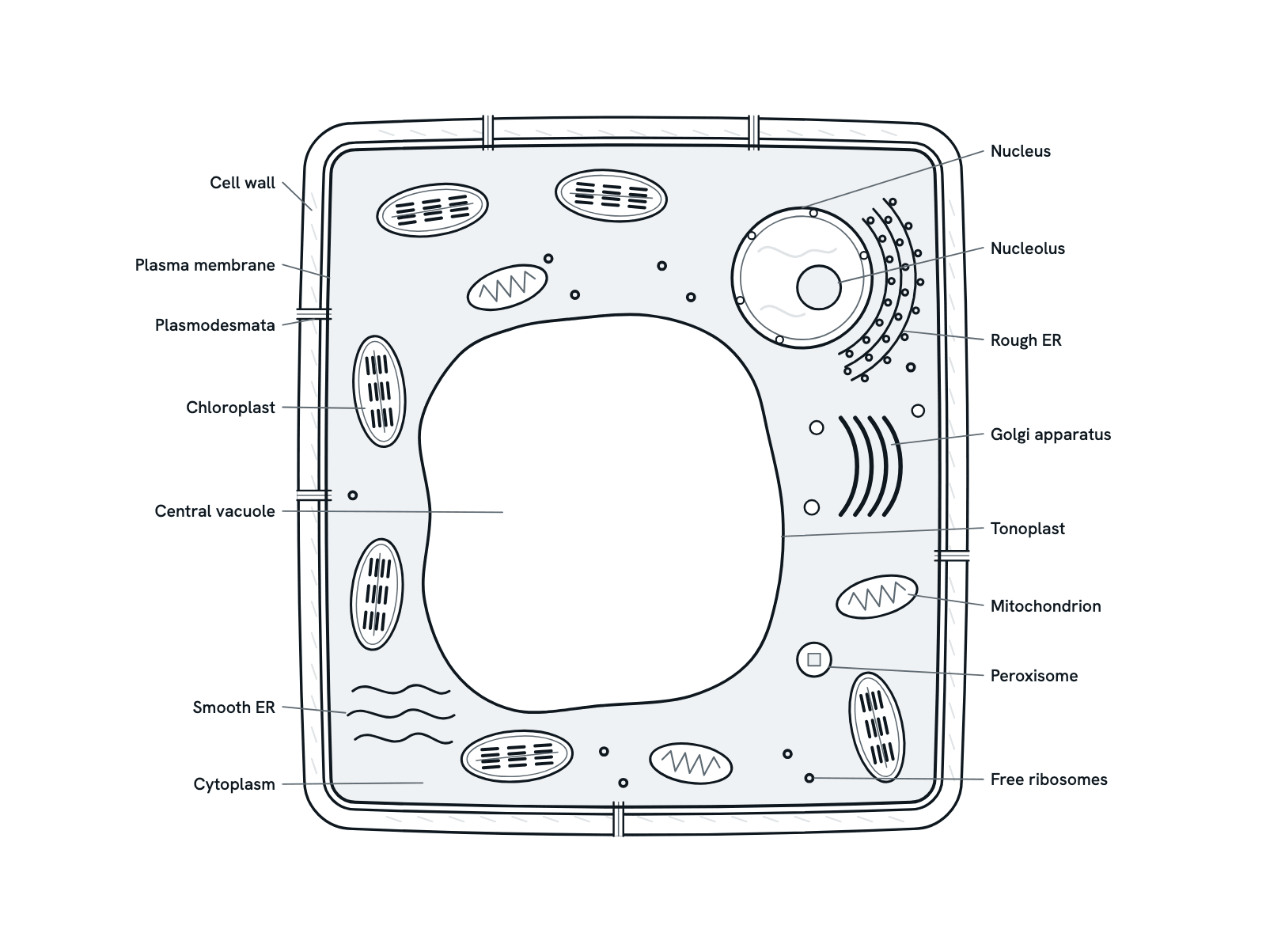
A plant cell is a eukaryotic cell like an animal cell, with a nucleus and much the same organelles, plus three things of its own: a cell wall, chloroplasts and a large central vacuole. Drawn in section, as in a leaf. Press any part to see what it is and what it does, or take the tour in order. Not to scale.
Press any part of the diagram, or pick one here, to see what it is and what it does.
Download the diagramChecked against its sources on 29 October 2026.
A tour
A tour of the plant cell
01The plant cell at a glance
A plant cell is a eukaryotic cell: its DNA is kept in a nucleus, and its work is split between organelles, as in an animal cell. Three things set it apart: a cell wall outside the plasma membrane, chloroplasts for photosynthesis, and a large central vacuole.
02The cell wall and plasma membrane
Outside the plasma membrane, the cell builds a wall of cellulose fibres bound together by hemicelluloses and pectins. Water flows into the cell by osmosis and pushes the membrane against the wall; the wall holds firm, and that pressure, turgor, keeps stems and leaves stiff.
03Plasmodesmata join neighbouring cells
The wall would cut each cell off from its neighbours, so it is crossed by plasmodesmata: channels lined with plasma membrane, with a fine strand of ER down the middle. Through them the cytoplasm of one cell joins the next, and small molecules such as sugars and ions pass from cell to cell.
04The central vacuole
A large vacuole, bounded by its own membrane, the tonoplast, fills much of a mature cell. It stores water, ions, sugars, pigments and waste, and breaks down unwanted material. By taking up water it presses the cytoplasm against the wall, so the cell can grow large cheaply and the plant stays firm. When it loses water, the plant wilts.
05Chloroplasts
Chloroplasts capture light energy and use it to make sugar from carbon dioxide and water. Each has an outer and an inner membrane round a fluid stroma, with flattened thylakoids stacked into grana. Like mitochondria, they have their own DNA and ribosomes, a sign that they came from bacteria taken in long ago.
06The nucleus and nucleolus
The nucleus holds the cell's DNA as chromatin, inside the double-membraned nuclear envelope, whose pores let messenger RNA out and proteins in. In the nucleolus, ribosomal RNA is made and built into ribosome subunits. In a mature cell, the vacuole presses the nucleus, with the rest of the cytoplasm, towards the wall.
07Ribosomes, the ER and the Golgi apparatus
Ribosomes make proteins. Those on the rough ER make proteins for membranes, the vacuole and the wall; the smooth ER makes lipids. The Golgi apparatus modifies and sorts these proteins, and in plant cells it also makes the wall's hemicelluloses and pectins, which vesicles carry to the surface.
08Mitochondria and peroxisomes
Plant cells have mitochondria too: they break down the sugars that chloroplasts make and turn their energy into ATP, as in animal cells. Peroxisomes break down fatty acids; in leaves they work with chloroplasts and mitochondria in photorespiration, and in seeds they help turn stored fat into sugar.
09Plant and animal cells compared
A plant cell has a cell wall, chloroplasts and a large central vacuole, which an animal cell lacks; its vacuole also does much of the work of an animal cell's lysosomes. It usually has no centrioles: its microtubules, and the spindle that separates chromosomes when it divides, are organised without them. Both have mitochondria.
Parts
What each part of the plant cell does
- Cell wall
- A tough layer outside the plasma membrane, built of cellulose fibres set in a matrix of hemicelluloses and pectins. It gives the cell its shape and resists the pressure of the water it takes in, so the cell cannot burst.
- Plasma membrane
- A double layer of phospholipids with proteins in it, pressed against the inside of the wall. It controls what enters and leaves the cell, and enzymes in it spin out the cellulose fibres of the wall.
- Plasmodesmata
- Fine channels through the wall, lined with plasma membrane, that join the cytoplasm of neighbouring cells. Sugars, ions and other small molecules pass through them, and some proteins and RNAs can be let through too.
- Cytoplasm
- Everything inside the plasma membrane but outside the nucleus: the watery cytosol and the organelles in it. In a mature plant cell the vacuole presses it against the wall, often into a thin layer; it is drawn thicker here so its organelles show.
- Central vacuole
- A large sac of watery cell sap that often fills more than 30% of the cell, and up to 90% in some. It stores ions, sugars, pigments and waste, breaks down unwanted material, and its water keeps the cell firm.
- Tonoplast
- The membrane round the central vacuole. Its pumps and channels control what passes between the cytosol and the vacuole, including the water and ions that set the cell's turgor pressure.
- Chloroplasts
- Carry out photosynthesis, using light energy to make sugar from carbon dioxide and water. Each has two membranes round a fluid stroma, holding flattened thylakoids stacked into grana, where chlorophyll sits. They have their own DNA.
- Nucleus
- Holds the cell's DNA as chromatin, inside a double membrane, the nuclear envelope. Pores in the envelope let RNA out and proteins in. In a mature cell the vacuole pushes it to one side, close to the wall.
- Nucleolus
- A dense region of the nucleus where ribosomal RNA is made and joined with proteins into the two subunits of ribosomes.
- Ribosomes
- Make proteins by reading messenger RNA. Free ribosomes in the cytosol make proteins for the cytosol, nucleus, mitochondria, chloroplasts and peroxisomes; others sit on the rough ER.
- Rough endoplasmic reticulum
- Folded membranes joined to the nuclear envelope, studded with ribosomes. Proteins for membranes, the vacuole and the wall are made here and fold inside it.
- Smooth endoplasmic reticulum
- Tubes of membrane with no ribosomes, where lipids for the cell's membranes are made. Fine strands of it run through the plasmodesmata, joining the ER of neighbouring cells.
- Golgi apparatus
- A stack of flattened sacs that modifies and sorts proteins from the ER. In plant cells it also makes the hemicelluloses and pectins of the wall, which vesicles carry out to the cell surface.
- Mitochondria
- Make ATP by aerobic respiration, breaking down sugars that the chloroplasts made. Plant cells have them too, and respire just as animal cells do. Each has two membranes, the inner one folded into cristae.
- Peroxisome
- A small organelle whose enzymes break down fatty acids. In leaf cells it works with chloroplasts and mitochondria to recover carbon lost in photorespiration; in seeds it helps turn stored fat into sugar.
Dictionary
The terms to know
Practise it
The quizzes and cards that fit
- Cell Biology quizzes
- Characteristics of Life15 questions
- Lab Safety15 questions
- Cell Theory15 questions
- Botany quizzes
- Chloroplasts15 questions
- Parts of a Flower15 questions
- Plant Hormones15 questions
- Cell Biology flashcards
The subject's terms as a ready-made deck, free to flip through.
Next to it
More diagrams
Sources
Where the facts come from
- Cooper, The Cell: A Molecular Approach, 2nd edition: Cell Walls and the Extracellular Matrix (NCBI Bookshelf)
- Cooper, The Cell: A Molecular Approach, 2nd edition: Chloroplasts and Other Plastids (NCBI Bookshelf)
- Cooper, The Cell: A Molecular Approach, 2nd edition: Microtubules (NCBI Bookshelf)
- Cooper, The Cell: A Molecular Approach, 2nd edition: Peroxisomes (NCBI Bookshelf)
- Alberts and others, Molecular Biology of the Cell, 4th edition: The Plant Cell Wall (NCBI Bookshelf)
- Alberts and others, Molecular Biology of the Cell, 4th edition: Cell Junctions (NCBI Bookshelf)
- Alberts and others, Molecular Biology of the Cell, 4th edition: Transport from the Trans Golgi Network to Lysosomes (NCBI Bookshelf)
Drawn and written by biofideX from these sources.