Photosynthesis Diagram
How a chloroplast turns light, water and carbon dioxide into sugar and oxygen: the light-dependent reactions and the Calvin cycle.
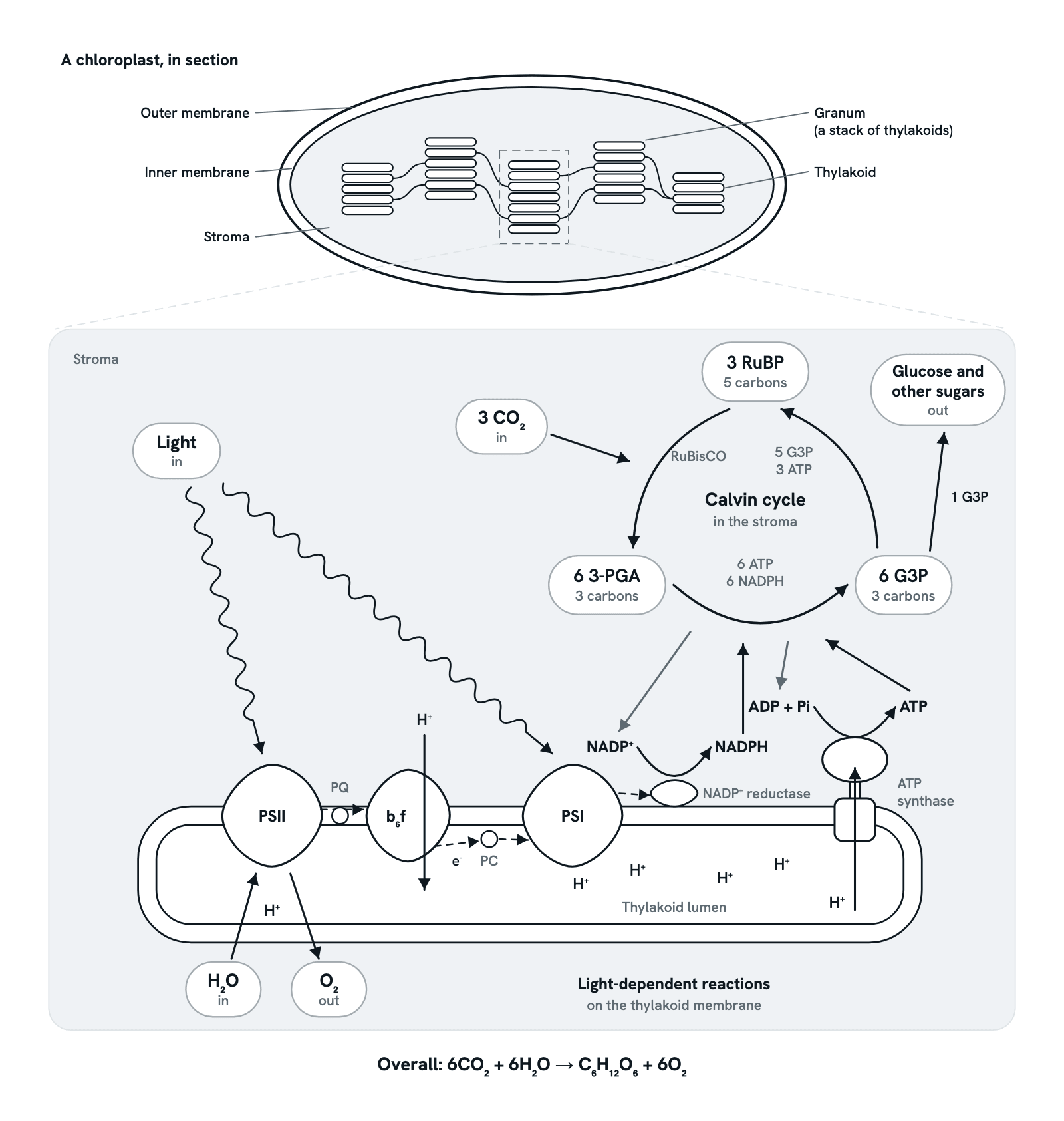
Plants, algae and cyanobacteria use the energy of light to make sugar from carbon dioxide and water, giving off oxygen. Above, a chloroplast in section; below, one thylakoid enlarged, with the light-dependent reactions on its membrane and the Calvin cycle in the stroma around it. Step through it, or press any part. Not to scale.
Step 1 of 10
Photosynthesis at a glance
Photosynthesis stores the energy of light in sugar. It runs in two linked stages in the chloroplast: the light-dependent reactions, on the thylakoid membranes, make ATP and NADPH and give off oxygen; the Calvin cycle, in the stroma, spends them to build sugar from carbon dioxide. Summed up: 6CO₂ + 6H₂O → C₆H₁₂O₆ + 6O₂. The Calvin cycle is sometimes called the dark reactions, but several of its enzymes are switched off in the dark, so it runs in the light.
Use ← and → to move between steps.
Step 1 of 10: Photosynthesis at a glance
Download the diagramChecked against its sources on 29 October 2026.
Step by step
The steps of the Photosynthesis
01Photosynthesis at a glance
Photosynthesis stores the energy of light in sugar. It runs in two linked stages in the chloroplast: the light-dependent reactions, on the thylakoid membranes, make ATP and NADPH and give off oxygen; the Calvin cycle, in the stroma, spends them to build sugar from carbon dioxide. Summed up: 6CO₂ + 6H₂O → C₆H₁₂O₆ + 6O₂. The Calvin cycle is sometimes called the dark reactions, but several of its enzymes are switched off in the dark, so it runs in the light.
02Where it happens: the chloroplast
A chloroplast has an outer and an inner membrane round a fluid, the stroma. Inside lies a third membrane, folded into flattened sacs called thylakoids, many of them stacked into grana; the space inside them is the lumen. The light-dependent reactions run on the thylakoid membrane, and the Calvin cycle in the stroma.
03Light reaches photosystem II
Each photosystem holds hundreds of chlorophyll and other pigment molecules, which pass the energy of absorbed light to a special pair of chlorophylls at its reaction centre. In photosystem II this energy lifts an electron to a high energy level, and the electron is handed to an acceptor, starting a flow of electrons along the membrane.
04Water is split and oxygen released
Photosystem II replaces the electrons it loses by taking them from water. A cluster of manganese atoms splits two water molecules into four hydrogen ions, four electrons and one molecule of oxygen: 2H₂O → 4H⁺ + 4e⁻ + O₂. The hydrogen ions stay in the lumen; the oxygen leaves the leaf through the stomata.
05Electrons pass along and pump hydrogen ions
Plastoquinone carries the electrons to the cytochrome b₆f complex, and plastocyanin carries them on to photosystem I. As they pass through the cytochrome b₆f complex, it pumps hydrogen ions from the stroma into the lumen, which becomes far more acidic than the stroma: about pH 5.5 to 6 against pH 8.
06Photosystem I makes NADPH
Photosystem I absorbs more light and lifts the electrons to a higher energy level again. They pass to ferredoxin, a small protein on the stroma side, and the enzyme NADP⁺ reductase uses them to reduce NADP⁺ to NADPH, the reducing power the Calvin cycle needs.
07ATP synthase makes ATP
The hydrogen ions crowded in the lumen can flow back to the stroma only through ATP synthase. Their flow drives the enzyme to join ADP and phosphate (Pi) into ATP, on the stroma side of the membrane. Making ATP this way, with energy from light, is called photophosphorylation.
08RuBisCO fixes carbon dioxide
In the stroma, the enzyme RuBisCO adds carbon dioxide to ribulose bisphosphate (RuBP), a five-carbon sugar. The six-carbon product splits at once into two molecules of 3-phosphoglycerate (3-PGA), so 3 CO₂ and 3 RuBP give 6 3-PGA. RuBisCO is slow, so leaves hold a great deal of it; it is probably the most abundant protein on Earth.
093-PGA is reduced to G3P
Each 3-PGA takes a phosphate from ATP and is then reduced by NADPH to glyceraldehyde 3-phosphate (G3P), a three-carbon sugar. For 6 3-PGA this uses 6 ATP and 6 NADPH. The ADP, phosphate and NADP⁺ left over go back to the thylakoid membrane to be recharged.
10One G3P leaves, five remake RuBP
Of the 6 G3P, one leaves the cycle: the net gain from fixing 3 CO₂. Two G3P make one glucose, and the cell builds sucrose, starch and its other molecules from G3P. The other 5 G3P are rearranged, using 3 more ATP, into 3 RuBP, so the cycle turns again. In all, 3 CO₂ make 1 G3P for 9 ATP and 6 NADPH.
Parts
What each part of the photosynthesis does
- Outer membrane
- The outer of the chloroplast's two envelope membranes. Pore proteins in it let small molecules pass freely.
- Inner membrane
- The inner envelope membrane. It lets ions and other molecules through only by its transport proteins, so it controls what enters and leaves the stroma. G3P leaves through it in exchange for phosphate.
- Thylakoids and grana
- Flattened sacs of membrane inside the chloroplast, many of them stacked into piles called grana and joined by unstacked lamellae. Their membrane holds the chlorophyll, the photosystems, the electron carriers and ATP synthase.
- Stroma
- The fluid inside the inner membrane, around the thylakoids. It holds the enzymes of the Calvin cycle, including RuBisCO, and the chloroplast's own DNA and ribosomes. Starch is stored here as grains.
- Thylakoid lumen
- The space inside the thylakoids. In the light, hydrogen ions released and pumped into it build up until it is about pH 6, or nearer pH 5.5 in bright light, against about pH 8 in the stroma.
- Light
- Sunlight, absorbed by chlorophyll, the green pigment of the thylakoid membrane, and by accessory pigments such as carotenoids, which collect light of other wavelengths and protect the chlorophyll.
- Photosystem II
- An antenna of pigments that funnels light energy to a reaction centre, joined to an enzyme that splits water. It comes first in the chain, though it was named second for historical reasons.
- Water
- The source of the electrons. Photosystem II splits it, and its oxygen atoms become the oxygen the plant gives off. Water reaches leaf cells from the roots.
- Oxygen
- A by-product of splitting water. It leaves the leaf through the stomata. Almost all the oxygen in the air was made this way, and the plant's own mitochondria use some of it.
- Electron carriers
- Plastoquinone, which moves within the membrane, carries electrons from photosystem II to the cytochrome b₆f complex; plastocyanin, a small copper protein in the lumen, carries them on to photosystem I.
- Cytochrome b₆f complex
- Passes electrons from plastoquinone to plastocyanin and uses their energy to pump hydrogen ions from the stroma into the lumen. It resembles the cytochrome b-c₁ complex of mitochondria.
- Hydrogen ions
- Hydrogen ions (H⁺), released from water and pumped in by the cytochrome b₆f complex, crowd into the lumen. Their push to flow back out to the stroma stores the energy that ATP synthase uses.
- Photosystem I
- A second antenna and reaction centre. Light absorbed here lifts each electron high enough to reduce NADP⁺, by way of the small protein ferredoxin and the enzyme NADP⁺ reductase.
- NADPH
- The reduced form of the coenzyme NADP⁺, made on the stroma side of the membrane by NADP⁺ reductase. It carries high-energy electrons to the Calvin cycle and comes back as NADP⁺ to be reduced again.
- ATP synthase
- An enzyme in the thylakoid membrane with its head in the stroma. Hydrogen ions flowing through it from the lumen to the stroma drive it to make ATP from ADP and phosphate, as the same kind of enzyme does in mitochondria.
- ATP
- The cell's energy carrier, made from ADP and phosphate (Pi) by ATP synthase. The Calvin cycle spends 9 ATP for every 3 CO₂ it fixes, and the ADP and phosphate return to the membrane to be made into ATP again.
- Carbon dioxide
- Enters the leaf through the stomata and reaches the stroma. The Calvin cycle builds it into sugar: this is how carbon from the air enters living things.
- RuBisCO
- Ribulose bisphosphate carboxylase/oxygenase, the enzyme that fixes carbon dioxide onto RuBP. It is slow, handling about three molecules a second, so leaves make a great deal of it. It sometimes adds oxygen instead, which wastes carbon (photorespiration).
- RuBP
- Ribulose 1,5-bisphosphate, a five-carbon sugar carrying two phosphate groups. It takes up the carbon dioxide, and the cycle makes it again from G3P.
- 3-PGA
- 3-Phosphoglycerate, a three-carbon acid: the first stable product of carbon fixation. Each CO₂ fixed onto a RuBP gives two of it.
- G3P
- Glyceraldehyde 3-phosphate, a three-carbon sugar and the cycle's product. Of every six made, one is the net gain and five go to remake RuBP.
- Glucose and other sugars
- G3P that leaves the cycle is built into glucose, into sucrose that is carried round the plant, into starch for storage, and into the cell's other organic molecules.
Dictionary
The terms to know
Practise it
The quizzes and cards that fit
- Botany quizzes
- Chloroplasts15 questions
- Parts of a Flower15 questions
- Plant Hormones15 questions
- Biochemistry quizzes
- Photosynthesis and Cellular Respiration15 questions
- Molarity and Dilutions15 questions
- ATP and Cellular Energy15 questions
- Cell Biology quizzes
- Characteristics of Life15 questions
- Lab Safety15 questions
- Cell Theory15 questions
- Botany flashcards
The subject's terms as a ready-made deck, free to flip through.
Next to it
More diagrams
Sources
Where the facts come from
- Alberts and others, Molecular Biology of the Cell, 4th edition: Chloroplasts and Photosynthesis (NCBI Bookshelf)
- Cooper, The Cell: A Molecular Approach, 2nd edition: Photosynthesis (NCBI Bookshelf)
- Cooper, The Cell: A Molecular Approach, 2nd edition: Chloroplasts and Other Plastids (NCBI Bookshelf)
- Berg, Tymoczko and Stryer, Biochemistry, 5th edition: The Calvin Cycle Synthesizes Hexoses from Carbon Dioxide and Water (NCBI Bookshelf)
- Didaran and others, Proton Motive Force Partitioning Links Energy and Redox Balance to Photoprotection and Carbon Gain, Frontiers in Plant Science, 2026 (PubMed Central)
Drawn and written by biofideX from these sources.