Nucleotide Structure Diagram
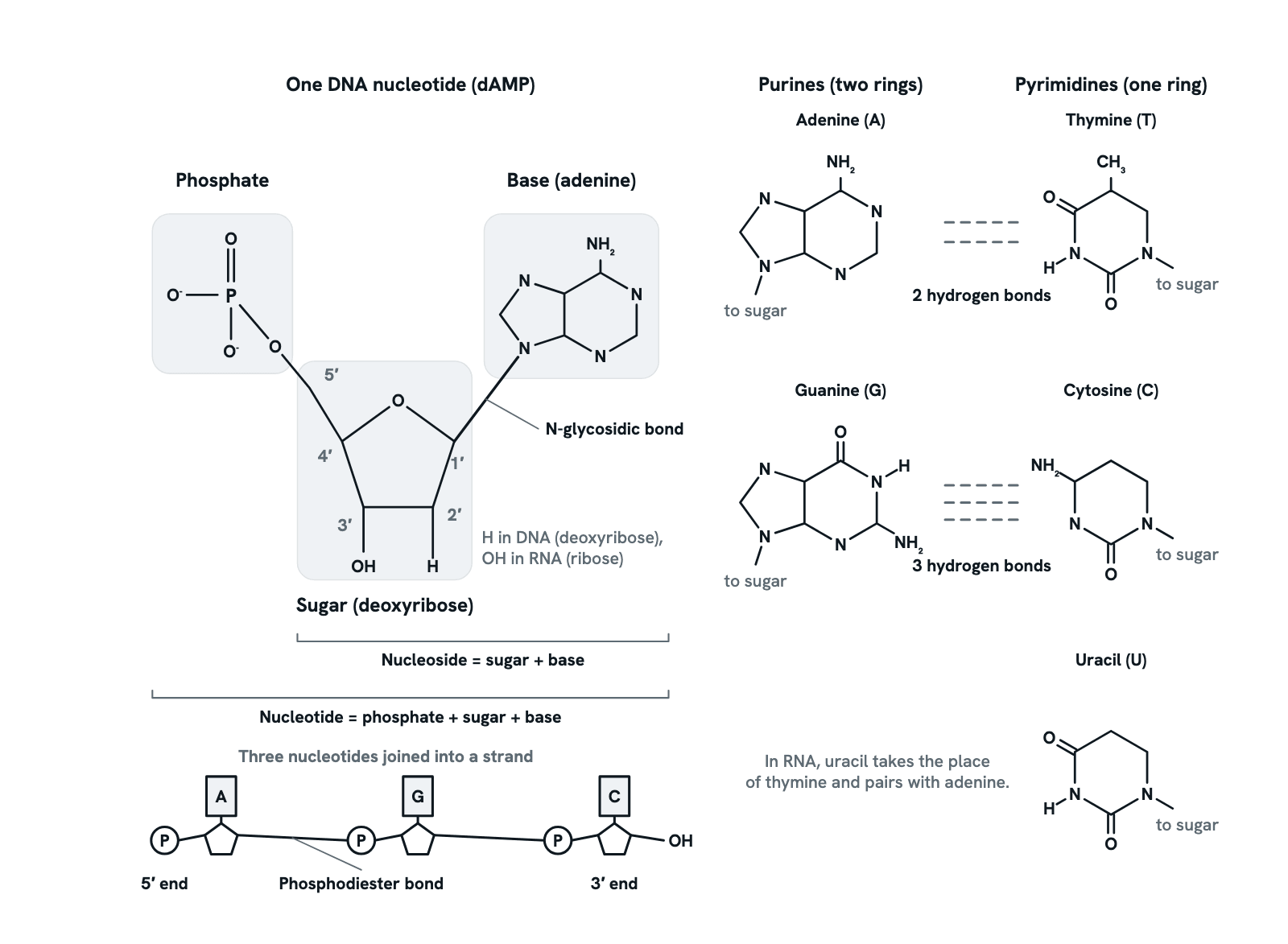
A DNA nucleotide drawn atom by atom, its phosphate, sugar and base, and the five bases with how they pair.
A nucleotide is the unit DNA and RNA are built from: a phosphate group, a five-carbon sugar and a nitrogen-containing base. On the left is one DNA nucleotide, deoxyadenosine monophosphate, drawn atom by atom, and under it three nucleotides joined into a strand. On the right are the five bases as rings with their nitrogens and side groups, double bonds left out. Press any part to see what it is and what it does.
Also called Nucleotide, Parts of a nucleotide or DNA nucleotide.
Press any part of the diagram, or pick one here, to see what it is and what it does.
Download the diagramChecked against its sources on 5 November 2026.
A tour
A tour of the nucleotide structure
01A nucleotide at a glance
A nucleotide has three parts: a phosphate group, a five-carbon sugar and a nitrogen-containing base. The sugar is deoxyribose in DNA and ribose in RNA, and the base is one of five. On the left is one DNA nucleotide, deoxyadenosine monophosphate, drawn atom by atom; on the right are the five bases. Chains of nucleotides, joined through their phosphates, make up DNA and RNA.
02The phosphate group
The phosphate is joined to the sugar's 5′ carbon through an oxygen. It is acidic, so in the cell it carries negative charge: this is why DNA and RNA are called nucleic acids, and why DNA binds the positively charged histone proteins. A nucleotide may carry one, two or three phosphates in a row. ATP is adenosine triphosphate, and the building blocks a polymerase uses to make DNA are deoxynucleoside triphosphates.
03The sugar and its numbering
The sugar is a ring of four carbons and an oxygen, with a fifth carbon outside the ring. Its carbons are numbered 1′ to 5′, one prime to five prime, to tell them from the atoms of the base. The base hangs from the 1′ carbon, the phosphate from the 5′ carbon, and the 3′ carbon carries a hydroxyl group. The 5′ and 3′ positions are what give a strand of DNA or RNA its direction.
04Deoxyribose or ribose: DNA or RNA
Deoxyribose and ribose differ at one place. The 2′ carbon carries a hydrogen in deoxyribose and a hydroxyl group in ribose, and that one oxygen separates a DNA nucleotide from an RNA nucleotide. RNA also uses the base uracil where DNA uses thymine, and it is usually a single strand. It is broken down more readily than DNA, which lets the cell change which genes it is expressing.
05The base and the N-glycosidic bond
The base is joined to the sugar's 1′ carbon by an N-glycosidic bond from one of its ring nitrogens: N9 in a purine, N1 in a pyrimidine. Here the base is adenine, a purine with an amino group on its six-membered ring. A base joined to a sugar is a nucleoside; with a phosphate on the 5′ carbon it is a nucleotide.
06Purines and pyrimidines
Adenine and guanine are purines: a six-membered ring fused to a five-membered ring. Cytosine, thymine and uracil are pyrimidines, a single six-membered ring. The bases differ in the groups on their rings. Adenine has an amino group; guanine an amino group and a carbonyl oxygen; cytosine an amino group and an oxygen; thymine and uracil two oxygens, and thymine alone a methyl group, which is all that tells it from uracil. DNA uses A, G, C and T; RNA uses U in place of T.
07Base pairing and hydrogen bonds
In double-stranded DNA the bases of the two strands pair across the helix, held by hydrogen bonds: adenine with thymine by two, guanine with cytosine by three. So a G-C pair holds more tightly than an A-T pair, and a DNA molecule has as much A as T and as much G as C, as Chargaff found. A purine always faces a pyrimidine, so every pair is the same width and the 1′ carbons of the two sugars sit the same distance apart. In RNA, uracil pairs with adenine.
08Nucleoside, nucleotide and ATP
A nucleoside is a base joined to a sugar; a nucleotide is a nucleoside with one or more phosphates. Adenine on ribose is adenosine; with three phosphates it is ATP, the cell's energy carrier, which releases energy when a phosphate is split off. Nucleoside analogues, altered nucleosides that halt DNA synthesis, are used as drugs against HIV.
09Joining nucleotides into a strand
Nucleotides join into a strand through phosphodiester bonds: the phosphate on one nucleotide's 5′ carbon bonds to the 3′ hydroxyl of the next sugar, so sugar and phosphate alternate along the backbone and the bases stick out. One end of the strand has a free 5′ phosphate, the other a free 3′ hydroxyl, which gives it a direction. Polymerases can only add a nucleotide at the 3′ end, so every strand grows 5′ to 3′; the incoming triphosphate loses two phosphates as it is added.
Parts
What each part of the nucleotide structure does
- Phosphate group
- A phosphorus atom with four oxygens, one of them the link to the sugar's 5′ carbon. It is acidic and negatively charged, which is why DNA and RNA are nucleic acids. In a strand each phosphate joins two sugars; in ATP three phosphates sit in a row.
- Sugar (deoxyribose)
- The five-carbon sugar of DNA: a ring of four carbons and an oxygen, with the fifth carbon outside the ring. RNA's sugar, ribose, differs only by a hydroxyl group on the 2′ carbon.
- Base (adenine here)
- The nitrogen-containing ring, joined to the sugar's 1′ carbon by an N-glycosidic bond. The base is the only part that varies from one nucleotide to the next in a strand, so the order of bases is what carries the information.
- The carbons, 1′ to 5′
- The sugar's carbons are numbered one prime to five prime, the prime telling them from the atoms of the base. The base is on 1′, the phosphate on 5′, and the hydroxyl that joins the next nucleotide on 3′.
- 3′ hydroxyl (OH)
- The OH group on the 3′ carbon. In a strand it forms the phosphodiester bond to the next nucleotide's phosphate, and polymerases add every new nucleotide here, so a strand grows at its 3′ end.
- 2′ carbon: H in DNA, OH in RNA
- In deoxyribose the 2′ carbon carries only a hydrogen; in ribose it carries a hydroxyl group. That single oxygen is the difference between a DNA nucleotide and an RNA nucleotide.
- N-glycosidic bond
- The bond between the sugar's 1′ carbon and a nitrogen of the base: N9 of a purine, N1 of a pyrimidine. A base joined to a sugar this way is a nucleoside.
- Nucleoside: sugar + base
- A base joined to a sugar, with no phosphate: adenosine, for instance, is adenine on ribose. Some drugs against HIV are nucleoside analogues, altered nucleosides that halt DNA synthesis.
- Nucleotide: phosphate + sugar + base
- A nucleoside with one or more phosphate groups on its 5′ carbon. Nucleotides are the units of DNA and RNA; as triphosphates (ATP, GTP) they are also the cell's energy carriers and the building blocks polymerases use.
- Phosphodiester bond
- The link between nucleotides in a strand: a phosphate bonded to the 5′ carbon of one sugar and the 3′ carbon of the next. These bonds make the sugar-phosphate backbone; the schematic shows three nucleotides joined, their bases above.
- 5′ end and 3′ end
- A strand's two ends differ: the 5′ end has a free phosphate on a 5′ carbon, the 3′ end a free hydroxyl on a 3′ carbon. Sequences are written 5′ to 3′, the direction in which polymerases build them.
- Purines (A and G)
- Adenine and guanine: the larger bases, a six-membered ring fused to a five-membered ring. They join the sugar through N9. In every base pair a purine faces a pyrimidine.
- Pyrimidines (C, T and U)
- Cytosine, thymine and uracil: the smaller bases, a single six-membered ring with two nitrogens. They join the sugar through N1. In every base pair a pyrimidine faces a purine.
- Adenine (A)
- A purine with an amino group on carbon 6 (C5H5N5). It pairs with thymine in DNA and with uracil in RNA, by two hydrogen bonds. Adenine is also the base of ATP.
- Guanine (G)
- A purine with an amino group on carbon 2 and a carbonyl oxygen on carbon 6 (C5H5N5O). It pairs with cytosine by three hydrogen bonds, so stretches rich in G and C hold together more tightly.
- Cytosine (C)
- A pyrimidine with an amino group on carbon 4 and an oxygen on carbon 2 (C4H5N3O). It pairs with guanine by three hydrogen bonds, in DNA and in RNA.
- Thymine (T)
- A pyrimidine with oxygens on carbons 2 and 4 and a methyl group on carbon 5 (C5H6N2O2), that is, 5-methyluracil. Found in DNA, where it pairs with adenine by two hydrogen bonds.
- Uracil (U)
- A pyrimidine with oxygens on carbons 2 and 4 and no methyl group (C4H4N2O2). RNA uses it in place of thymine, pairing it with adenine. Its presence is one reason RNA is broken down more readily than DNA.
- Base pairs and hydrogen bonds
- The weak bonds that hold the two strands of DNA together: two between A and T, three between G and C. Each is weak, so the strands can be parted for copying and reading, yet together they hold the strands as one.
Dictionary
The terms to know
Practise it
The quizzes and cards that fit
- Molecular Biology quizzes
- Epigenetics & Chromatin Remodeling20 questions
- DNA Replication Machinery15 questions
- Recombinant DNA Technology15 questions
- Biochemistry quizzes
- Photosynthesis and Cellular Respiration15 questions
- Molarity and Dilutions15 questions
- ATP and Cellular Energy15 questions
- Genetics quizzes
- Incomplete Dominance and Codominance15 questions
- Pedigree Analysis15 questions
- Blood Types15 questions
- Molecular Biology flashcards
The subject's terms as a ready-made deck, free to flip through.
- Reverse Complement
The reverse complement, complement or reverse of a DNA or RNA sequence, or DNA written as RNA, from bare letters or FASTA.
- GC Content Calculator
GC content, base counts, length and molecular weight of a DNA or RNA sequence, with GC along the sequence in a sliding window.
Next to it
More diagrams
Sources
Where the facts come from
- Minchin and Lodge, Understanding biochemistry: structure and function of nucleic acids, Essays in Biochemistry 2019 (PMC)
- NHGRI Talking Glossary: Nucleotide
- NHGRI Talking Glossary: Base Pair
- NHGRI Talking Glossary: Adenine
- NHGRI Talking Glossary: Guanine
- NHGRI Talking Glossary: Uracil
- MedlinePlus Genetics: What is DNA?
- Chang and others, Tunnelling readout of hydrogen-bonding-based recognition, Nature Nanotechnology 2009 (PMC), on the two and three hydrogen bonds of the base pairs
- PubChem: deoxyadenosine monophosphate (dAMP), CID 12599
- PubChem: adenine, CID 190
- PubChem: guanine, CID 135398634
- PubChem: cytosine, CID 597
- PubChem: thymine, CID 1135
- PubChem: uracil, CID 1174
- PubChem: adenosine triphosphate (ATP), CID 5957
Drawn and written by biofideX from these sources.