Mitosis vs Meiosis
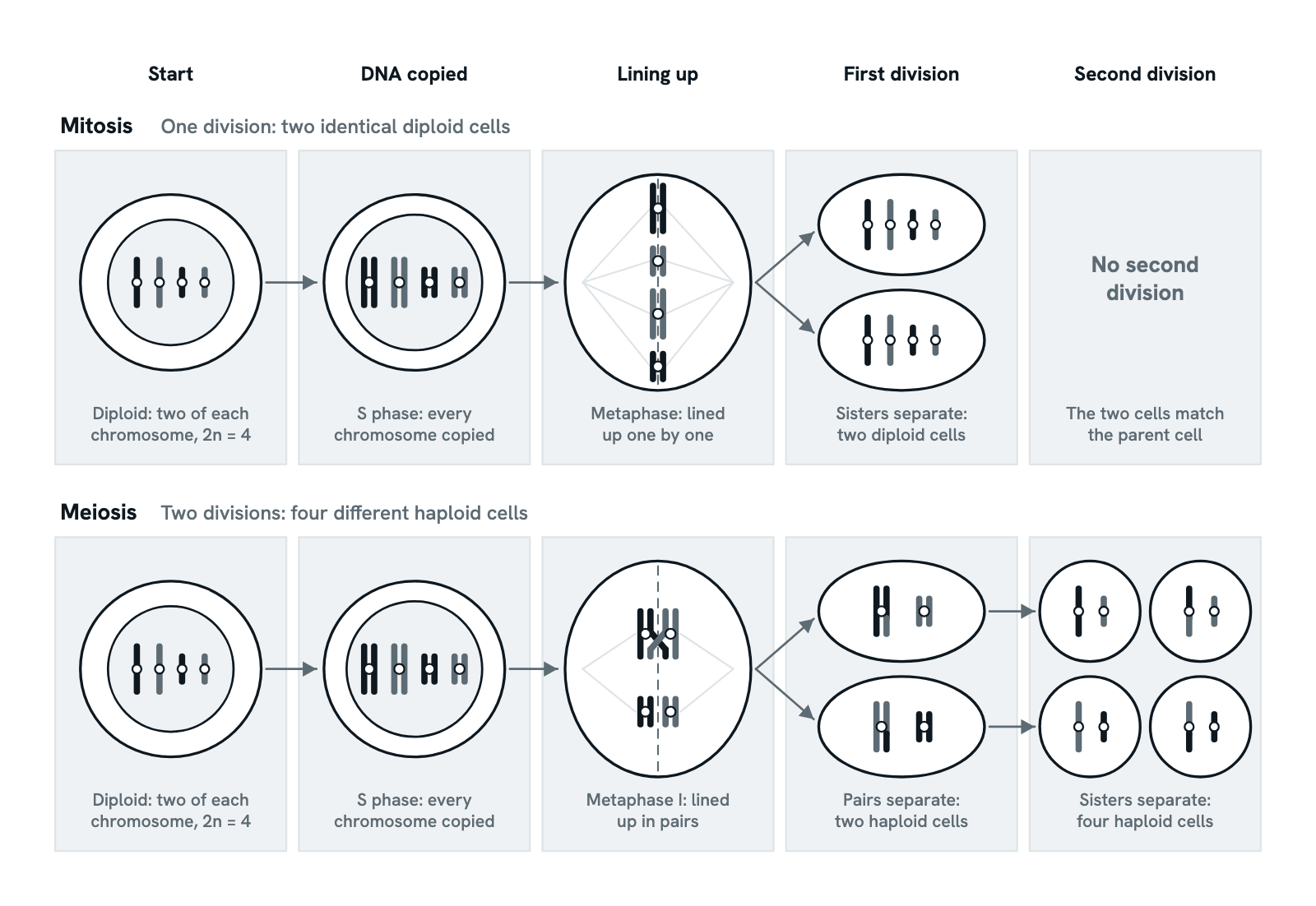
Mitosis makes two genetically identical cells with the full set of chromosomes, for growth and repair. Meiosis makes four genetically different cells with half the set, which give rise to eggs and sperm. Both copy the DNA once, then mitosis divides once and meiosis twice; meiosis first separates the two chromosomes of each pair, which halves the number (46 to 23 in humans).
Divisions
- Mitosis
- 1
- One round of division
- Meiosis
- 2
- Meiosis I, then meiosis II
Cells made
- Mitosis
- 2
- From each cell that divides
- Meiosis
- 4
- From each cell that divides
Chromosome number
- Mitosis
- 2n → 2n
- 46 stays 46 in humans
- Meiosis
- 2n → n
- 46 becomes 23 in humans
The new cells
- Mitosis
- Identical
- Copies of the parent cell
- Meiosis
- All different
- Crossing over and independent assortment
Step 1 of 7
Mitosis and meiosis side by side
Both start from the same diploid cell, drawn with two pairs of chromosomes, one long and one short; of each pair, the one from one parent is in ink and the other in grey. Mitosis, on top, divides once and gives two cells identical to the first. Meiosis, below, divides twice and gives four haploid cells that all differ.
Use ← and → to move between steps.
Step 1 of 7: Mitosis and meiosis side by side
Download the diagramChecked against its sources on 8 November 2026.
Side by side
Mitosis vs Meiosis: the full table
Every difference between mitosis and meiosis, feature by feature, as it happens in humans and other animals.
What it is for
- Mitosis
- Growth, repair and replacing worn-out cells; in some organisms, asexual reproduction
- Meiosis
- Sexual reproduction: it makes the gametes (eggs and sperm) in animals, and spores in plants and fungi
Where it happens
- Mitosis
- Any dividing body cell, and germ cells before meiosis
- Meiosis
- Only germ cells, in the ovaries and testes
DNA replication
- Mitosis
- Once, in S phase before it starts
- Meiosis
- Once, before meiosis I; never between meiosis I and II
Number of divisions
- Mitosis
- One
- Meiosis
- Two: meiosis I and meiosis II
Cells made
- Mitosis
- Two
- Meiosis
- Four
Chromosome number
- Mitosis
- Kept: diploid to diploid (46 to 46 in humans)
- Meiosis
- Halved: diploid to haploid (46 to 23 in humans)
The new cells
- Mitosis
- Genetically identical to each other and to the parent
- Meiosis
- Genetically different from each other and from the parent
Homologues pair up
- Mitosis
- No: each chromosome behaves on its own
- Meiosis
- Yes, in prophase I, as bivalents (tetrads)
Crossing over
- Mitosis
- Not part of a normal mitosis
- Meiosis
- Yes, in prophase I; nearly every pair has at least one crossover
Lined up at metaphase
- Mitosis
- Single chromosomes, one by one
- Meiosis
- Metaphase I: homologous pairs; metaphase II: single chromosomes
Separated at anaphase
- Mitosis
- Sister chromatids
- Meiosis
- Anaphase I: homologous chromosomes; anaphase II: sister chromatids
Sister kinetochores
- Mitosis
- Attached to opposite poles
- Meiosis
- Meiosis I: to the same pole; meiosis II: to opposite poles
Prophase
- Mitosis
- Short and simple
- Meiosis
- Prophase I is long, in five stages; human eggs pause in it from before birth until just before ovulation, for 10 to 50 years
Sources of variation
- Mitosis
- None by design: the cells are clones, barring rare errors
- Meiosis
- Crossing over and independent assortment, then random fertilisation
When chromosomes fail to separate
- Mitosis
- Body cells get the wrong number: mosaicism if it happens early in development; common in cancer cells
- Meiosis
- A gamete gets the wrong number: the leading genetic cause of miscarriage, and of conditions such as Down syndrome
| Feature | Mitosis | Meiosis |
|---|---|---|
| What it is for | Growth, repair and replacing worn-out cells; in some organisms, asexual reproduction | Sexual reproduction: it makes the gametes (eggs and sperm) in animals, and spores in plants and fungi |
| Where it happens | Any dividing body cell, and germ cells before meiosis | Only germ cells, in the ovaries and testes |
| DNA replication | Once, in S phase before it starts | Once, before meiosis I; never between meiosis I and II |
| Number of divisions | One | Two: meiosis I and meiosis II |
| Cells made | Two | Four |
| Chromosome number | Kept: diploid to diploid (46 to 46 in humans) | Halved: diploid to haploid (46 to 23 in humans) |
| The new cells | Genetically identical to each other and to the parent | Genetically different from each other and from the parent |
| Homologues pair up | No: each chromosome behaves on its own | Yes, in prophase I, as bivalents (tetrads) |
| Crossing over | Not part of a normal mitosis | Yes, in prophase I; nearly every pair has at least one crossover |
| Lined up at metaphase | Single chromosomes, one by one | Metaphase I: homologous pairs; metaphase II: single chromosomes |
| Separated at anaphase | Sister chromatids | Anaphase I: homologous chromosomes; anaphase II: sister chromatids |
| Sister kinetochores | Attached to opposite poles | Meiosis I: to the same pole; meiosis II: to opposite poles |
| Prophase | Short and simple | Prophase I is long, in five stages; human eggs pause in it from before birth until just before ovulation, for 10 to 50 years |
| Sources of variation | None by design: the cells are clones, barring rare errors | Crossing over and independent assortment, then random fertilisation |
| When chromosomes fail to separate | Body cells get the wrong number: mosaicism if it happens early in development; common in cancer cells | A gamete gets the wrong number: the leading genetic cause of miscarriage, and of conditions such as Down syndrome |
Mitosis keeps whatever number of chromosomes the cell has: haploid cells divide by mitosis too, such as the cells of a plant's gametophyte. Most bacteria divide by binary fission; none by mitosis.
In common
What mitosis and meiosis share
The DNA is copied once, beforehand
Both follow an interphase in which every chromosome is copied in S phase, so each enters the division as two sister chromatids joined at the centromere.
The same machinery
Both build a spindle of microtubules that attaches to the chromosomes at their kinetochores, and both pass through prophase, metaphase, anaphase and telophase, ending in cytokinesis.
Meiosis II works like mitosis
In meiosis II the chromosomes line up singly and the sister chromatids separate to opposite poles, just as in mitosis. The differences are that the cells are haploid and no DNA was copied first.
Both go on in the body for years
Mitosis replaces blood cells and the lining of the gut throughout life, hundreds of billions of cells a day. Meiosis goes on in the testes from puberty; in the ovaries it starts before birth, resumes just before ovulation and ends only at fertilisation.
Easy to mix up
Where people go wrong
Meiosis II is not a mitosis
It looks like one, but the cells are already haploid, the DNA was not copied before it, and after crossing over the two sister chromatids are no longer identical. So meiosis II also makes cells that differ.
Count chromosomes by centromeres
After S phase a human cell still has 46 chromosomes, now as 92 chromatids. Each cell after meiosis I has 23 chromosomes of two chromatids each: it is already haploid, even though it holds as much DNA as a cell before S phase.
Meiosis I does the halving
The chromosome number halves at anaphase I, when the homologues of each pair go to opposite poles. Meiosis II separates sister chromatids and leaves the number as it was.
Homologues are not sisters
Homologous chromosomes are a pair, one from each parent, with the same genes but possibly different alleles. Sister chromatids are the two copies of one chromosome made in S phase.
Not always four gametes
In men each meiosis gives four sperm. In women it gives one egg and two or three small polar bodies, which break down; the second division finishes only if the egg is fertilised, and the egg keeps nearly all the cytoplasm.
Quick quiz
Test yourself in 7 questions
Question 1 of 7
How many cells does one meiosis make in the testes?
Questions
What people ask
What is the main difference between mitosis and meiosis?
Mitosis divides a cell once into two identical cells with the full set of chromosomes. Meiosis divides it twice into four different cells with half the set. Mitosis is for growth and repair; meiosis makes the eggs and sperm.
Is meiosis II the same as mitosis?
It works the same way, since the sister chromatids separate, but it is not the same. The cells dividing are haploid, the DNA was not copied before it, and after crossing over the two sisters of a chromosome are no longer identical.
What is the difference between meiosis I and meiosis II?
Meiosis I separates the homologous chromosomes of each pair and halves the number, so it is called the reductional division. Meiosis II separates the sister chromatids and keeps the number, so it is called the equational division. Pairing and crossing over happen only in meiosis I.
What do mitosis and meiosis have in common?
Both follow a single round of DNA replication, both use a spindle to pull chromosomes to the poles through prophase, metaphase, anaphase and telophase, and both end in cytokinesis. Meiosis II runs much like a mitosis.
How many chromosomes are there after mitosis and after meiosis?
In humans, each cell made by mitosis has 46 chromosomes, the same as the parent. Each cell made by meiosis has 23, one of every pair. An egg and a sperm, 23 each, give the zygote its 46 at fertilisation.
Do bacteria divide by mitosis?
No. Bacteria have no nucleus and no mitotic spindle; they copy their chromosome, usually circular, and most split in two by binary fission. Mitosis and meiosis are found only in eukaryotes.
Each on its own
Mitosis and Meiosis, one at a time
- Mitosis in the dictionary
One division that gives two cells identical to the parent, for growth, repair and replacing cells.
- Meiosis in the dictionary
Two divisions that give four genetically different cells with half the chromosomes, for eggs and sperm.
Practise it
The quizzes and cards that fit
Full quizzes
- The Cell Cycle & Mitosis15 questions
- Mitosis Basics: Phases & Checkpoints10 questions
- Meiosis Explained15 questions
- Meiosis & Genetic Variation10 questions
- Chromosomal Basis of Inheritance15 questions
- Cell Biology flashcards
The subject's terms as a ready-made deck, free to flip through.
- Genetics flashcards
The subject's terms as a ready-made deck, free to flip through.
- Dihybrid Cross Calculator
The Punnett square for any cross of two genes, with the gametes, the genotype and phenotype ratios, gene interactions and a chi-square test of your counts.
Dictionary
The terms to know
Sources
Where the facts come from
- Ohkura, Meiosis: an overview of key differences from mitosis, Cold Spring Harbor Perspectives in Biology 2015 (PMC)
- NHGRI Talking Glossary: Mitosis
- NHGRI Talking Glossary: Meiosis
- NHGRI Talking Glossary: Crossing Over
- Nagaoka, Hassold and Hunt, Human aneuploidy: mechanisms and new insights into an age-old problem, Nature Reviews Genetics 2012 (PMC)
- MedlinePlus Genetics: Down syndrome
- Jones, Kleckner and Zickler, Meiosis through three centuries, Chromosoma 2024 (PMC)
- Sender and Milo, The distribution of cellular turnover in the human body, Nature Medicine 2021
- Oduwole, Peltoketo and Huhtaniemi, Role of follicle-stimulating hormone in spermatogenesis, Frontiers in Endocrinology 2018 (PMC)
- Holland and Cleveland, Losing balance: the origin and impact of aneuploidy in cancer, EMBO Reports 2012 (PMC)
- Pandey and others, Molecular control of sporophyte-gametophyte ontogeny and transition in plants, Frontiers in Plant Science 2021 (PMC)
- Pląskowska and others, Binary or nonbinary fission? Reproductive mode of a predatory bacterium depends on prey size, mBio 2023 (PMC)
Drawn and written by biofideX from these sources.