Flower Diagram
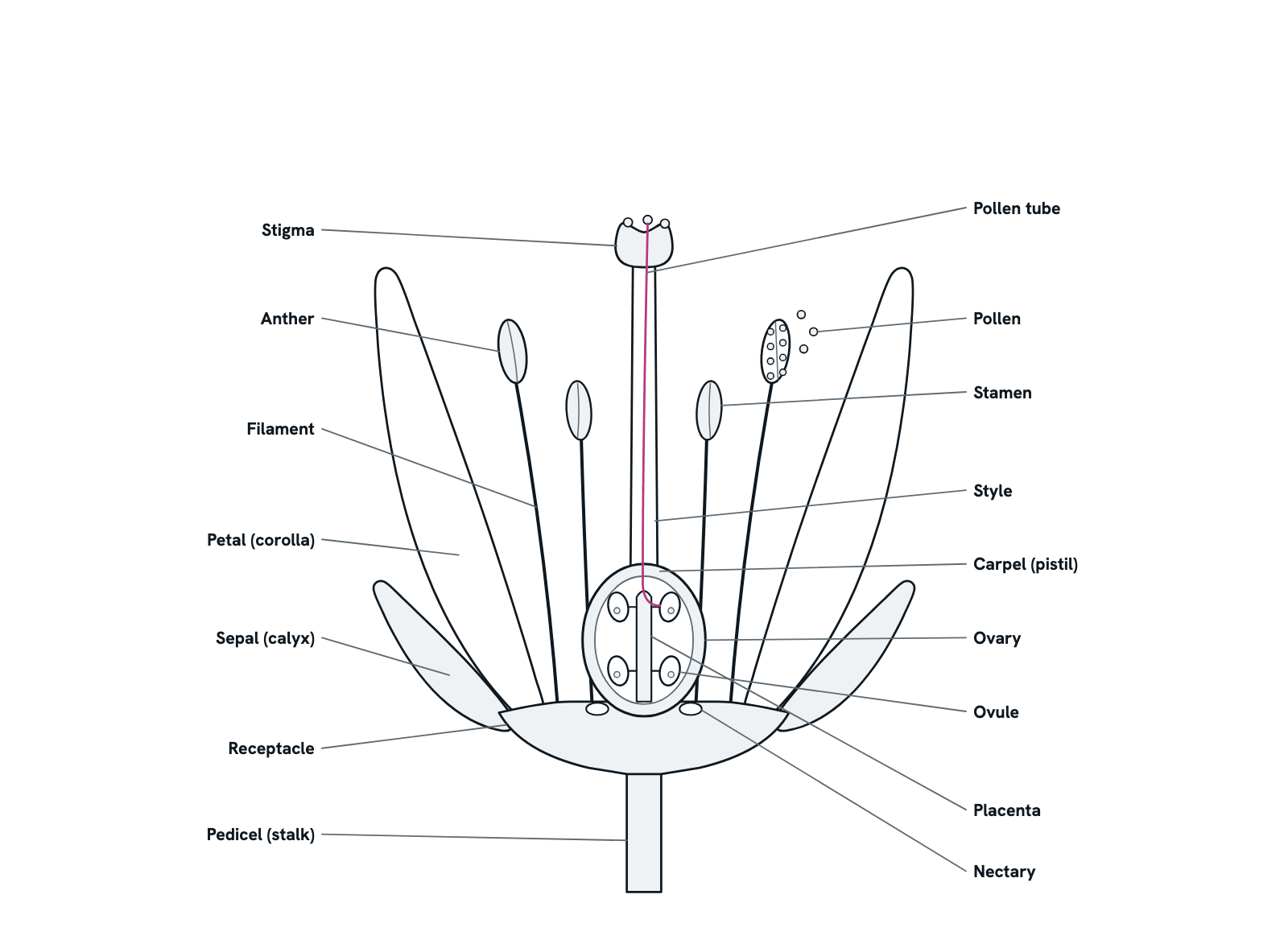
A flower cut in half with every part labelled, from pedicel and sepals to stamens, pollen and the carpel's stigma, style and ovary.
A flower cut lengthways, as botany textbooks draw it, so that every whorl can be seen: the stalk and receptacle below, sepals and petals outside, stamens with their anthers, and the carpel in the centre with its ovary opened to show the ovules. Press any part to see what it is and what it does, or take the tour from the outer whorl to the seed. Not to scale.
Also called Parts of a flower, Flower structure or Flower anatomy.
Press any part of the diagram, or pick one here, to see what it is and what it does.
Download the diagramChecked against its sources on 5 November 2026.
A tour
A tour of the flower
01The flower at a glance
A flower is a shoot whose sole function is sexual reproduction. Its parts stand in four rings, or whorls, on the receptacle at the top of the stalk: sepals outside, then petals, then the stamens that make pollen, and in the centre the carpel, whose ovary holds the ovules. This is a half-section, so each whorl is cut through and seen from the side.
02Four whorls, from the outside in
The sepals together make the calyx and the petals the corolla; the two together are the perianth. The stamens together are the androecium, the male part, and the carpels together the gynoecium, the female part. The ABC model of flower development explains how three classes of genes, each active in two neighbouring whorls, act alone or in pairs to tell each whorl which of the four organs to become.
03The male part: stamen, anther and pollen
Each stamen is a filament holding up an anther, which has one to several chambers where pollen is made. A pollen mother cell divides by meiosis into four haploid microspores, each of which becomes a pollen grain, a tiny male gametophyte. Its first mitosis gives a large vegetative cell and a small generative cell, which divides again into two sperm cells: before the pollen is shed in about 30% of flowering plants, inside the pollen tube in the rest.
04The female part: carpel, stigma, style and ovary
The carpel is the female organ: an ovary at the base, a slender style, and the stigma at the tip, whose sticky surface receives pollen. In many flowers several carpels are fused into one pistil, as here, where the ovary holds two rows of ovules. Inside each ovule, wrapped in two integuments, lies the female gametophyte: in most flowering plants a haploid egg cell with two synergid cells beside it, a large central cell with two nuclei, and three antipodal cells.
05Pollination: by wind, by animals or within the flower
Pollination is the transfer of pollen from an anther to a stigma. Grasses let the wind carry it and need no showy flowers; fragrant, colourful flowers with nectaries have evolved to attract insects, and birds and bats pollinate others, picking up pollen as they feed on nectar. Pollen from the same plant gives self-pollination, from another plant cross-pollination. Many species reject their own pollen through self-incompatibility, which favours outbreeding.
06The pollen tube grows down the style
A grain that lands on a compatible stigma sticks to its papilla cells, takes in water and germinates. Its vegetative cell grows out as a pollen tube, which lengthens at its tip down through the style along the transmitting tract and then across to an ovule, guided by chemical signals from the female tissues. It enters through the micropyle, the gap between the integuments, reaches the two synergid cells and bursts, releasing its two sperm cells.
07Double fertilisation: zygote and endosperm
Flowering plants fertilise twice. One sperm cell fuses with the egg cell to form the diploid zygote, which grows into the embryo. The other fuses with the central cell, with its two nuclei, to form the triploid endosperm, the tissue that stores food for the embryo. Signals set off by fertilisation then keep further pollen tubes and sperm out, so that each ovule is fertilised only once.
08The ovule becomes the seed, the ovary the fruit
After fertilisation the ovule develops into a seed: the embryo and the endosperm inside, wrapped in a seed coat that grows from the two integuments. The ovary around the seeds matures into the fruit.
09Complete or incomplete, perfect or imperfect
A complete flower has all four whorls: sepals, petals, stamens and pistils. An incomplete flower lacks one or more of them. A perfect flower has both stamens and pistils; an imperfect flower lacks one or the other, so it is male or female. Plants with separate male and female flowers on the same plant are monoecious; those with the sexes on different plants, like box elder, are dioecious.
10Parts in threes, or in fours and fives
The number of parts in each whorl is a clue to the plant's group. Monocots have their flower parts in threes or multiples of three. Dicots have theirs in fours or fives or their multiples: most roses have five petals, as Theophrastus noted about 300 BC, and an apple flower has a calyx of five sepals.
Parts
What each part of the flower does
- Pedicel
- The stalk of an individual flower, which carries it on the stem. The stalk that supports a whole cluster of flowers is the peduncle.
- Receptacle
- The expanded tip of the flower stalk, which bears the flower's parts: the sepals, petals, stamens and carpels all arise from it.
- Sepal (calyx)
- One of the small, usually green, leaf-like parts at the base of the flower. All the sepals together are the calyx, the outermost whorl.
- Petal (corolla)
- One of the usually brightly coloured parts that together make the corolla, the second whorl. Calyx and corolla together are the perianth. Showy, fragrant petals, often with nectaries, attract the insects that pollinate the flower.
- Stamen
- The male organ of the flower: a filament holding up an anther. All the stamens together are the androecium, the third whorl.
- Filament
- The long, slender stalk of a stamen, which holds the anther in place so that its pollen can be carried off by wind or by animals.
- Anther
- The head of the stamen, with one to several chambers in which pollen is made. The right-hand anther is drawn cut open to show the pollen grains inside.
- Pollen
- Pollen grains are the male gametophytes, made by meiosis and then mitosis. Each holds a vegetative cell wrapped round a generative cell, which divides into two sperm cells: before the pollen is shed in about 30% of flowering plants, inside the pollen tube in the rest. On a stigma, a grain takes in water and germinates.
- Carpel (pistil)
- The female organ: an ovary joined by a style to a stigma. One carpel, or several fused together, makes a pistil, and all the carpels of a flower are the gynoecium, the innermost whorl.
- Stigma
- The sticky, receptive tip of the carpel where pollen lands: the site of pollination. Its surface cells, the papillae, hold the grains while they take in water and germinate.
- Style
- The stalk between the stigma and the ovary. Pollen tubes grow down through it along its transmitting tract towards the ovules.
- Ovary
- The swollen base of the carpel, which holds the ovules. After fertilisation it matures into the fruit.
- Ovule
- A small body in the ovary that holds the female gametophyte, with the egg cell, inside two integuments. Each ovule produces a single egg cell, and after fertilisation it develops into a seed.
- Placenta
- The tissue in the ovary to which the ovules are attached, each by a short stalk, the funiculus. The ovules arise from it, and nutrients reach them through that attachment. Here it is a central column with two rows of ovules.
- Nectary
- A gland that makes nectar, here at the base of the flower. Nectar rewards the insects, birds and bats that visit, and pollen sticks to them as they feed and is carried to the next flower.
- Pollen tube
- The tube a germinating pollen grain grows down the style, carrying its two sperm cells to an ovule. It enters through the micropyle and bursts, releasing the sperm for double fertilisation.
Dictionary
The terms to know
Practise it
The quizzes and cards that fit
- Botany quizzes
- Chloroplasts15 questions
- Parts of a Flower15 questions
- Plant Hormones15 questions
- Cell Biology quizzes
- Characteristics of Life15 questions
- Lab Safety15 questions
- Cell Theory15 questions
- Botany flashcards
The subject's terms as a ready-made deck, free to flip through.
Next to it
More diagrams
Sources
Where the facts come from
- Bleckmann, Alter and Dresselhaus: The beginning of a seed, regulatory mechanisms of double fertilization, Frontiers in Plant Science 2014 (PMC)
- NC State Extension Gardener Handbook, chapter 3: Botany (parts of the flower, flower types, pollination, fruit and seed)
- College of Micronesia-FSM, Botany: Floral Morphology (adapted from the Texas A&M FLORA laboratory)
- University of Wisconsin, Botany 130: Angiosperms (flower types, the Lilium life cycle)
- Dresselhaus, Sprunck and Wessel: Fertilization mechanisms in flowering plants, Current Biology 2016 (PMC): one sperm with the haploid egg, the other with the homodiploid central cell, giving the triploid endosperm
- Klodová and others: Regulatory dynamics of gene expression in the developing male gametophyte of Arabidopsis, Plant Reproduction 2023 (PMC): pollen mitosis I and II, tricellular pollen in about 30% of angiosperms
- Bowman and Moyroud: Reflections on the ABC model of flower development, The Plant Cell 2024 (PMC)
- National Park Service: What is a pollinator?
- Chabert and Mallinger: Self-sterility, self-incompatibility and xenia: a review of the mechanisms of cross-pollination benefits in animal-pollinated crops, Annals of Botany 2025 (PMC)
- Cucinotta and others: Gynoecium size and ovule number are interconnected traits that impact seed yield, Journal of Experimental Botany 2020 (PMC): the placenta, where ovules arise and through which the funiculus feeds them
- Cucinotta, Colombo and Roig-Villanova: Ovule development, a new model for lateral organ formation, Frontiers in Plant Science 2014 (PMC): ovules arise from the placenta, integuments make the seed coat
Drawn and written by biofideX from these sources.